
DeepSeek V4.1 Flash – DeepSeek's Intermediate Internal Testing Model Version

Executive Summary:
DeepSeek V4.1 Flash is an intermediate internal testing model version launched by DeepSeek, which adopts a new model architecture and for the first time natively integrates multimodal capabilities int...
1. What is DeepSeek V4.1 Flash
DeepSeek V4.1 Flash is an intermediate internal testing model version launched by DeepSeek, which adopts a new model architecture and for the first time natively integrates multimodal capabilities into the base model. This model is positioned as a lightweight, high-performance solution with stronger capabilities, faster speed, and lower cost. Community testing has shown output speeds generally reaching 300~400 tokens/s, with peak speeds reaching up to 507 tokens/s. The model is extremely convenient to call, with the base_url remaining unchanged; simply set the model name to deepseek-v4.1-flash-expires-on-0910 to access it, with a rate limit of 20 concurrent requests per account. As a preliminary technical validation version, this model provides real-world performance data to support the architectural design and technical direction of future official releases.
Image source: Official article
Image source: official article
Technical positioning and domain: It belongs to the domain of large language models (LLM) and is a lightweight, high-performance model based on the evolutionary route of the MoE (Mixture of Experts) architecture. It focuses on high-throughput inference, native multimodal integration, and cost-efficiency optimization, targeting application scenarios sensitive to latency and cost, such as real-time interaction, code generation, and visual understanding.
Development background: Developed by the DeepSeek team, which has deep expertise in MoE architecture and inference optimization. The V4 series has already established a technical route for sparse activation. V4.1 Flash serves as an intermediate validation version of this route, used to test the performance of the new architecture under real-world workloads, providing data support for the technical selection of the official version.
Core value: It addresses the pain point in lightweight models where speed, cost, and multimodal capabilities are difficult to balance. While maintaining the same billing standard as V4 Flash, it achieves native multimodal support and nearly a threefold increase in output speed compared to the V2 era, through architectural-level integration. Additionally, it enables seamless switching for existing users via a zero-cost access method, reducing migration barriers.
Technical features: It uses a new model structure, directly integrating visual encoding into the base model training, aligning text and images in a unified representation space. High-throughput output is achieved through MoE sparse activation and operator-level inference optimization. The billing remains at the V4 Flash level, with input prices as low as 0.05 RMB per million tokens during idle periods, effectively achieving a de facto price reduction.
2. Key Features
New Model Architecture: This version employs a different structural design compared to the V4 series, with a reengineered routing mechanism and layer structure built upon the MoE (Mixture of Experts) framework. It achieves higher throughput with fewer activated parameters. This architecture serves as a technical validation for the official release, paving the way for future iterations. Internal testing data will directly influence the final design decisions of the official version.
Native Multimodal Support: Unlike the V4 Flash, which launched a separate Vision version, V4.1 Flash integrates visual encoding directly into the base model training phase. This enables semantic alignment of text and images within the same representation space. This design eliminates the latency and feature information loss caused by cross-module concatenation, achieving more natural multimodal understanding. It can directly process image inputs without requiring an external visual module.
High-Speed Streaming Inference: Community testing data shows output speeds generally reaching 300~400 tokens/s, with a peak recorded at 507 tokens/s, representing a significant improvement over the V4 era. The high-speed output greatly enhances the streaming interaction experience, enabling near-zero waiting response feedback for conversation and generation tasks. It is especially suitable for applications highly sensitive to latency.
Cost Optimization Strategy: The billing standard remains consistent with deepseek-v4-flash, with enhanced capabilities but unchanged pricing. During idle periods and cache hit scenarios, input costs drop as low as 0.05 RMB per million tokens, while output costs are 4.5 RMB per million tokens. Combined with the high-speed generation capability, the per-token cost is further reduced over time, making it particularly favorable for high-frequency calling scenarios.
Zero-Cost Compatibility Access: The base_url remains unchanged (https://api.deepseek.com), and users can switch to using the model by simply modifying the model parameter to deepseek-v4.1-flash-expires-on-0910. No additional configuration or environmental adjustments are required. Existing users who have already adopted the DeepSeek API can seamlessly transition, significantly reducing migration costs.
Enhanced Code and Generation Capabilities: At the same performance level, V4.1 Flash demonstrates a perceptible improvement in code generation and text creation capabilities compared to V4 Flash, particularly in complex code snippet completion, structured output, and quality consistency. It is capable of meeting the requirements of higher-quality generation tasks.
3. How to Use
Environment Requirements: To use DeepSeek V4.1 Flash, you only need a network environment that can access the DeepSeek API. It supports mainstream programming languages such as Python, JavaScript, and Go, and is compatible with the OpenAI SDK. No local GPU resources are required, as all inference is completed in the cloud. There are no special requirements for the developer's local machine configuration.
Registration and Real-name Authentication: Go to the DeepSeek Open Platform (https://platform.deepseek.com/), complete account registration and real-name authentication. Accounts that have not completed authentication cannot use API services. The authentication process requires providing valid personal or corporate identity information.
Obtain API Key: After logging into the Open Platform, click "Create New Key" on the "API keys" page. Copy the generated API Key and store it securely. This key is used for authentication in requests. It is recommended to store it in environment variables or configuration files, avoiding hardcoding it directly into the code.
Confirm Account Balance: Ensure that your account has been topped up and has sufficient balance. The billing standard for V4.1 Flash is the same as for deepseek-v4-flash, at 4.5 RMB per million tokens for output. The input price fluctuates between 0.05 and 1.5 RMB per million tokens depending on cache hit rates. You can view real-time balance and consumption details on the platform.
Configure API Parameters: Keep the base_url unchanged, which remains https://api.deepseek.com. Set the model parameter in the request to deepseek-v4.1-flash-expires-on-0910. Configure other parameters (such as temperature, max_tokens, etc.) in the standard OpenAI-compatible format.
Initiate Calls and Handle Rate Limiting: Send requests in the standard OpenAI-compatible format to experience the new model. Note that each account is rate-limited to 20 concurrent requests. For high-frequency tasks, control the request volume or implement a retry mechanism. Since this version expires on September 10, 2026, it is recommended to configure dynamic model name management in your application code, and switch models promptly according to official announcements.
4. Pros and Cons Analysis
| Pros |
|---|
| Exceptional Inference Speed: Community testing shows an output speed of 300~400 tokens/s, with a peak of 507 tokens/s, significantly outperforming comparable models. The near real-time response enhances user experience in latency-sensitive scenarios. |
| Native Multimodal Architecture: Visual capabilities are directly integrated into the base model, eliminating the need for external visual modules. This removes delays and information loss from cross-module concatenation, enabling more efficient multimodal reasoning within a unified semantic space. |
| Capability Upgrade Without Price Increase: The pricing remains at the V4 Flash level, with input costs as low as 0.05 yuan per million tokens when cache hits are achieved. This maintains cost stability while enhancing capabilities, effectively achieving a covert price reduction. |
| Zero-Cost Integration Compatibility: The base_url remains unchanged, and the model can be called by simply modifying the model name. It seamlessly aligns with the existing OpenAI-compatible format, making migration for existing users extremely low-cost, with no changes required to infrastructure. |
5. Comparative Analysis with Similar Tools
| Dimension | DeepSeek V4.1 Flash | Zhipu GLM-5.3 Flash | OpenAI GPT-4o mini |
|---|---|---|---|
| Core Architecture | MoE (Mixture of Experts), new layer structure and routing design, native multimodal integration | Detailed architecture not disclosed, GLM series consistently uses self-developed Transformer approach | Standard Transformer architecture with multimodal support |
| Output Speed | 300~400 tokens/s (peak 507), community tested | Approximately 100~200 tokens/s (estimated based on public benchmarks, actual to be announced by official) | Approximately 100~150 tokens/s |
| Output Cost | 4.5 RMB per million tokens (~$0.62) | ~$0.50 per million tokens ($0.25 during promotional period) | $0.60 per million tokens |
| Input Cost | 0.05~1.5 RMB per million tokens (varies with cache hit rate) | ~$0.15 per million tokens ($0.075 during promotional period) | $0.15 per million tokens |
| Multimodal Capabilities | Native support for image understanding, architecture-level integration, no external modules required | Supports diverse inputs including images, videos, files, and text | Supports image input, but not native architecture-level integration |
| Deployment Method | Cloud API calling, OpenAI-compatible format, base_url remains unchanged | Cloud API calling, compatible with OpenAI format | Cloud API calling, OpenAI-compatible |
| Availability and Open Source | Internal test version, expires on September 10, 2026, not open source | Officially released, long-term availability, GLM series is consistently open source | Officially commercialized, not open source |
| Concurrency Limits | 20 concurrent requests per account (internal test rate limiting) | Normal commercial quota, no special restrictions | Tiered by package, no strict concurrency hard limits |
Selection Recommendations: For high-frequency calling scenarios that prioritize extreme output speed and low cost (such as agent execution layers or real-time dialogue systems), DeepSeek V4.1 Flash is currently the ideal choice within the available window period. Its output throughput of over 300 tokens/s provides a clear advantage among similar lightweight models, and its input cost is extremely low in cache-hit scenarios. However, note its internal test time-limited nature, making it suitable for short-term projects or pilot validations, but not recommended for direct integration into long-term production architectures.
For scenarios requiring long-term stable commercial use and high demand for multimodal input diversity (images, videos, files), Zhipu GLM-5.3 Flash offers more reliable guarantees with its open-source strategy and officially released status, and its promotional pricing is highly competitive. Google Gemini 2.0 Flash provides a good balance between inference speed and cost, with broader multimodal coverage, making it suitable for comprehensive applications requiring audio and video processing capabilities. OpenAI GPT-4o mini, on the other hand, benefits from a mature ecosystem and stable API services, making it ideal for enterprise users already utilizing the OpenAI technology stack, although it lacks significant advantages in terms of cost and speed.
6. Editor's Summary
As an intermediate internal test version model, DeepSeek V4.1 Flash holds significant technical implications beyond standard version updates. At the architectural level, this model abandons the conservative evolution of the V4 series and adopts a completely new structural design, directly integrating visual encoding into the base model training. This decision indicates that DeepSeek has confirmed native multimodal fusion as the next stage of technological development. From community testing data, the output speed of 300~400 tokens/s places it ahead of similar lightweight models, and its peak performance of 507 tokens/s is sufficient to support interactive applications highly sensitive to latency. This not only validates the inference efficiency of the new architecture but also provides effective data support for the technical roadmap of the official release.
In terms of business strategy, V4.1 Flash demonstrates a practical, developer-friendly approach—maintaining the same base_url, with only the model name needing to be modified for integration. The pricing standard remains consistent with V4 Flash, and the input cost for cache hits is as low as 0.05 yuan per million tokens. These design choices significantly reduce the barrier for users to experience new technology and reflect DeepSeek's emphasis on the developer ecosystem. This progressive upgrade strategy allows existing users to verify the actual performance of the new model at no cost, creating favorable conditions for smooth migration after the official release.
It is important to note that the availability window (ending on September 10, 2026) and the 20-concurrent-limit constraint make this model more suitable as a short-term verification and scenario pilot tool, rather than a stable dependency for long-term production environments. Detailed technical specifications (such as the implementation of the caching mechanism, operator-level optimization strategies, and routing algorithm design) have not yet been disclosed, and further technical transparency and in-depth evaluation will need to await the official technical report.
Overall, DeepSeek V4.1 Flash demonstrates clear technical progress in three key dimensions: speed, cost, and native multimodal fusion. It is well-suited for AI application developers, Agent system builders, and technical teams requiring high-frequency model calls to conduct in-depth validation during the internal testing window. Its architectural direction and technical selection data will provide valuable references for the entire field of lightweight, high-performance models. After the official release, if DeepSeek can maintain its current performance advantages while disclosing more technical details and relaxing concurrency limits, the model will have even broader application prospects.
7. Application Scenarios
Real-time Dialogue Assistant: Leveraging the streaming output capability of over 300 tokens per second, build interactive applications such as chatbots and intelligent customer service systems. The high-speed generation enables near-instantaneous streaming feedback for multi-turn conversations, providing users with a response experience that closely resembles human conversation. This is especially suitable for online customer service and virtual assistant scenarios that require immediate feedback.
AI Programming Assistant Tool: Code completion and snippet generation tasks are highly sensitive to latency. The high-speed output of V4.1 Flash can return code suggestions in milliseconds, seamlessly integrating into the auto-complete features of IDE plugins and code editors. Enhanced code generation capabilities make tasks such as complex function completion, boilerplate code generation, and automatic comment writing more fluid, significantly improving development efficiency.
Visual Understanding and Multimodal Applications: Native multimodal capabilities allow tasks such as screenshot Q&A, document image parsing, UI review, and OCR-enhanced understanding to be completed directly via API, without the need for additional visual model concatenation. In office automation scenarios, it can quickly extract textual information from images and combine it with contextual semantics for inference and understanding, enabling intelligent processing of image and text data.
Lightweight Agent Execution Layer: Agent systems require frequent sequential model calls for task decomposition, intent recognition, and result sorting, making them sensitive to throughput and per-call cost. The high-throughput output and cost-effective design of V4.1 Flash make it suitable as an execution layer engine for agents, effectively controlling overall operational costs while maintaining response speed. It is particularly well-suited for automated workflows that require batch processing of subtasks.
Content Batch Production Line: Pipeline tasks such as text rewriting, summarization, translation, and sentiment analysis require processing a large number of text segments. The low cost per unit of V4.1 Flash, combined with its context caching mechanism during idle periods (input as low as 0.05 RMB per million tokens), can significantly reduce the processing cost of batch tasks while maintaining quality. It is ideal for content platforms and marketing agencies that require large-scale content production.
8. FAQ
Q: Until when is the DeepSeek V4.1 Flash available?
A: This model is an internal test intermediate version, valid until September 10, 2026. After expiration, the model named deepseek-v4.1-flash-expires-on-0910 will no longer be callable, and you will need to switch to the official version or other available models. It is recommended to plan migration strategies in advance to avoid impacting production environments.
Q: How can I address the 20-concurrent request limit?
A: The 20-concurrent request limit per account is a restriction during the internal testing phase. For high-concurrency requirements, you can use request queues and retry mechanisms to keep instantaneous concurrency within the rate limit threshold. Alternatively, you can implement request scheduling strategies at the business layer to reduce concurrency peaks through asynchronous processing. After the official version is released, please pay attention to whether the official adjusts the concurrency limit.
Q: What input formats does the multimodal capability of V4.1 Flash support?
A: Based on the native architecture integration, this model natively supports image input understanding, suitable for scenarios such as screenshot Q&A and document image parsing. The official has not yet clearly disclosed support for voice and video inputs. It is recommended to refer to the technical documentation released at the time of the official version's launch.
Q: Is there a price difference between V4.1 Flash and V4 Flash?
A: No difference. The billing standard for V4.1 Flash is consistent with deepseek-v4-flash, at 4.5 yuan per million tokens for output, and input costs fluctuate between 0.05 and 1.5 yuan per million tokens depending on cache hit rates. With enhanced capabilities and unchanged pricing, this effectively represents an implicit price reduction, which is beneficial for cost control in high-frequency calling scenarios.
Q: Will internal test data be fed back into the official version?
A: As an intermediate verification version, one of the core purposes of V4.1 Flash is to collect performance data, stability metrics, and user feedback under real-world workloads, which will serve as a basis for architecture finalization and parameter optimization in the official version. User data and technical feedback collected during the internal test period will directly influence the final design of the official version.
Q: Is this model open source?
A: As of now, DeepSeek has not announced any open-source plans for V4.1 Flash. As an internal test version, the model is only available through API, and neither the technical implementation details nor the model weights are publicly disclosed. Whether the official version will continue the open-source tradition of previous versions such as DeepSeek V3 depends on the official announcement.
9. Project Links
- DeepSeek Open Platform (Official Website): https://platform.deepseek.com/
- API Interface Address: https://api.deepseek.com/
Related AI Model Articles
Xiaomi MiMo-V2.6 – Xiaomi's Open-Source Multimodal Model Series
Xiaomi MiMo-V2.6 is a series of fully multimodal models released and open-sourced by Xiaomi, comprising two native full-modal models: Pro and Flash. It is centered on large-scale Agentic reinforcement...
In-Depth Review of Step 5 Preview: A 600B Sparse MoE Flagship with 1M Token Context and 1/8 Cost Advantage
Step 5 Preview is a new-generation flagship foundation model launched by StepFun, designed for real-world Agentic tasks. Based on a sparse MoE architecture, the model has a total of 600B parameters bu...
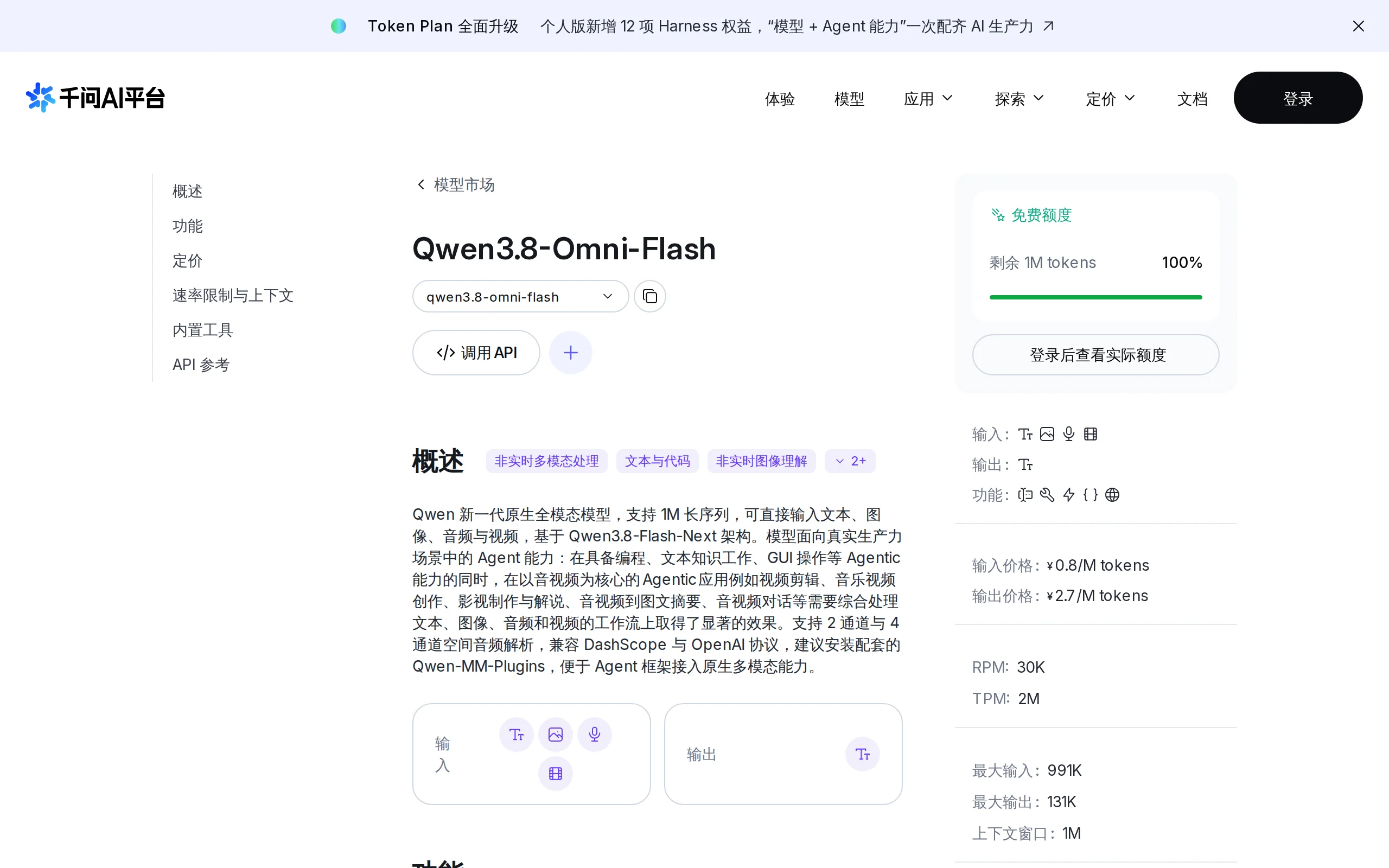
Qwen3.8-Omni-Flash – A Native Multimodal Model Launched by Alibaba Qwen
Qwen3.8-Omni-Flash is a native multimodal model launched by Alibaba Qwen. It jointly models four modalities—text, image, audio, and video—within a single architecture, supporting a context length of u...
Union Alpha – A Mysterious Multimodal Large Model with Unlimited Free Access for a Limited Time
Union Alpha is a multimodal large language model released in "stealth" mode, recently launched on mainstream AI service platforms such as OpenRouter, Cline, and OpenCode. The model supports dual-modal...
© All Rights Reserved. Some content on this site is partially generated by AI with human review.