
Cosmos 3 Edge – NVIDIA's 4B Parameter Open-Source World Model
Executive Summary:
Cosmos 3 Edge is a 4B parameter open-source world model introduced by NVIDIA, specifically designed for real-time inference in robotics and edge AI. Based on the Nemotron architecture, the model integ...
1. What is Cosmos 3 Edge
Cosmos 3 Edge is a 4B parameter open-source world model introduced by NVIDIA, specifically designed for real-time inference in robotics and edge AI. Based on the Nemotron architecture, the model integrates both autoregressive and diffusion dual Transformer towers, sharing a multimodal attention layer. It can run locally on devices such as Jetson Thor, RTX GPUs, and DGX, achieving 15 Hz real-time control. Developers can adapt the model to specific robots or environments within approximately one day, without relying on the cloud, enabling perception, inference, and generation of action strategies.
Technical Positioning and Domain: Cosmos 3 Edge belongs to the intersection of robotics foundation models and world models, with its core positioning as an edge-side real-time inference "World Action Model." Unlike large language models or vision-language models that rely on cloud computing power, this model focuses on completing the closed-loop from environmental understanding to action generation on resource-constrained hardware. It is a key component in NVIDIA's physical AI strategy, bridging simulation and real-world robots. Its technical approach combines autoregressive sequence modeling with diffusion generation, aiming to unify perception, prediction, and control in the robotics domain.
Development Background: This model was developed by NVIDIA's research team based on years of technical accumulation in GPU-accelerated computing, simulation platforms (such as Isaac Sim), and autonomous driving. The motivation for development stems from common issues in robot deployment, including cloud latency, communication bottlenecks, and data privacy concerns. By compressing a large-scale world model into 4B parameters and optimizing edge inference, NVIDIA aims to reduce the hardware barriers for physical AI implementation, promoting the transition of robots from the lab to industrial environments.
Core Value: Cosmos 3 Edge addresses the pain points of traditional vision-language-action (VLA) models, which are unable to perform causal reasoning, rely on the cloud, and suffer from high latency. Its unified architecture not only understands the current environmental state but also predicts the visual outcomes of executing a specific action and directly outputs control strategies. This "understand → simulate → act" closed-loop capability enables robots to make safer decisions in dynamic environments. Additionally, its fully open-source nature and rapid adaptation features significantly shorten the deployment cycle from simulation to real-world applications.
Technical Features: The model employs a dual-tower design where the autoregressive tower and diffusion tower share a multimodal attention layer, uniformly processing language, image, video, audio, and action tokens. It uses a general geometric vector representation for the action space of different robot morphologies, enabling cross-body migration. Through four-step knowledge distillation and vLLM optimization, it achieves up to 25 times faster inference while maintaining output quality. It also provides complete post-training scripts and DROID dataset policy checkpoints, supporting domain adaptation within a single day.
2. Key Features
World State Understanding: The autoregressive tower processes visual and text tokens using causal attention, enabling real-time interpretation of object categories, spatial relationships, and scene semantics in edge environments. This feature provides a unified shared world representation for subsequent reasoning, allowing robots to independently perceive complex environments without cloud assistance.
Future State Prediction: The diffusion tower denoises and generates visual, audio, and action tokens using bidirectional attention, simulating the visual outcome of performing a specific action. This capability grants robots the ability to "imagine," enabling them to evaluate the consequences of an action before execution, reducing trial-and-error costs and improving safety and task success rates.
Action Strategy Generation: Actions from different embodied forms, such as robotic arms, vehicles, and drones, are uniformly encoded into compact geometric vectors (translation, rotation, operational status). The model generates 32 continuous actions per inference and outputs control instructions at a frequency of 15 Hz. This general-purpose action representation allows the same model to be adapted to various robot platforms without redesigning the output layer.
On-Device Real-Time Inference: Deeply optimized for memory-constrained devices such as Jetson Thor, RTX PRO, and Jetson T2000/T3000, the model utilizes a lightweight design with 4B parameters and the vLLM inference framework to achieve memory-efficient, high-throughput inference. The model runs entirely locally, eliminating cloud round-trip latency and meeting the real-time control requirements of industrial applications.
Fast Domain Adaptation: Provides complete post-training scripts, DROID dataset policy checkpoints, and the Cosmos Framework fine-tuning framework. Developers can fine-tune the base model for specific robots, sensors, or environments on small H100 clusters or DGX Station within approximately one day, significantly reducing the deployment cycle for customized applications.
Knowledge Distillation and Inference Acceleration: Employs a 4-step knowledge distillation technique to compress the teacher model's knowledge into the student model, achieving up to 25x inference speedup while maintaining generation quality. Combined with vLLM's PagedAttention and continuous batching, the model significantly improves token generation speed on edge devices, meeting the timing constraints of real-time control.
3. How to Use
Environment Setup: First, install the NVIDIA Container Toolkit and pull the official Docker image (recommended:
nvidia/cosmos:latest). If using a Conda environment, configure Python 3.10+ and install dependencies such as PyTorch 2.1+, Diffusers, Transformers, and vLLM. It is recommended to use Ubuntu 22.04 or higher versions as the operating system, and the hardware should be equipped with at least an 8 GB GPU memory (e.g., RTX 3060). Jetson Thor or RTX PRO series are recommended options.Download Models and Resources: Download the model weights from Hugging Face (
nvidia/Cosmos3-Edge), and also obtain the post-training scripts and DROID dataset policy checkpoints. Use thegit lfs cloneorhuggingface-cli downloadcommand to ensure a complete download. All resources are open-sourced under the Apache 2.0 license and support commercial use.Post-training Fine-tuning: Use the fine-tuning scripts provided by the Cosmos Framework to run on a small H100 cluster (4–8 GPUs) or a DGX Station. Modify the configuration file to specify the target robot morphology, sensor parameters, and environmental data, then launch the training command:
python train.py --config configs/my_robot.yaml. Fine-tuning typically takes about one day and can generate policy checkpoints tailored to specific scenarios.Deployment for Inference: Export the fine-tuned model weights and deploy them to edge devices. On Jetson T2000/T3000 or RTX PRO, start the inference service using vLLM:
vllm serve /path/to/model --tensor-parallel-size 1 --max-num-seqs 8. Alternatively, you can encapsulate the model as a microservice using NVIDIA NIM to achieve real-time action generation at 15 Hz. It is recommended to enable FP16 or INT8 quantization to further reduce GPU memory usage.
Notes: During the fine-tuning phase, ensure that the dataset includes action labels and corresponding visual observations. When deploying, adjust the batch size according to the device's memory capacity. For the first run, it is recommended to use the example robot configuration provided by the official documentation to verify the workflow. Best practice is to first perform zero-shot testing using the DROID checkpoints, and then decide whether to fine-tune based on actual performance.
4. Pros and Cons Analysis
| Pros |
|---|
| On-device real-time inference: A lightweight design with 4B parameters combined with vLLM optimization achieves 15 Hz real-time control on the Jetson Thor, eliminating cloud latency and meeting industrial-grade response requirements. |
| Fast adaptation capability: Provides complete post-training scripts and DROID checkpoints, allowing developers to complete domain fine-tuning in about one day, greatly reducing the deployment cycle from simulation to real-world applications. |
| Unified multimodal architecture: The autoregressive and diffusion towers share attention layers, enabling unified processing of language, vision, audio, and actions, achieving a perception-prediction-control loop, with a technically forward-looking architecture. |
| Fully open-source ecosystem: Model weights, training scripts, post-training solutions, and distillation checkpoints are all open-sourced (Apache 2.0). It supports deployment with Hugging Face Diffusers and vLLM, allowing the community to freely extend and customize. |
| Benchmark performance leadership: Ranked first in the VANTAGE-Bench visual analysis tasks, with robotic policy learning reaching industry-leading levels, verifying the effectiveness of the architecture. |
5. Comparative Analysis with Similar Tools
| Dimension | Cosmos 3 Edge | SmolVLA | OpenVLA |
|---|---|---|---|
| Developer | NVIDIA | HuggingFace / Community | Stanford University / Open Source Community |
| Parameter Scale | 4B | 450M | 7B |
| Architecture Type | World-Action Model (WAM) dual-tower architecture | Vision-Language-Action (VLA) model | VLA model (based on Prismatic VLM) |
| Core Mechanism | Shared attention between autoregressive tower and diffusion tower, unifying world understanding and action generation | SigLIP + DinoV2 dual vision encoders, block-wise action prediction | SigLIP vision encoder + Llama 2 language model, directly outputting action tokens |
| Open Source Status | Fully open-sourced (weights + training scripts + post-training solutions) | Fully open-sourced (weights + code + evaluation scripts) | Fully open-sourced (weights + code + dataset) |
| Edge Deployment | Jetson Thor / RTX PRO / T2000 / T3000, 15 Hz real-time control | Single RTX 4090, 15–30 Hz inference | Requires at least 24 GB VRAM GPU, inference speed ~5 Hz |
| Fine-tuning Cost | Small H100 cluster or DGX Station, about one day | Single A100 or consumer-grade GPU, several hours | Single A100 or 4090, several hours |
| World Modeling | Built-in world model, capable of predicting visual outcomes of actions | No built-in world model, directly maps observations to actions | No built-in world model, simulates indirectly through language reasoning |
| Applicable Scenarios | Complex operations and dynamic environments requiring causal reasoning and simulation | Fast-reacting grasping and placing in structured environments | Desktop operations, generalized grasping, and instruction-following |
Selection Recommendations: For industrial robotic scenarios requiring real-time closed-loop control on edge devices, Cosmos 3 Edge is the optimal choice, offering a built-in world model and 15 Hz inference capabilities that provide clear advantages in safety and response speed. If the project has limited budget and involves simple grasping and placing tasks, SmolVLA is more cost-effective due to its extremely low fine-tuning cost and support for consumer-grade GPUs. OpenVLA is suitable for medium-complexity tasks that require strong language understanding and generalization, but its lower inference speed should be noted. Although RT-2 is powerful, its lack of open-sourcing and high deployment costs make it suitable only for research institutions with large-scale computing resources for benchmark testing.
6. Editor's Summary
Cosmos 3 Edge demonstrates significant innovation in its technical architecture by integrating autoregressive and diffusion models within a unified world action framework, enabling the model to possess both causal reasoning and generative prediction capabilities. This is the first instance in foundational robot models. The design of a shared multimodal attention layer effectively aligns four modalities—language, vision, audio, and action—addressing the semantic fragmentation issue typically encountered in traditional multimodal models that require separate encoders and concatenation. The introduction of a general geometric vector action representation further unifies the control interfaces for different robot forms at a fundamental level, laying the groundwork for cross-body transfer. In terms of practical value, the model's greatest contribution lies in bringing the world model from the cloud to the edge: with 4B parameters combined with knowledge distillation and vLLM optimization, real-time control becomes feasible, directly addressing long-standing issues of latency and privacy in robot deployment. The full open-source strategy (Apache 2.0) and complete fine-tuning toolchain reduce industry barriers, allowing both industrial robot integrators and academic research teams to quickly get started. The target audience includes robot algorithm engineers, edge computing developers, intelligent manufacturing system integrators, and researchers in the field of physical AI. In terms of future development potential, the "perception-prediction-action" integrated paradigm established by Cosmos 3 Edge is likely to become the standard architecture for foundational robot models. As NVIDIA continues to iterate on its Jetson series hardware and the community ecosystem matures, the application depth and breadth of this model in fields such as warehousing and logistics, autonomous driving, and medical assistance will further expand. However, the capability boundaries of the 4B parameter scale in extremely complex scenarios still require more validation, and the hardware costs for fine-tuning also need to be reduced.
7. Application Scenarios
Industrial Robotic Arm Control: On factory production lines, Cosmos 3 Edge is deployed on edge controllers to real-time perceive the position and posture changes of workpieces, generating sequences of grasping and assembly actions. Without the need for cloud round-trip communication, response latency is kept within 67 ms, meeting the requirements of high-speed production line cycles. The model can predict the visual results after actions, proactively avoiding collision risks.
Warehouse and Logistics Robots: Autonomous Mobile Robots (AMR) equipped with Jetson Thor use the model to real-time understand the layout of warehouse corridors, shelf locations, and dynamic obstacles, planning the optimal picking path and outputting motion commands at a frequency of 15 Hz. The model's world prediction capability allows robots to anticipate spatial changes when turning or avoiding obstacles, enhancing operational safety.
Autonomous Driving Edge Perception: On the in-vehicle Jetson platform, the model performs real-time inference on data from front-facing cameras and LiDAR, understanding road scenarios (vehicles, pedestrians, traffic signs), predicting the future trajectories of other vehicles, and generating acceleration, braking, or steering strategies for the host vehicle. Local inference eliminates network latency, which is especially critical for high-speed scenarios.
Medical Assistance Robots: In hospital operating rooms or wards, assistance robots use the model to understand environmental changes (such as instrument positions and personnel movement), adjusting robotic arm actions in real-time to support medical procedures. The model can simulate the impact of different actions on the surgical field of view, ensuring operational accuracy and safety.
Agricultural Automation: On edge devices deployed in the field, the model real-time identifies crop maturity, weed distribution, and terrain undulations, generating picking or spraying actions. In weak network environments outdoors, fully localized inference ensures continuous operations, and the model's robustness to changes in lighting has been specifically optimized.
8. FAQ
Q: What hardware is required to run Cosmos 3 Edge?
A: The minimum inference requirement is an 8 GB VRAM GPU (such as RTX 3060). It is recommended to use NVIDIA Jetson Thor, RTX PRO series, or DGX Station. For fine-tuning, it is suggested to use 4-8 H100 GPUs or a DGX Station. The model supports FP16 and INT8 quantization, allowing it to run on devices with limited VRAM.
Q: What types of robots does the model support?
A: The model represents the action space using a general geometric vector, supporting common forms such as robotic arms (6/7 degrees of freedom), wheeled mobile robots, quadruped robots, and drones. Developers only need to provide the corresponding action space mapping configuration during fine-tuning.
Q: Is a 15 Hz inference frequency sufficient for real-time control?
A: For most industrial robotic arms and mobile robots (speed < 2 m/s), a 15 Hz update rate is sufficient for smooth control. For high-speed motion (e.g., drone stunts), it is recommended to combine with an external interpolation controller or use a lighter action output strategy.
Q: How can I fine-tune the model for my own robot platform?
A: First, collect a dataset containing visual observations and action labels (it is recommended to use the DROID format). Then configure the fine-tuning script in the Cosmos Framework, specifying robot parameters and environmental information. Run python train.py on a small H100 cluster, and typically, a compatible checkpoint can be obtained within a day. The official documentation provides example configurations for reference.
Q: Does the model support inference frameworks other than PyTorch?
A: The official support is mainly for vLLM and NVIDIA NIM microservices. Since the model architecture is based on Diffusers and Transformers, it can theoretically be exported using ONNX Runtime or TensorRT, but manual conversion is required. The community is currently developing support for TensorRT-LLM.
Q: Can the model run on non-NVIDIA hardware?
A: The model itself is based on PyTorch and can run on AMD GPUs (via ROCm) or Apple Silicon (via MPS), but it has not been officially optimized, so inference speed may significantly decrease. vLLM currently only supports CUDA, so it is recommended to use NVIDIA hardware for the best experience.
9. Project Links
- Official Technical Blog and Introduction: https://huggingface.co/blog/nvidia/cosmos3edge
- HuggingFace Model Weights Library: https://huggingface.co/nvidia/Cosmos3-Edge
Related AI Model Articles
Xiaomi MiMo-V2.6 – Xiaomi's Open-Source Multimodal Model Series
Xiaomi MiMo-V2.6 is a series of fully multimodal models released and open-sourced by Xiaomi, comprising two native full-modal models: Pro and Flash. It is centered on large-scale Agentic reinforcement...
In-Depth Review of Step 5 Preview: A 600B Sparse MoE Flagship with 1M Token Context and 1/8 Cost Advantage
Step 5 Preview is a new-generation flagship foundation model launched by StepFun, designed for real-world Agentic tasks. Based on a sparse MoE architecture, the model has a total of 600B parameters bu...
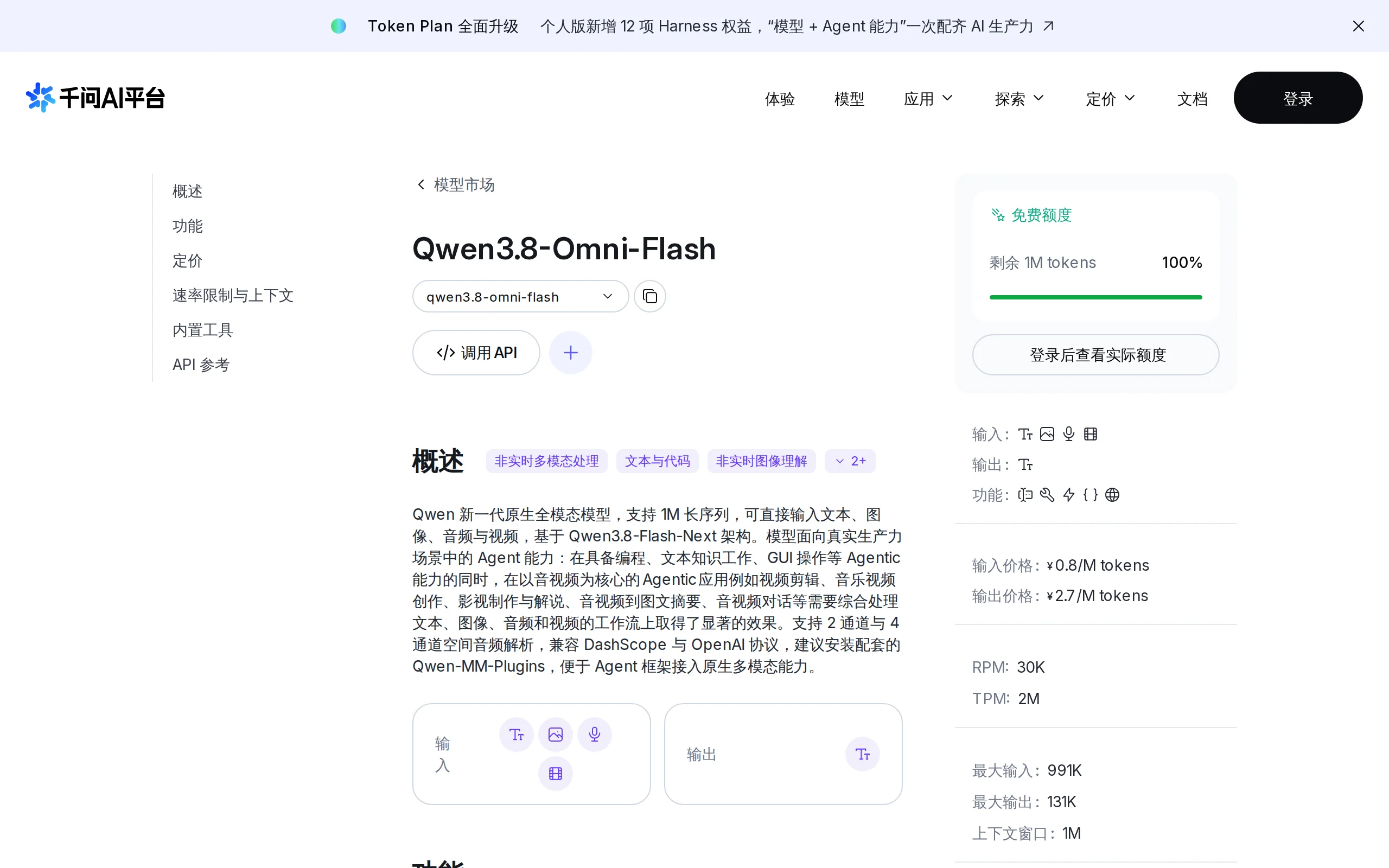
Qwen3.8-Omni-Flash – A Native Multimodal Model Launched by Alibaba Qwen
Qwen3.8-Omni-Flash is a native multimodal model launched by Alibaba Qwen. It jointly models four modalities—text, image, audio, and video—within a single architecture, supporting a context length of u...
Union Alpha – A Mysterious Multimodal Large Model with Unlimited Free Access for a Limited Time
Union Alpha is a multimodal large language model released in "stealth" mode, recently launched on mainstream AI service platforms such as OpenRouter, Cline, and OpenCode. The model supports dual-modal...
© All Rights Reserved. Some content on this site is partially generated by AI with human review.