
Zing-0.5 – Loopit's Open-Source Real-Time Interactive Video World Model
Executive Summary:
Zing-0.5 is an open-source real-time interactive video world model developed by the Loopit team, with 5B parameters. It is trained on the Wan2.2-TI2V-5B base model and released under the Apache 2.0 li...
1. What is Zing-0.5
Zing-0.5 is an open-source real-time interactive video world model developed by the Loopit team, with 5B parameters. It is trained on the Wan2.2-TI2V-5B base model and released under the Apache 2.0 license. Its core capability is "joint control": both keyboard spatial operations and natural language semantic rewriting are fed into the Causal DiT in parallel. Users can control character movement while simultaneously rewriting the world with text, and new instructions are applied to the current world rather than resetting the scene. It can generate video in real-time at over 24 FPS on a single RTX 5090 GPU, with a streaming inference cost of about 6 cents per minute. In the WBench evaluation, it ranks first among real-time world models.
Technical Positioning and Domain: It belongs to the intersection of video generation and interactive world modeling. Unlike one-time text-to-video tools, Zing-0.5 emphasizes the real-time nature and intervenability of the generation process, positioning itself as a playable generative world engine. Its technical approach combines diffusion Transformers (DiT), autoregressive temporal modeling, and multimodal conditional control, with a clear differentiated positioning in the niche area of real-time interactive video generation.
Development Background: Developed by the Loopit team, the base model used is Wan2.2-TI2V-5B, a mature video generation model. Instead of training a complete world model from scratch, the team opted to add lightweight action control pathways and semantic rewriting mechanisms on top of the existing base model, demonstrating the efficiency of an engineering approach. The WBench evaluation was jointly launched by Meituan's LongCat and Fudan University, and Zing-0.5 ranks first among real-time world models in this benchmark.
Core Value: It addresses the core issue of "disconnection between control and generation" in interactive video generation. Traditional video generation models can only generate unidirectionally, and users cannot intervene in the process. Zing-0.5 realizes an interactive paradigm of "playing and modifying simultaneously," allowing keyboard operations and text instructions to act concurrently on the generation process, with new instructions precisely applied to the current world rather than resetting the scene. This provides foundational technical support for scenarios such as AI gaming, interactive content consumption, and virtual live streaming.
Technical Features: The dual-control pathway architecture is the core innovation—action pathways (action residual) and text pathways (cross-attention) are decoupled and run in parallel, both injecting into the Causal DiT. Prompt switching during training enables the model to natively learn rewriting capabilities. An active perturbation training strategy, which introduces disturbances to historical frames, allows the model to learn resistance to error accumulation, and this capability is fully embedded in the model weights with zero additional inference cost. The four-step DMD distillation sampling compresses diffusion sampling to just four steps, which is key to achieving real-time generation on a single GPU.
2. Key Features
Joint Control: Keyboard spatial operations (W/A/S/D for movement + I/J/K/L for perspective) and natural language semantic rewriting jointly influence the generation process. The two control pathways are decoupled and operate in parallel, allowing users to manipulate character movement while simultaneously inputting text commands to alter the world, such as having a dragon maintain its flight direction while breathing fire. The operation and rewriting do not interfere with each other.
Real-time Streaming Generation: A single RTX 5090 can achieve a generation speed of over 24 FPS, with a streaming inference cost of approximately 6 cents per minute. By compressing diffusion sampling into 4 steps using a four-step DMD distillation sampling method, combined with causal KV caching, the model supports infinite-length sequential autoregressive inference, enabling low-latency, low-cost continuous generation.
Mid-generation Semantic Rewriting: Natural language instructions can be inserted at any time during the generation process (e.g., "blizzard," "dragon breathes fire"). The model retains the previously generated visual and operational history, and writes the new instruction into the current world through cross-attention. The rewriting only affects the content related to the instruction, while the character, art style, and distant scenes remain stable.
Multi-object Simultaneous Response: A single instruction can simultaneously drive multiple distinct objects to undergo related changes, such as "character kneels and prays + multiple statues open their eyes and emit light." The model possesses semantic parsing and object-level control capabilities, rather than simply performing global style transfer.
Long-term Consistency: Character appearance, scene structure, and art style (e.g., pixel style) remain stable during continuous generation, without drifting or changing styles. This is achieved through a training strategy that actively introduces perturbations to historical frames, enabling the model to distinguish the true state from frames with errors.
Error Accumulation Resistance: In autoregressive generation, the model's own outputs can introduce errors. Zing-0.5 actively applies noise, blurring, color shifts, and perspective changes to historical frames during training, simulating real inference errors and forcing the model to learn error correction. This capability is fully embedded in the model weights, and no additional error correction model is needed during inference, thus not increasing latency.
Action Control: 8-dimensional continuous action signals (values [0,1]), supporting forward/backward/left/right movement and four-directional perspective changes. The action signals are encoded using sin/cos encoding and causal temporal convolution (less than 10M parameters), and then converted into per-frame action residuals. These residuals are aligned with video tokens and injected into the generation network frame by frame.
Local Deployment and Open Source: The model can run on a single card with 5B parameters, requiring a Linux + PyTorch environment, with 80GB+ VRAM or sliding window attention configuration (RTX 4090 level is also supported). It outputs 24 FPS MP4 files encoded in H.264. Licensed under Apache 2.0, the code and weights are fully open on GitHub, ModelScope, and HuggingFace.
3. How to Use
Environment Setup: Requires a Linux operating system and an NVIDIA GPU. It is recommended to use a GPU with 80GB or more VRAM (e.g., H100/A100). An RTX 4090-level GPU can run the model with sliding window attention configuration. The basic environment requires Python 3.11, PyTorch 2.9, and CUDA.
Obtaining Code and Model: Clone the repository by executing
git clone https://github.com/seedleap/zing-world-model.git. Enter the directory and runpip install -r requirements.txtto install dependencies. Model weights can be downloaded via ModelScope: first, runpip install modelscope, then executemodelscope download --model seedleap/Zing-0.5 --local_dir ./Zing-0.5. The weights directory containsgenerator/model.pt(generator) andpretrained/(text_encoder, tokenizer, vae).Running Inference: Use the
run.shscript for text-driven mode, specifying--pretrained-dir,--checkpoint,--messages examples/case3_action_t2v.jsonl, the output directory, and a random seed. For image-initialized mode, switch to configurations such asexamples/case4_action_ti2v.jsonlfor image-to-video generation.Attention Parameter Configuration: For GPUs with 80GB+ VRAM, use
--local-attn-size 97 --sink-size 9; for GPUs with less than 80GB, use--local-attn-size 33 --sink-size 5; for full historical attention, use--local-attn-size -1 --sink-size 0. Sliding window attention maintains long context within limited VRAM through local attention and sink tokens.Interactive Operations: Use W/A/S/D to control forward/backward/left/right movement, and I/J/K/L to control perspective rotation. These inputs are internally mapped to an 8-dimensional continuous vector (values [0,1]). Natural language instructions can be entered during generation to achieve mid-process semantic rewriting, with the world responding in real time and the scene not being reset.
Viewing Output: The generated results are 24 FPS MP4 files encoded with H.264, saved in the directory specified by
--output-dir. If you prefer not to deploy locally, you can wait for the official announcement of the Loopit APP international version, which will be launched within two weeks. You can directly experience the real-time interactive world through the App.
4. Pros and Cons Analysis
| Pros |
|---|
| Unique joint control capability: Keyboard operations and text rewriting run in parallel through dual pathways, enabling an "interactive while modifying" paradigm. New instructions are precisely integrated into the current world state without resetting the scenario, a feature that most real-time world models lack. |
| Excellent real-time performance: Single-card RTX 5090 achieves over 24 FPS. The streaming inference cost for one minute is approximately 6 cents. The four-step DMD distillation sampling is key to real-time performance, placing it ahead in the real-time world model category. |
| Outstanding long-term consistency: The model's training strategy of actively perturbing historical frames enables it to resist error accumulation. Character appearance and scene structure remain stable over long generation periods, with error correction capabilities embedded in the weights, resulting in zero additional inference overhead. |
| True open-source ecosystem: Released under the Apache 2.0 license, the full codebase, weights, and deployment documentation are open. Commercial use has no restrictions, and based on the mature Wan2.2-TI2V-5B base model, the cost of secondary development is low. |
5. Comparative Analysis with Similar Tools
| Comparison Dimension | Zing-0.5 (Loopit/SeedLeap) | HiDream-O1-World (HiDream.ai) |
|---|---|---|
| WBench Overall Ranking | 2nd (1st on real-time leaderboard) | 3rd |
| Comprehensive Average Score | 81.0 | 80.9 |
| Visual Quality (Quality) | 80.6 | 81.0 |
| Scene Setting (Setting) | 77.8 | 82.2 |
| Interaction Ability (Interaction) | 84.2 | 80.0 |
| Consistency (Consistency) | 88.5 | 88.0 |
| Physical Laws (Physical) | 73.8 | 73.3 |
| Real-time Performance | Real-time (over 24 FPS on a single 5090 card) | No real-time label indicated |
| Interaction Type | Action + text joint control, supports world rewriting mid-play | Action control only |
| Parameter Scale | 5B (base model: Wan2.2-TI2V-5B) | Not disclosed |
| Open Source Status | Open source (Apache 2.0, code + weights) | No open source label indicated |
| Inference Cost | Approximately 6 cents per minute for streaming generation | Not disclosed |
If the primary requirement is real-time interaction and a "modify-as-you-go" generation experience, Zing-0.5 is currently the only open-source solution that supports both action control and mid-play text rewriting. It also achieves the highest scores among the three in the Interaction (84.2) and Consistency (88.5) dimensions, making it well-suited for AI game prototyping and interactive content creation.
If visual quality and the intricacy of scene settings are of greater importance, HiDream-O1-World leads in the Setting dimension (82.2), making it ideal for content generation tasks that demand high visual fidelity. LingBot-World v2 excels in speed but has a relatively lower score in the Physical dimension, making it suitable for fast generation scenarios where physical accuracy is not a critical factor.
6. Editor's Summary
The technical innovation of Zing-0.5 is reflected in three aspects: first, the dual control link architecture, which decouples and injects action signals and textual semantics in parallel into the Causal DiT, achieving true joint control; second, the innovation in training strategies, through switching prompts midway during autoregression and actively perturbing historical frames, enabling the model to natively acquire rewriting and error-correction capabilities, rather than assembling these functions during inference; third, engineering efficiency, with the action control link containing less than 10M parameters, and four-step DMD distillation sampling allowing a 5B model to achieve real-time generation at over 24 FPS on a single RTX 5090 card, with costs controlled to about 6 cents per minute.
In terms of practical value, Zing-0.5 moves video generation from "one-time generation" to "sustainable interaction," providing a feasible technical foundation for content forms such as AI games, interactive short videos, and virtual live streaming. The Apache 2.0 license and full open-source nature reduce the barriers for secondary development, allowing developers to quickly build vertical applications based on the mature Wan2.2-TI2V-5B base model.
The target users mainly include: AI game and interactive content developers, world model researchers, UGC creators, and game teams needing to rapidly validate gameplay concepts. Its limitations lie in the need for further improvements in the accuracy of physical law simulations, as well as the fact that productization entry points are not yet fully established.
In terms of development potential, Zing-0.5 demonstrates the feasibility of the "lightweight control link + mature base model" approach. As the overseas version of the Loopit APP launches and the community ecosystem matures, real-time interactive world models are expected to open up new product categories in the content consumption domain.
7. Application Scenarios
AI Interactive Entertainment / AI Gaming: Players use a keyboard to control characters in a generated world, and can随时 rewrite the storyline and environment with language commands (such as snowing or summoning monsters), achieving a "generative game accessible to everyone." Compared to traditional games that require pre-modeling and physics engines, the world model directly generates interactive visuals, significantly lowering the barrier to game development.
"Playable TikTok"-style Content Consumption: Short videos transform from "watching" to "playing," allowing each user to experience different outcomes within the same content. Creators generate an interactive video world, and viewers modify the storyline through actions and text commands, reshaping the consumption model of content platforms.
UGC Interactive Content Creation: Creators generate interactive video worlds for fans to experience, turning viewers from passive observers into active participants. Zing-0.5's open-source license and low-cost inference enable individual creators to produce interactive content, giving rise to entirely new content categories.
Rapid Game Prototype Validation: Game teams no longer need to build engine environments; they can quickly generate interactive demos using the world model, enabling low-cost validation of gameplay mechanics and level design. Operational feel and narrative pacing can be tested early in the project lifecycle, shortening the evaluation period for project initiation.
Virtual Live Streaming / Virtual Streamers: Streamers drive virtual worlds in real-time, and viewers participate in rewriting scenes and events through live chat text, enhancing the interactivity of the stream. For example, when viewers send a "rain" command, the virtual scene responds in real-time to weather changes, increasing the unpredictability and engagement of live content.
8. FAQ
Q: What is the fundamental difference between Zing-0.5 and conventional text-to-video models?
A: Conventional text-to-video models generate a fixed-length video in one go, and users cannot intervene during the generation process. Zing-0.5 is an interactive world model, where generation is continuous and users can influence the content in real-time through keyboard input and text commands. New instructions do not reset the already generated scene.
Q: Can Zing-0.5 run with less than 80GB of VRAM?
A: Yes. When VRAM is below 80GB, use the sliding window attention configuration --local-attn-size 33 --sink-size 5, which allows Zing-0.5 to run on an RTX 4090-level GPU. However, the maintainable context length will be shortened accordingly. Full historical attention requires more than 80GB of VRAM; it is recommended to use GPUs such as H100 or A100.
Q: Will entering text instructions midway cause the scene to reset?
A: No. During training, the model switches prompts while retaining the already generated visual and operational history. New instructions are written into the current world via cross-attention. Only the content related to the new instruction is rewritten, while the character's appearance, art style, and distant scenes remain stable.
Q: Will the image drift after long-term generation?
A: Zing-0.5 actively introduces perturbations to historical frames during training (e.g., noise, slight blurring, color shifts, and perspective changes), simulating real errors in autoregressive inference. The model has learned to distinguish states from imperfect history. As a result, the character's appearance and scene structure remain stable during long-term generation, and its error-correction capability is embedded in the weights without incurring additional inference costs.
Q: Are there any restrictions on commercial use of Zing-0.5?
A: No restrictions. Zing-0.5 is released under the Apache 2.0 license, with full open access to both code and weights. It supports both commercial and academic use, with no barriers to commercial deployment. The base model Wan2.2-TI2V-5B is also an open-source model.
Q: What is the relationship between Zing-0.5 and Wan2.2-TI2V-5B?
A: Zing-0.5 is trained on the Wan2.2-TI2V-5B base model, inheriting its video generation capabilities. It adds an action control pathway (action residual) and a mid-generation text rewriting mechanism, and is optimized for real-time interactive scenarios in terms of sampling efficiency and long-term consistency.
9. Project Links
- GitHub Repository: https://github.com/seedleap/zing-world-model
- HuggingFace Model Library: https://huggingface.co/seedleap/zing-0.5
- ModelScope Model Library: https://modelscope.cn/models/seedleap/Zing-0.5
Related AI Model Articles

Kimu: In-Depth Review of the Open-Source AI Video Editor from the trykimu Team
Kimu (officially named Kimu Studio) is an open-source AI video editor developed by the trykimu team. Its core concept lies in describing requirements through natural language, allowing AI to automatic...

Qwen-Audio-3.1: A Full-Stack Evaluation of the Qwen Audio Large Model Series
Qwen-Audio-3.1 is a series of large audio models launched by Alibaba's Qwen. It consists of five models: ASR speech recognition, ASR-Next audio understanding, TTS speech synthesis, TTS-Next audio crea...

Qwen3.8-LiveTranslate – A Real-Time Simultaneous Interpretation Model Launched by Alibaba Tongyi
Qwen3.8-LiveTranslate is a real-time simultaneous interpretation large model launched by the Tongyi Qianwen team at Alibaba. Based on the Interleave single-stream architecture, it processes audio and ...
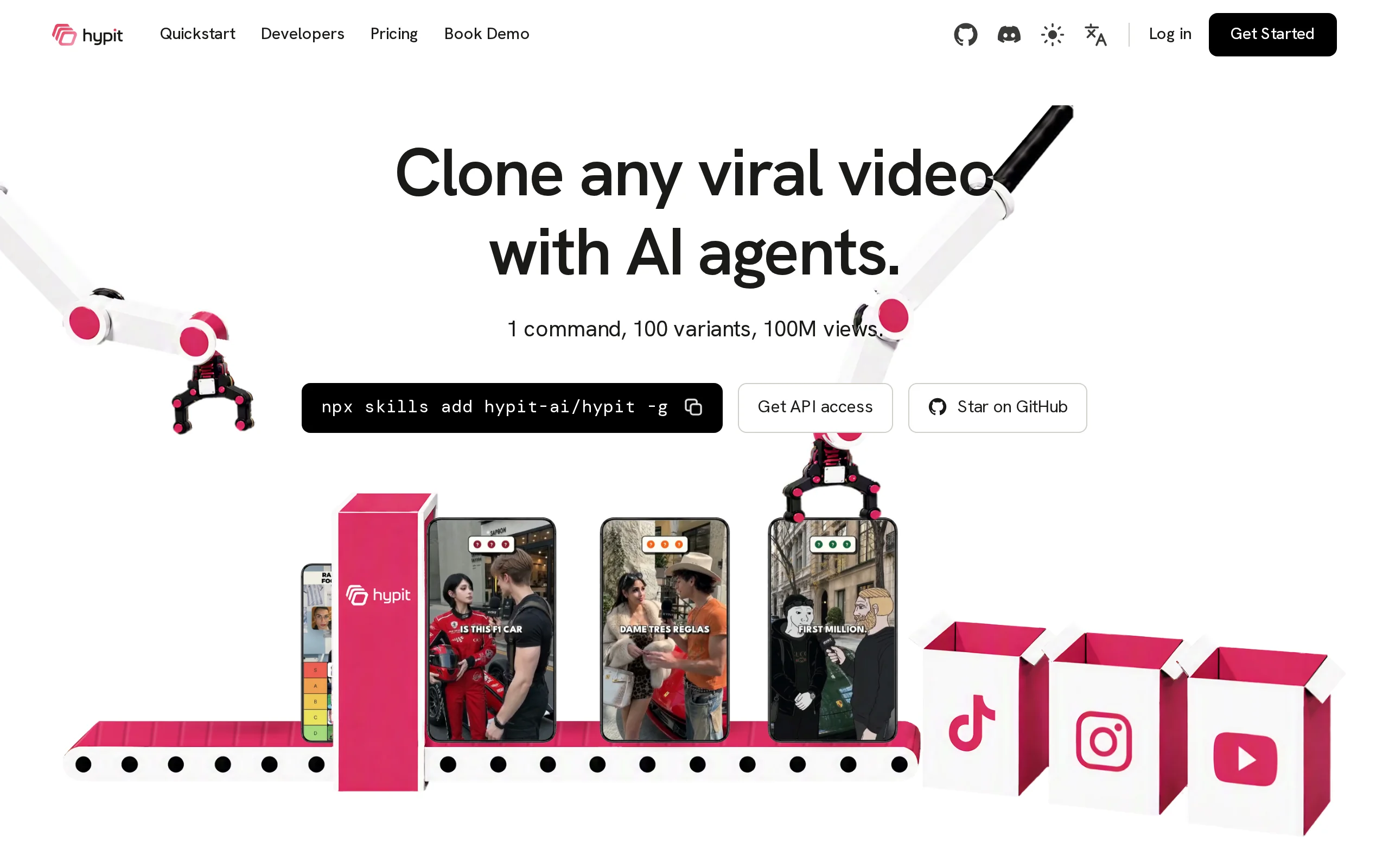
Hypit – Open-Source AI Video Generation Tool, Automatically Replicates Viral Videos
Hypit is an open-source AI video generation tool, centered on the methodology of "Provide an Agent with a viral video, and it will automatically replicate the entire workflow." It breaks down viral vi...
© All Rights Reserved. Some content on this site is partially generated by AI with human review.