
Stable Audio 3 – Stability AI's Open-Source Audio Generation Model Series
Executive Summary:
Stable Audio 3 is Stability AI's next-generation open-source audio generation model series, built on flow-matching latent-space diffusion architecture. It supports text-to-music and sound effects, aud...
1. What Is Stable Audio 3
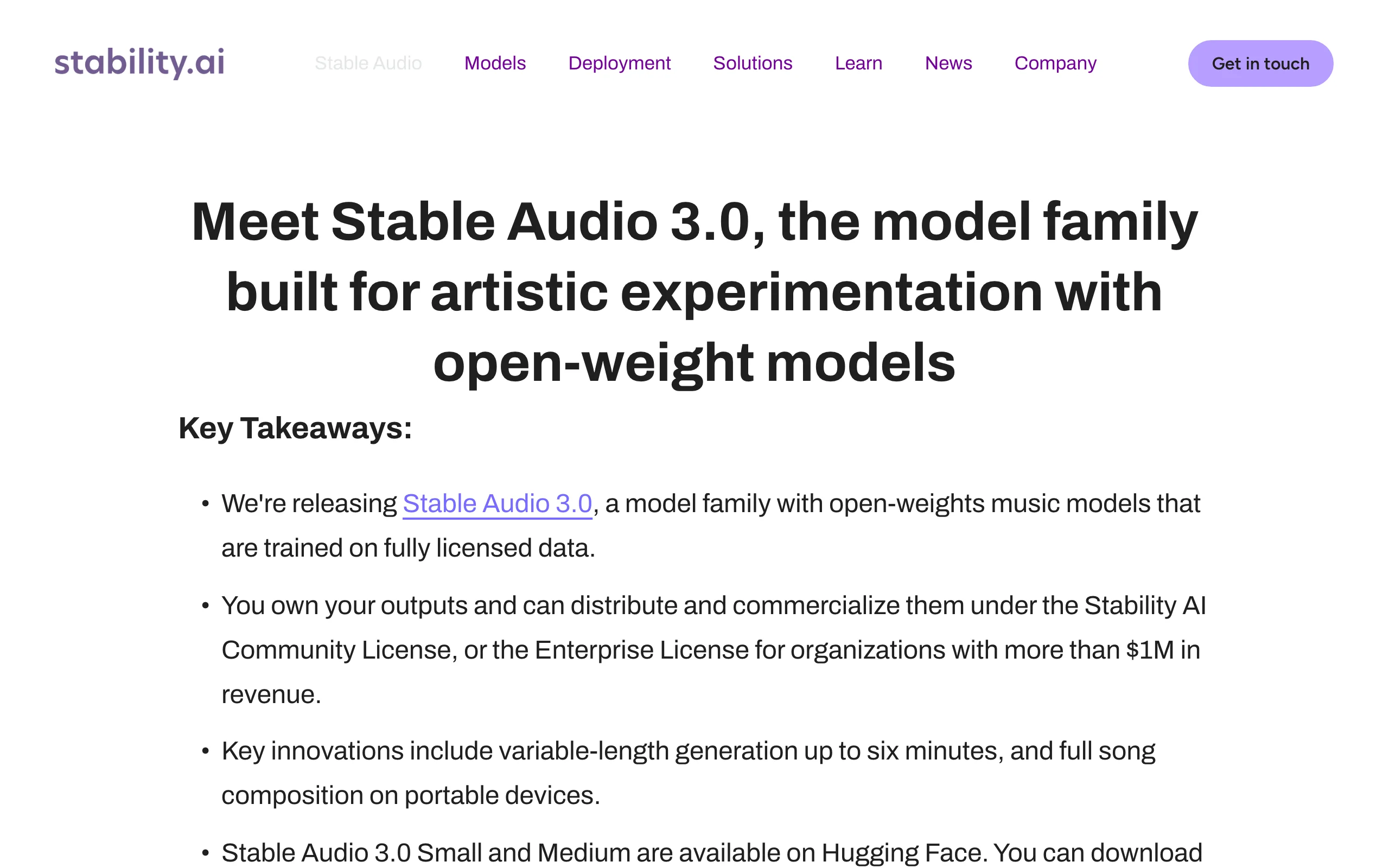
Stable Audio 3 is Stability AI's next-generation open-source audio generation model series, built on flow-matching latent-space diffusion architecture. It supports text-to-music and sound effects, audio editing, and continuation. The series offers Small, Medium, and Large variants—the Small version runs locally on consumer devices like MacBook Pro and generates up to 2 minutes of audio, while Medium and Large support over 6 minutes of high-quality generation. All models are trained on fully licensed data; Small and Medium weights are open with LoRA fine-tuning support, achieving sub-2-second inference on H200 GPUs.
Image source: Official article
Technical positioning and domain: Belongs to generative AI audio, specifically text-conditioned audio generation, editing, and continuation. Core positioning is an industrial-grade audio generation tool for professional music producers, sound designers, and content creators, filling gaps in open-source audio models for long duration, high quality, and editability.
Development background: Developed by Stability AI, which previously released Stable Audio Open and Stable Audio 2.0. Motivation stems from limitations of existing open-source audio models in generation duration, editing capability, and local deployment—Stable Audio Open supported only fixed 47-second generation without editing. Stable Audio 3 aims to break these bottlenecks through flow-matching architecture and adversarial post-training.
Core value: Solves three major pain points of open-source audio models: inability to generate long audio, inability to perform local editing, and inability to run on consumer hardware. Core innovations include first achieving over 6 minutes of high-quality generation, single/multi-segment mask editing and continuation, and Small model fully offline on MacBook Pro—unprecedented flexibility and privacy for creators.
Technical characteristics: Based on SAME semantic-acoustic autoencoder achieving 4096× downsampling, mapping 44.1kHz stereo to 256-dim latent space; flow-matching training with mini-batch optimal transport coupling for training stability; differential attention Transformer enhancing long-sequence modeling; adversarial post-training compressing inference steps to extreme levels for second-level inference.
2. Key Features
Text-to-audio generation: Users input English text prompts to generate instrumental music or ambient sound effects with precise second-level duration control. Based on flow-matching latent diffusion mapping text semantics to audio latent space, supporting arbitrary duration from 5 seconds to 6+ minutes—significantly outperforming traditional fixed-length models.
Variable-length audio synthesis: Model allocates latent sequence length proportional to requested duration, avoiding compute and memory waste from fixed maximum length. Breaks traditional diffusion fixed-sequence limits—short audio generation cost greatly reduced while long audio quality unaffected, optimal balance between inference efficiency and generation quality.
Local audio editing and inpainting: Single or multi-segment masks enable local redrawing (inpainting), replacing target regions while preserving original segments. Works without additional training data annotation via random mask strategy—suited for fixing recording flaws, replacing specific tracks, or adjusting musical passages.
Intelligent audio continuation: Causal masking mechanism coherently extends existing audio, expanding short recordings into complete works over 6 minutes. Especially practical in music creation—record a motif melody, model auto-generates style-consistent subsequent passages with natural harmonic, rhythmic, and timbral transitions.
LoRA style fine-tuning: First release of LoRA training documentation with Small and Medium weights, enabling efficient custom style adaptation with proprietary audio libraries. Low-rank adaptation allows fine-tuning on consumer GPUs with minimal VRAM, generating models with specific instrument timbres, genres, or sound effect styles.
Full-chain local deployment: 3.0 Small runs fully offline on consumer devices like MacBook Pro for network-free private creation. Based on model quantization and inference optimization controlling parameter scale for mobile and laptop hardware while maintaining generation quality.
Multi-tier model selection: Small, Medium, Large for different hardware scenarios. Small for consumer devices (2-minute audio); Medium and Large for professional workstations (6+ minute high-quality generation)—flexible choice by hardware and task complexity.
3. How to Use
Obtain model weights: Visit Hugging Face
Stability-AI/stable-audio-3repository, download 3.0 Small, Small SFX, or Medium weights. Note Large weights not yet open—API access only via Stability AI.Configure environment: Clone
stable-audio-toolsrepo (git clone https://github.com/Stability-AI/stable-audio-tools.git), install dependencies. Ensure PyTorch ≥2.0, CUDA ≥11.8 (NVIDIA) or Apple Metal backend (Mac). Python 3.10+ recommended.Load model and encoder: Instantiate SAME autoencoder and corresponding diffusion Transformer in Python:
from stable_audio_tools import create_model_from_config
model, sample_rate = create_model_from_config("path/to/config.yaml")
model.load_state_dict(torch.load("path/to/weights.pt"))
model.eval()
Write generation prompt: Input English prompt describing target audio style, instruments, and mood with precise output duration (seconds). Example:
"A melodic piano piece with soft strings, upbeat tempo, 30 seconds". Include style, instruments, tempo, mood.Execute inference: Call model generation interface with prompt and duration. Model performs variable-length inference per duration parameter, outputting 44.1kHz stereo WAV. On MacBook Pro M4, ~5-10 seconds for 30-second audio; on H200 GPU, under 2 seconds for 6-minute 20-second audio.
Audio editing and continuation: For local editing, provide original audio and mask array (1=keep, 0=replace), call inpainting method. For continuation, use causal mask specifying continuation start point for automatic subsequent content generation.
4. Pros and Cons
| Pros |
|---|
| Fully licensed, commercial-friendly: All models trained on licensed and Creative Commons data; Community License allows free ownership and commercial use of generated content without copyright concerns. |
| Native consumer hardware support: 3.0 Small open weights run offline on MacBook Pro M4—first lightweight model supporting local full-track composition for privacy-sensitive scenarios. |
| Ultra-long high-quality generation: Medium and Large support 6+ minute high-quality audio—orders of magnitude beyond Stable Audio Open's 47-second cap, filling market gap. |
| Extreme inference efficiency: Adversarial post-training optimization—Large model generates 6-minute 20-second audio in under 2 seconds on H200, seconds on MacBook Pro—near real-time generation. |
| Zero-annotation flexible editing: Single/multi-segment editing and continuation via random and causal masks without extra training annotation—integrates directly into real creative workflows. |
5. Comparison with Similar Tools
| Dimension | Stable Audio 3 | Stable Audio Open | MusicGen |
|---|---|---|---|
| Developer | Stability AI | Stability AI | Meta (FAIR) |
| Architecture | Flow-matching latent diffusion + SAME autoencoder | Latent diffusion | Autoregressive + EnCodec |
| Max generation duration | 6 min 20 sec (Medium/Large) | 47 sec (fixed) | ~2 minutes |
| Variable length support | Native second-level control, latent length proportional to duration | Not supported (fixed 47 sec) | Limited (truncate/pad) |
| Consumer local run | Small on MacBook Pro (M4) | Requires discrete GPU (≥8GB VRAM) | Requires discrete GPU (≥4GB VRAM) |
| Open weights | Small / Medium / Small SFX | Small | Small / Medium / Large |
| Audio editing | Single/multi-segment mask editing + causal continuation | Not supported | Not supported |
| Inference speed (long audio) | <2 sec (H200, 6 min 20 sec) | Slower (47 sec takes seconds) | Medium (2 min takes seconds) |
| Fine-tuning support | LoRA (open docs and weights) | Not supported | Not supported |
| License | Community License (commercial-friendly) | Creative Commons NC | MIT (non-commercial limits) |
Selection recommendation: For professionals needing long audio (2+ minutes) or editing/continuation, Stable Audio 3 is the only choice—variable-length inference and editing are unique among open-source models. For short audio only (game SFX, short video scoring) with lower hardware requirements, MusicGen's mature ecosystem may be easier. For fully offline consumer devices with privacy requirements, Stable Audio 3 Small is currently the only MacBook Pro local option.
6. Editor's Review
Stable Audio 3 shows significant breakthroughs in technical innovation, especially on "long duration" and "editability"—two core audio generation challenges. Flow-matching latent diffusion with SAME autoencoder achieves 4096× downsampling—a first among open-source audio models. Adversarial post-training compresses inference steps to extremes—Large model generates 6-minute 20-second audio in under 2 seconds on H200, absolutely leading among peers.
Most notable practical contribution: bringing professional audio generation to consumer hardware. Small model runs offline on MacBook Pro—indie musicians, small studios, even hobbyists access high-quality generation at zero cloud cost. Open LoRA fine-tuning further lowers customization barriers without large datasets.
Clear target audience: professional producers via Medium/Large for efficient creative assistance; sound designers via editing/continuation for rapid iteration; privacy-sensitive users via Small for fully offline work. Community License provides legal assurance for commercial AI audio integration.
Strong future potential despite Large not yet open—Stability AI committed to releasing more variants. As community matures and third-party toolchains improve, Stable Audio 3 may become de facto open-source audio generation standard. Recommend prioritizing Chinese support, editing precision, and industry partnership case studies.
Scoring: Technical innovation (5/5), practical value (4.5/5), ease of use (4/5), community ecosystem (3.5/5), commercialization potential (5/5). Deductions mainly for Large not open source and limited Chinese support.
7. Application Scenarios
Game and film sound effects: Rapidly generate interactive SFX, ambient atmosphere, and background music; local editing precisely matches visual rhythm and emotional needs. Game developers generate dynamic SFX for different scenes (forest, city, combat) and extend to full level duration via continuation.
Short video and ad scoring: Generate customized instrumental segments at exact duration without manual cropping—direct fit for short videos, trailers, podcast transitions. Input "30-second upbeat electronic music" for precise output without post-editing.
Music creation assistance: Generate motif inspiration, extend unfinished drafts, or replace song sections—significantly accelerating arrangement iteration. Record a guitar riff, use continuation for complete harmonic progression and percussion.
Local privacy-sensitive creation: 3.0 Small fully offline for film studios and indie musicians requiring data privacy and network isolation—all processing local, suited for confidential commercial projects.
Personalized brand sound: LoRA fine-tune proprietary audio assets for consistent UI sounds, brand alerts, and exclusive musical styles. Tech companies fine-tune on proprietary recordings for recognizable notification sounds and background music.
8. FAQ
Q: Main differences between Stable Audio 3 and Stable Audio Open?
A: Significant upgrades in architecture, features, and performance. Flow-matching latent diffusion replaces traditional latent diffusion; supports variable-length generation (seconds to 6+ minutes) vs Open's fixed 47 seconds. Stable Audio 3 adds editing, continuation, LoRA fine-tuning; Small supports MacBook Pro local run.
Q: Can Stable Audio 3 Small run on MacBook Air?
A: Yes, but performance depends on hardware. Best on MacBook Pro M4; MacBook Air M2/M3 also works but slower (~15-20 seconds for 30-second audio). Recommend ≥16GB RAM and close other GPU-intensive apps.
Q: Can generated audio be used commercially?
A: Yes. Community License allows free ownership and commercial use without additional fees to Stability AI. Note training data is licensed/Creative Commons—users should confirm generated content doesn't infringe third-party copyright.
Q: How to improve poor results with Chinese prompts?
A: Model optimized for English; Chinese support limited. Translate Chinese prompts to English with specific style, instrument, and mood descriptions. E.g., "悲伤的钢琴曲" → "A melancholic piano piece with slow tempo." Future versions may add multilingual support.
Q: How much training data and VRAM for LoRA fine-tuning?
A: Typically 10-20 audio samples (5-30 seconds each). Small model fine-tunes on 8GB GPU; Medium recommends 16GB+. Detailed training docs on GitHub repository.
9. Project Links
- Official announcement: https://stability.ai/news-updates/meet-stable-audio-3-the-model-family-built-for-artistic-experimentation-with-open-weight-models
- GitHub repository: https://github.com/Stability-AI/stable-audio-3
- HuggingFace model hub: https://huggingface.co/collections/stabilityai/stable-audio-3
- arXiv paper: https://arxiv.org/pdf/2605.17991
Related AI Model Articles
Review of DeepSeek Harness Desktop: How the Official GUI Client Lowers the Bar for Agent Usage
DeepSeek Harness Desktop is the official graphical client launched by DeepSeek, designed to provide a visual interface for the originally command-line-based DeepSeek Harness framework. After users log...
In-Depth Review of Spark-ASR-2.0: A New Paradigm in Speech Recognition with Non-Autoregressive Architecture
Spark-ASR-2.0 is the latest generation speech recognition large model launched by iFLYTEK based on its proprietary Spark-Audio speech foundation model. This model continues the non-autoregressive para...
Qwen-Audio-3.1: A Full-Stack Evaluation of the Qwen Audio Large Model Series
Qwen-Audio-3.1 is a series of large audio models launched by Alibaba's Qwen. It consists of five models: ASR speech recognition, ASR-Next audio understanding, TTS speech synthesis, TTS-Next audio crea...
Qwen3.8-LiveTranslate – A Real-Time Simultaneous Interpretation Model Launched by Alibaba Tongyi
Qwen3.8-LiveTranslate is a real-time simultaneous interpretation large model launched by the Tongyi Qianwen team at Alibaba. Based on the Interleave single-stream architecture, it processes audio and ...
© All Rights Reserved. Some content on this site is partially generated by AI with human review.