
SCAIL-2 – Zhipu AI and Tsinghua's Open-Source Character Animation Model
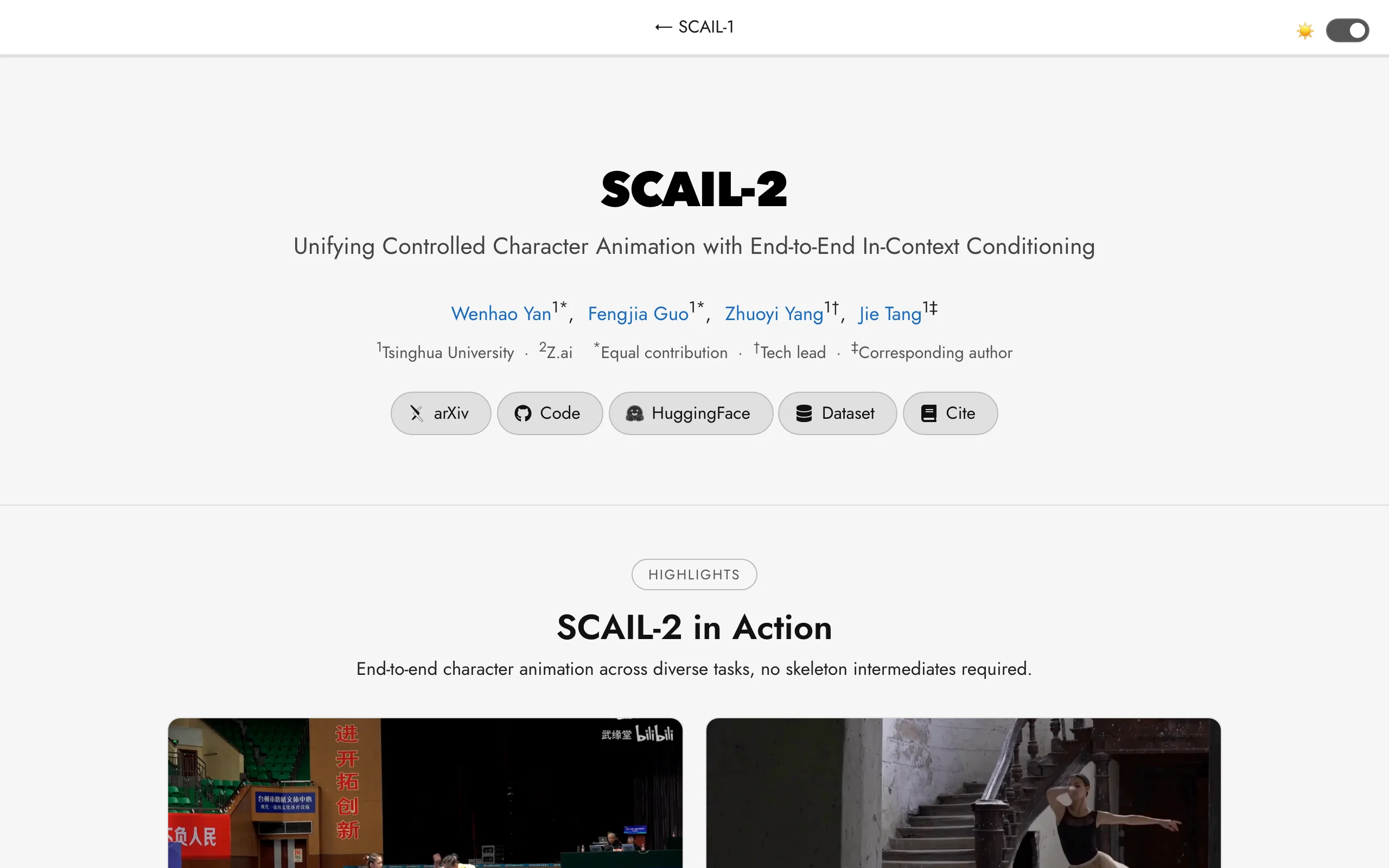
Executive Summary:
SCAIL-2 is the second-generation film-grade character animation framework open-sourced jointly by Zhipu AI and Professor Liu Yongjin's research group at Tsinghua University. Built on a Diffusion Trans...
1. What Is SCAIL-2
SCAIL-2 is the second-generation film-grade character animation framework open-sourced jointly by Zhipu AI and Professor Liu Yongjin's research group at Tsinghua University. Built on a Diffusion Transformer (DiT) architecture, it achieves high-quality animation transfer through end-to-end training without traditional pose-estimation intermediates, avoiding skeleton-map ambiguity. It supports both animation generation and character replacement modes, with SAM3 mask enhancement for precise matching. It can drive human bodies and handle non-human targets such as animals and hand-drawn characters, supports multi-character interaction, and provides efficient animation solutions for film, games, virtual idols, and related fields.
Image source: Official article
Technical positioning and domain: SCAIL-2 belongs to the intersection of computer vision and graphics, specifically video-driven character animation based on diffusion models. Unlike traditional two-stage methods (pose estimation + animation generation), it directly leverages DiT contextual learning for motion transfer without intermediate skeleton representations, avoiding ambiguity in complex scenes. The framework targets film-grade quality while supporting non-human characters (animals, hand-drawn art, robots) and multi-person interaction, filling gaps in generality and precision among existing open-source solutions.
R&D background: Developed jointly by Zhipu AI and Tsinghua's Liu Yongjin group. Zhipu AI is a leading domestic LLM company with deep expertise in NLP and visual generation; the Liu Yongjin group has long focused on computer graphics, animation generation, and 3D vision. The collaboration combines academic DiT architecture with industrial-quality data pipelines to move character animation from lab to film-grade applications. SCAIL-2 as the second generation significantly improves generation quality, driving diversity, and spatiotemporal coherence over the first version.
Core value: SCAIL-2 addresses two major pain points in traditional character animation: (1) skeleton-map ambiguity from pose-estimation intermediates, leading to poor animation on non-standard characters (animals, cartoons); (2) accumulated error in two-stage pipelines causing jitter and incoherence in long sequences. Through end-to-end training and full-context pose injection, SCAIL-2 achieves more precise, stable animation transfer while supporting character replacement, greatly lowering animation production barriers and cost. Its open-source nature lets small teams and individual creators use film-grade animation technology.
Technical characteristics: Core technologies include DiT-based diffusion transformers, 3D-consistent pose representation (preserving depth and occlusion), full-context pose injection (P-RoPE mechanism) for joint spatiotemporal reasoning, and SAM3 explicit mask conditioning for improved matching precision. A high-quality data curation pipeline covers human, animal, hand-drawn, and diverse targets with strong generalization.
2. Key Features
End-to-end animation generation: Based on DiT diffusion transformers, directly bypassing traditional pose estimation to achieve high-quality end-to-end transfer from reference image to driven video motion. This avoids skeleton-map ambiguity in complex scenes (occlusion, non-standard characters), producing more natural animation—especially for hand-drawn characters and animals.
Animation mode: Fully transfers reference character appearance onto the motion sequence of a driving video for action replication. Users provide one character image and a driving video with target motion to generate animation of the character performing those actions—suitable for virtual idol motion reproduction and rapid game character animation library generation.
Replacement mode: Precisely replaces specified characters in driving video while preserving original motion trajectories and background. Useful for post-production actor replacement, virtual character insertion in ads, or swapping brand IP in marketing videos without reshooting or reprocessing backgrounds.
SAM3 mask enhancement: Uses SAM3 (Segment Anything Model 3) to extract explicit masks from reference images and driving sequences as conditional input, significantly improving character-motion matching. Mask information helps separate foreground from background, reducing background interference and edge blur—especially effective in multi-person or complex backgrounds.
Diverse driving source support: Supports not only human motion but also animals, hand-drawn characters, robots, and other non-human targets. Notably, the model can control quadruped animals without corresponding animal training data, thanks to contextual learning and 3D-consistent pose representation generalization. For example, human walking video can drive a cartoon dog to perform the same motion.
Multi-character interaction: Handles coordinated motion and relative positioning among multiple characters in multi-person scenes. The system can identify and drive multiple characters simultaneously, maintaining interaction logic (handshakes, combat) without overlap or motion conflicts—suitable for game cutscenes and crowd scenes in film.
3D-consistent pose representation: Preserves depth and occlusion internally, ensuring spatially reasonable, consistent animation. Traditional 2D pose estimation loses depth, causing front-back confusion during rotation and occlusion; SCAIL-2's 3D representation maintains correct spatial positioning, improving film-grade realism.
Full-context pose injection: Combined with P-RoPE (Pose-shifted RoPE) for joint spatiotemporal reasoning, improving long-sequence coherence. P-RoPE injects pose information into full-sequence context so the model considers both temporal motion continuity and spatial pose consistency, effectively reducing jitter and sudden motion changes in long sequences.
3. How to Use
Environment requirements: A machine with NVIDIA GPU is required (Linux or Windows); 16GB+ VRAM recommended (RTX 4080 or higher). Software: Python 3.8+, PyTorch 2.0+, Diffusers, OpenCV, ffmpeg, etc. Use conda for an isolated environment to avoid dependency conflicts.
Clone repository and configure environment: Pull code from GitHub (https://github.com/zai-org/SCAIL-2):
git clone https://github.com/zai-org/SCAIL-2.git
cd SCAIL-2
pip install -r requirements.txt
If version conflicts occur, refer to recommended dependency versions in the README.
Download pretrained weights: Download SCAIL-2 weights from Hugging Face (https://huggingface.co/zai-org/SCAIL-2), including DiT main model, SAM3 mask extraction model, etc. Place files in the
checkpointsfolder at project root or as specified in the README.Prepare input assets: One reference character image (512×512+ recommended, clean background) and one driving video (24–30fps recommended, ≤30 seconds, clear human motion). The system automatically calls SAM3 to extract explicit masks from reference and driving sequences—no manual annotation needed.
Choose mode and run commands: Select animation or replacement mode. For animation:
python NLFPoseExtract/process_animation_aio.py --subdir <your_example_dir> --e2e_modeFor replacement:
python NLFPoseExtract/process_replacement.py --subdir <your_example_dir><your_example_dir>must contain reference image and driving video organized per README directory structure.Obtain results: After completion, find generated character animation video in the output directory (default
outputs/) as MP4 for post-editing. Check animation quality; if jitter occurs, try adjusting driving video frame rate or using higher-quality reference images.
Notes: First run downloads SAM3 weights—ensure network connectivity. If VRAM is insufficient, lower driving video resolution or use --half_precision for half-precision inference. For non-human characters, reference images should show complete contours for best matching.
4. Pros and Cons
| Pros |
|---|
| End-to-end without intermediates: Direct DiT-based animation transfer without pose estimation, avoiding skeleton ambiguity—simpler pipeline and more reliable results, especially for non-standard characters. |
| Film-grade quality: High-quality data curation and 3D-consistent pose representation preserve depth and occlusion; output meets film-grade standards with coherent motion and spatial reasonableness. |
| Diverse driving capability: Supports human, animal, hand-drawn, robot, and other non-human targets; can control quadrupeds without corresponding training data—excellent generalization. |
| Dual-mode flexibility: Animation mode for appearance transfer; replacement mode for video editing—one framework covering animation generation and post-production. |
5. Comparison with Similar Tools
| Dimension | SCAIL-2 (Zhipu × Tsinghua) | Viggle AI | MagicAnimate (Alibaba) |
|---|---|---|---|
| Developer | Zhipu AI × Tsinghua University | Viggle team | Alibaba Tongyi Lab |
| Open source | Fully open (model + code + paper) | Closed commercial product | Open (code + model) |
| Architecture | DiT diffusion transformer, end-to-end | Proprietary closed model | Stable Diffusion + pose control network |
| Driving method | Direct video drive, no pose estimation | Video/motion template drive | Depends on OpenPose etc. |
| Supported characters | Human, animal, hand-drawn, robot, multi-person | Mainly human, some stylized | Mainly human |
| Core modes | Animation transfer + character replacement | Mix / Animate / Move etc. | Single animation mode |
| Generation quality | Film-grade, 3D-consistent pose, spatiotemporal coherence | High quality, social entertainment focus | Academic grade, complex motion may jitter |
| Usage barrier | Local GPU deployment, technical barrier | Web zero-barrier | Local deployment, complex setup |
Selection advice: For film-grade quality and non-human characters (animals, hand-drawn), SCAIL-2 is the best current open-source choice—its end-to-end architecture and dual-mode flexibility excel in animation and video editing. Note hardware and deployment costs. For casual creators or social media, Viggle AI's web zero-barrier experience is friendlier but closed-source and lacks non-human support. For academic research or Stable Diffusion ecosystems, MagicAnimate and AnimateDiff provide mature baselines but require pose estimation and are less robust on complex motion than SCAIL-2. Overall, SCAIL-2 leads in professionalism and openness for film, games, and virtual idols.
6. Editor's Review
SCAIL-2 marks a new stage in character animation generation. Technically, it abandons the long-dominant two-stage pipeline (pose estimation + animation) for unified DiT end-to-end training—simplifying the flow and fundamentally addressing skeleton-map ambiguity. 3D-consistent pose representation and P-RoPE full-context injection achieve film-grade spatiotemporal coherence rare in open-source solutions. Notably, generalization to non-human characters without specific training data—driving quadrupeds via contextual learning and quality data pipelines—demonstrates strong representation learning.
Practically, dual-mode design (animation + replacement) covers animation production through video editing workflows. In film, it can replace parts of traditional motion capture, reducing cost; in games, rapid action library generation; in virtual idols, batch or real-time content creation. Open-source access gives small teams and creators capabilities previously limited to large studios.
Target users: Technically skilled animators, game developers, film post-production staff, and AI researchers. Pure art creators still need CLI operation; a future GUI would significantly lower barriers. Strong future potential as DiT optimizes and hardware costs fall—SCAIL-2 may become a standard tool. Extensions may include real-time inference, multimodal input (voice drive), and finer physics (cloth, hair dynamics).
Full marks for innovation and practical value; deductions for deployment barrier and documentation. For professional users, this is the most worthwhile open-source character animation framework to try today.
7. Application Scenarios
Film animation production: Replace traditional motion capture; quickly transfer character designs to preset motions. Animators draw one concept image, use human performance video as drive, and generate character animation—greatly reducing cost and cycle, especially for indie animation teams.
Game development: Generate walk, combat, interaction animations or efficient cutscene (CG) production. Animation mode drives new characters from existing motion libraries; replacement mode swaps character appearance in cutscenes while preserving motion.
Virtual idols and digital humans: Drive virtual streamers and digital employees for live interaction or short-video content. Replacement mode implants different virtual personas into the same driving video; animation mode transfers human motion to virtual characters for high-fidelity replication.
Advertising and brand marketing: Insert brand IP or virtual spokespeople into dynamic ads. Film human product demos, then replace humans with brand mascots via replacement mode while preserving interaction and background—rapid multi-version asset production.
Social media content creation: Turn hand-drawn images, memes, or photos into dynamic videos for short-form platforms. Upload a hand-drawn character and a dance video to generate dancing character animation with minimal effort.
Education and training: Create historical figure reenactments and instructional character demos. Use historical portraits as reference with lecture motion video to bring figures "to life" for engaging online courses.
8. FAQ
Q: What hardware is needed to run SCAIL-2 smoothly?
A: NVIDIA RTX 4080+ with 16GB+ VRAM recommended. RTX 3070 (8GB) may run short sequences (≤10s) with half-precision and lower resolution; long sequences (30s+) may OOM. CPU inference is not supported.
Q: Can SCAIL-2 drive non-standard characters (animals, robots)? Extra training needed?
A: Yes, without extra training for animals or robots. Contextual learning generalizes from human driving video to non-human targets. Clear character contours in reference images and moderate motion amplitude in driving video yield best results.
Q: What's the difference between animation and replacement modes? Which should I choose?
A: Animation mode fully transfers reference appearance onto driving video motion—create new animation from scratch. Replacement mode replaces a character in existing video while keeping motion and background—post-production editing. Character image + action video → new video: use animation. Existing video, swap character: use replacement.
Q: Jitter or incoherent motion—how to optimize?
A: Check driving video frame rate stability (24–30fps); avoid violent shake or sudden cuts. Keep reference background simple. Try --half_precision to reduce VRAM pressure or lower driving resolution (e.g., 512×512). Segment long sequences and stitch if needed.
Q: Does SCAIL-2 support multi-person interaction? How to input multi-person driving video?
A: Yes. The model drives multiple characters while maintaining interaction logic. Driving video should contain multiple character motions; SAM3 masks distinguish characters automatically. Keep each character's outline relatively clear; avoid severe occlusion. Currently cannot specify which reference maps to which character—all follow driving video order.
Q: Is SCAIL-2 open source? Can it be used commercially?
A: Yes, under an open license (see GitHub). Code, weights, and paper are public. Commercial use must comply with license terms (often Apache 2.0 or MIT)—review the specific license for restrictions.
9. Project Links
- Project site (paper, demos): https://teal024.github.io/SCAIL-2/
- GitHub (code, install guide): https://github.com/zai-org/SCAIL-2
- Hugging Face (pretrained weights): https://huggingface.co/zai-org/SCAIL-2
Related AI Model Articles

Kimu: In-Depth Review of the Open-Source AI Video Editor from the trykimu Team
Kimu (officially named Kimu Studio) is an open-source AI video editor developed by the trykimu team. Its core concept lies in describing requirements through natural language, allowing AI to automatic...

Qwen-Audio-3.1: A Full-Stack Evaluation of the Qwen Audio Large Model Series
Qwen-Audio-3.1 is a series of large audio models launched by Alibaba's Qwen. It consists of five models: ASR speech recognition, ASR-Next audio understanding, TTS speech synthesis, TTS-Next audio crea...

Qwen3.8-LiveTranslate – A Real-Time Simultaneous Interpretation Model Launched by Alibaba Tongyi
Qwen3.8-LiveTranslate is a real-time simultaneous interpretation large model launched by the Tongyi Qianwen team at Alibaba. Based on the Interleave single-stream architecture, it processes audio and ...
Hypit – Open-Source AI Video Generation Tool, Automatically Replicates Viral Videos
Hypit is an open-source AI video generation tool, centered on the methodology of "Provide an Agent with a viral video, and it will automatically replicate the entire workflow." It breaks down viral vi...
© All Rights Reserved. Some content on this site is partially generated by AI with human review.