
PixVerse Game – The First Real-Time Video Game Engine from PixVerse Tech

Executive Summary:
PixVerse Game is the first real-time video game engine introduced by PixVerse Tech, built upon its self-developed PixVerse R1 real-time world model. This engine constructs a complete gaming experience...
1. What is PixVerse Game
PixVerse Game is the first real-time video game engine introduced by PixVerse Tech, built upon its self-developed PixVerse R1 real-time world model. This engine constructs a complete gaming experience on a continuously generated real-time interactive video stream, completely overturning the traditional paradigm of game development that relies on pre-set assets, modeling, and animation pipelines. Creators no longer need to possess programming or artistic skills; by simply defining rules and the game's world view, they can generate and run an interactive game world in real time. Its core lies in the real-time coupling of game logic, visual presentation, and player input, achieving seamless integration from "creation" to "play."
Image source: Official article
Image source: official article
Technical positioning and domain: PixVerse Game is positioned at the intersection of real-time interactive video generation and game engine technologies, representing a cutting-edge application of generative AI in game development. It is not a traditional game development tool (such as Unity or Unreal Engine), but rather a world simulator based on large models, presenting and interacting with games as real-time generated video streams.
Development background: This engine was developed by PixVerse Tech, a company with deep technical expertise in the field of video generation. The PixVerse series of models are competitive in terms of video generation quality and speed. The motivation behind developing PixVerse Game was to elevate video generation models from "content creation tools" to "interactive world engines," exploring the potential of AI in game creation and real-time interaction.
Core value: The core problem addressed by PixVerse Game is the high barrier to entry and long development cycle in game creation. By leveraging natural language interaction and real-time video generation, it enables non-technical users to independently create playable games. It also reduces the traditional 3–6 month prototype development cycle to just a few weeks. Additionally, its "dynamic infinite content" feature allows the game world to evolve in real time based on player actions, unbounded by pre-set assets, offering a new technological pathway for UGC (user-generated content) and personalized gaming experiences.
Technical features: The core technical system of this engine includes: real-time world modelingbased on PixVerse R1 to achieve low-latency image generation; Mechanism-Expression Decoupling (MED), which separates abstract game rules from visual expression, enabling independent iteration of gameplay and visuals; Generative Game Loop (GGL), which generates subsequent frames and events based on player actions and mechanism states for every frame; and Real-Time Consistency Orchestration (LCO), ensuring that character appearance, scene style, and narrative logic remain coherent across multiple rounds of interaction. These technologies collectively support an AI-driven, real-time responsive game world.
2. Key Features
Real-time Video Stream Game Rendering: This is the foundational feature of PixVerse Game. It replaces the complex modeling, texturing, animation, and rendering pipelines in traditional game engines with continuously generated dynamic video streams. Each frame of the game is computed and generated in real-time by the model based on the current game state, player input, and world rules, delivering an immediate "what you see is what you get" feedback experience.
Natural Language World Building: Creators and players can directly participate in world generation, character creation, and narrative rewriting through text input. For example, entering "Add a dark elf that attacks the player" or "Switch the scene to a rainy night in an abandoned castle," the engine parses the instruction in real-time and updates the game world, significantly lowering the barrier to content creation.
Typed Game Templates: The engine includes multiple playable prototype templates such as adventure, strategy, and action combat. These templates provide foundational game loops and mechanism frameworks for different game genres, allowing creators to quickly initiate projects based on these templates and customize them using natural language or visual tools.
Visual Toolchain (Game Composer): With tools like Game Composer, creators can build game mechanics and narrative logic using low-code or even no-code approaches. This includes defining character attributes, setting trigger conditions, and orchestrating event sequences, enabling narrative designers and planners without a programming background to deeply engage in game logic design.
AI Agent Orchestration: The engine can drive NPCs (non-player characters) and events in the game, responding to real-time player input while maintaining consistency in character behavior and narrative logic. For instance, an NPC can remember past interactions with the player and respond in a way that aligns with its predefined characteristics based on the current situation, made possible by LCO (Live Consistency Orchestration) technology.
3. How to Use
PixVerse Game is currently in the early internal testing phase and is not fully open to the public. According to official information, the general usage process is as follows:
Apply for Beta Access: At present, PixVerse Game is only open to a select group of invited creators. Developers or content creators interested in participating should visit the official PixVerse website, follow the beta recruitment announcements, and submit an application. The official team will screen applicants based on their background and creative plans.
Select or Create a Game Template: After obtaining beta access, users will enter the creation interface of PixVerse Game. The first step is to choose a pre-set game template (such as adventure, simulation, or combat), or start from scratch by describing in natural language the type of game and core gameplay you want to create.
Define World Rules and Narrative: Using the Game Composer tool or directly through natural language, creators define the game's setting, physical rules, character designs, narrative direction, and win conditions. For example, you could describe, "This is a magical world, and players need to collect three gems to seal an ancient demon." The engine will convert these descriptions into executable game mechanics.
Test and Iterate: After completing the initial setup, creators can immediately "play" their game. During gameplay, any element can be adjusted in real-time through input commands, such as "Reduce this boss's attack power by 20%" or "Add a hidden treasure chest to the scene." Each modification takes effect instantly, enabling a fast "create-test-edit" cycle.
Notes: As the game is still in the beta phase, its stability and generation quality may still be under optimization. Creators should exercise patience during debugging. Additionally, since the generation process heavily relies on cloud computing power, the stability of the network connection is crucial to the user experience. Best practices include starting with simple prototypes and gradually increasing complexity to better understand the engine's capability boundaries.
4. Pros and Cons Analysis
| Pros |
|---|
| Extremely low creation barrier: No programming or art background is required; non-technical users can independently create games using natural language, significantly expanding the creator community. |
| Significantly shortened development cycle: Traditional 3-6 month game prototyping pipelines can be compressed to a few weeks or even less to create an early playable version, greatly reducing the cost of trial and error. |
| Dynamic infinite content: The game world does not rely on pre-set assets and can grow and change in real-time based on player actions, offering dynamic storytelling and infinite replayability that traditional games cannot achieve. |
| Strong character and scene consistency: LCO technology ensures the stability and uniformity of character appearance, scene style, and narrative logic in long-form games, addressing common issues of "forgetting" and "drifting" in generative content. |
5. Comparative Analysis with Similar Tools
| Dimension | PixVerse Game | Oasis (Decart) |
|---|---|---|
| Core Positioning | Real-time video stream game engine, emphasizing complete game mechanics and narrative construction | Real-time interactive world system, focusing on physics and motion simulation |
| Interaction Method | Natural language + real-time input (keyboard/mouse) | Real-time keyboard control (e.g., WASD) |
| Latency Performance | Low-latency real-time feedback, aiming for a smooth gameplay experience | Real-time streaming generation, low latency |
| Game Mechanics | Built-in abstract mechanism engine (MED/GGL), supports defining rules, states, and events | Focuses on physics and motion simulation, with relatively simple game mechanics |
| Creation Threshold | Extremely low, building through natural language and visual tools | Low, but requires training specific scene models |
| Content Consistency | Strong, ensuring long-term consistency of characters and scenes through LCO technology | Moderate, potential for visual drift in long sequence generation |
Selection Recommendations: For creators aiming to quickly build interactive experiences with complete game mechanics (such as tasks, states, win conditions) and narrative logic, PixVerse Game offers a more suitable toolchain and abstraction layer, especially for independent game prototyping and interactive narrative creation. If the focus is on simulating realistic physical worlds or open-world exploration, and real-time interaction latency is not a strict requirement, Oasis and Genie 2 may be more appropriate. However, for traditional game development projects requiring precise control, complex numerical systems, and stable competitive experiences, these AI engines are currently unable to fully replace Unity or Unreal Engine.
6. Editor's Summary
PixVerse Game represents a significant direction in the evolution of generative AI from "content generation" to "world simulation" and "interactive experiences." Its technological innovation lies not in simply packaging a video generation model as a game tool, but in designing a series of mechanisms—such as MED, GGL, and LCO—specifically for game interaction at the architectural level. This architectural innovation distinguishes it from tools that can only generate static or linear video clips, truly enabling a "playable" experience.
In terms of practical value, PixVerse Game's greatest contribution is its "democratization" of game creation. It shifts the core capabilities of game development from programming and artistry to creativity, storytelling, and rule design. This makes it an extremely attractive platform for independent creators, narrative designers, educators, and brands looking to explore interactive storytelling. It allows for the rapid validation of game concepts and the production of functional prototypes at a very low cost, which holds revolutionary significance for the early-stage exploration of the creative industry.
This tool is primarily suitable for creators who do not require highly complex game mechanics but emphasize storytelling, world-building, and player-driven experiences. For AAA game development teams aiming for top-tier visual fidelity, precise physics simulation, or intricate competitive balance, PixVerse Game is not a replacement at this stage, but rather a powerful tool for concept validation and rapid prototyping.
Looking ahead, the potential of PixVerse Game lies in the scalability of its technical approach. As the underlying models continue to evolve, the quality of generated visuals, real-time performance, and the ability to handle complex logic will steadily improve. If Aispeech can further open up the interfaces for GGL and MED, allowing developers to create custom game rule modules, PixVerse Game could evolve from a "templated" creation platform into a true "general-purpose" AI game engine, profoundly transforming the creative paradigm in the gaming industry.
7. Application Scenarios
Independent Game Prototype Validation: Small teams or individual developers can use PixVerse Game to quickly build playable prototypes in vertical genres such as dating, adventure, and simulation within weeks. They can leverage natural language to rapidly iterate on core gameplay mechanics, storytelling, and art style, efficiently validating the feasibility of game concepts before investing significant resources into formal development, thereby compressing the traditional 3–6 month pipeline into just weeks.
Interactive Narrative and Visual Novels: Creators can build dynamic story worlds with rich branching narratives using natural language. Every choice a player makes in the game will instantly influence the subsequent visuals, character dialogue, and event progression, enabling a true "player-driven" narrative. This provides a new way of creating and experiencing genres such as visual novels and role-playing games (RPGs).
AI Virtual Streamers and Live Interaction: Streamers without technical backgrounds can use PixVerse Game to set up a virtual character live stream that responds in real-time to chat messages, gifts, and scene changes. For example, if an audience member sends a chat message saying "rain," the game scene will instantly switch to a rainy day; if a viewer gives a specific gift, the virtual character will trigger a unique action or dialogue, enabling a highly interactive live streaming experience.
Education and Immersive Simulation: Educators can create interactive historical scenarios (such as the Roman market), language environments (such as an English café), or business decision-making sandboxes. Students can freely explore, make decisions, and observe the consequences within a dynamically generated world powered by AI, transforming abstract knowledge into immersive, hands-on experiences and improving learning outcomes.
Community-Driven UGC Game Ecosystem: The platform can open up PixVerse Game's creative capabilities, allowing ordinary players to participate in world rule creation and content co-creation. Players can design their own maps, quests, and characters, and share them with other players to experience, forming a continuously evolving, infinitely expandable collective creation game ecosystem, similar to an AI-powered version of Minecraft or Roblox.
8. FAQ
Q: Is PixVerse Game completely free?
A: Currently, the product is in an early internal testing phase and is only open to a limited number of invited creators. Specific pricing and payment models have not been announced yet. In the future, when officially launched, it may offer a free basic version and paid options for advanced features or higher computational demands. Please refer to official announcements for details.
Q: What computer configuration is required to use PixVerse Game?
A: Since the game visuals are generated in real-time by the cloud-based AI model, the computational requirements for the user's local device are not high. A regular computer or tablet that can smoothly access the internet is sufficient. However, users need a stable and high-bandwidth network connection to ensure low-latency video streaming and interactive experience.
Q: Can PixVerse Game create games as complex as The Legend of Zelda?
A: At present, PixVerse Game is more suitable for games with relatively simple rules and narrative-driven gameplay. For AAA titles that require precise physics engines, complex numerical balance, and a large number of pre-set animations, its capabilities are still limited. It is better suited for quickly prototyping games, interactive storytelling, and simulation management genres.
Q: Will the characters and scenes in my generated game world remain consistent?
A: PixVerse Game's LCO (Live Consistency Orchestration) technology is specifically designed to address this issue. It ensures that the main characters' appearances, the style of the scenes, and the narrative logic remain coherent throughout a longer gameplay session, avoiding common AI-generated content issues such as character "drift" or "forgetting." However, maintaining consistency in extremely complex scenarios remains a challenge.
Q: Can I learn to use PixVerse Game if I have no programming background at all?
A: Yes. The core design philosophy of PixVerse Game is "technique-free." Its primary interaction method is natural language and visual tools (Game Composer), allowing users to define world rules, characters, and storylines without writing any code. Its creation threshold is much lower than traditional game engines, making it highly suitable for creators without a technical background.
9. Project Links
- Project Website (In-depth Analysis Article): https://pixverse.ai/en/blog/pixverse-game-engine-deep-dive
Related AI Model Articles

Kimu: In-Depth Review of the Open-Source AI Video Editor from the trykimu Team
Kimu (officially named Kimu Studio) is an open-source AI video editor developed by the trykimu team. Its core concept lies in describing requirements through natural language, allowing AI to automatic...

Qwen-Audio-3.1: A Full-Stack Evaluation of the Qwen Audio Large Model Series
Qwen-Audio-3.1 is a series of large audio models launched by Alibaba's Qwen. It consists of five models: ASR speech recognition, ASR-Next audio understanding, TTS speech synthesis, TTS-Next audio crea...

Qwen3.8-LiveTranslate – A Real-Time Simultaneous Interpretation Model Launched by Alibaba Tongyi
Qwen3.8-LiveTranslate is a real-time simultaneous interpretation large model launched by the Tongyi Qianwen team at Alibaba. Based on the Interleave single-stream architecture, it processes audio and ...
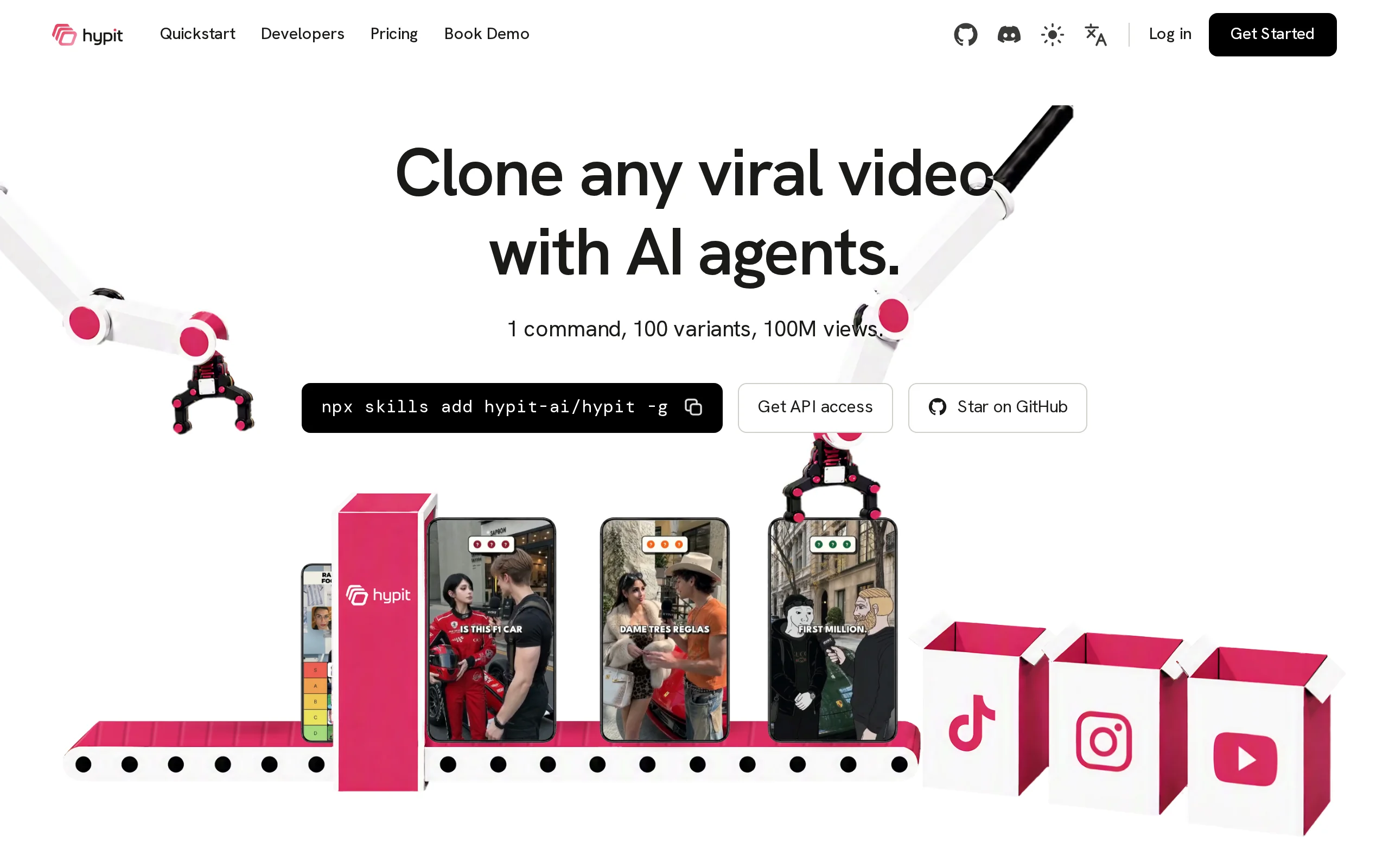
Hypit – Open-Source AI Video Generation Tool, Automatically Replicates Viral Videos
Hypit is an open-source AI video generation tool, centered on the methodology of "Provide an Agent with a viral video, and it will automatically replicate the entire workflow." It breaks down viral vi...
© All Rights Reserved. Some content on this site is partially generated by AI with human review.