
Pixal3D – Tencent & Tsinghua Open Single-Image 3D Generation
Executive Summary:
Pixal3D is a single-image 3D generation project from Tencent ARC Lab, Tsinghua University, and Victoria University of Wellington. Via a back-projection mechanism, it lifts 2D pixel features explicitly...
1. What Is Pixal3D
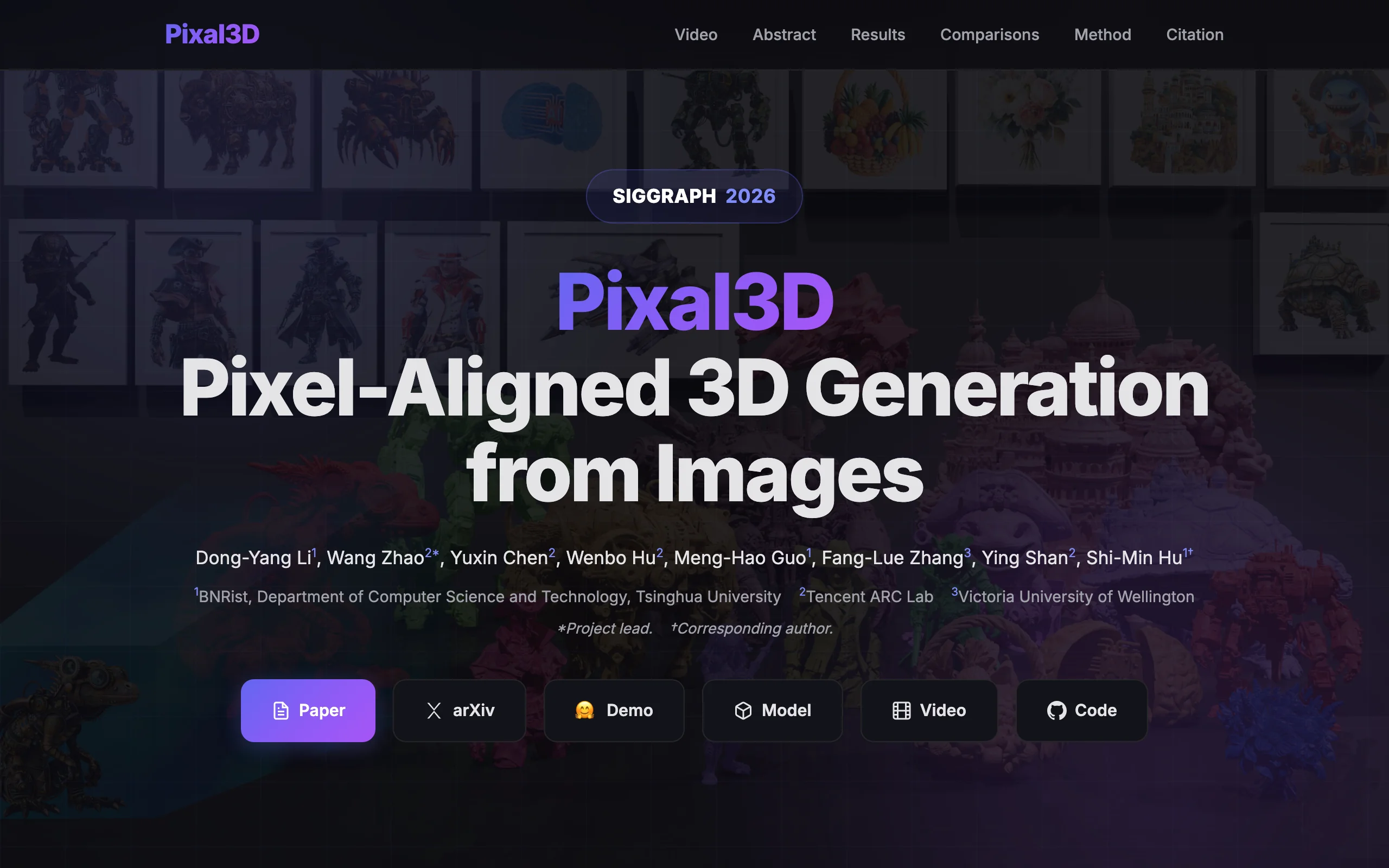
Pixal3D is a single-image 3D generation project from Tencent ARC Lab, Tsinghua University, and Victoria University of Wellington. Via a back-projection mechanism, it lifts 2D pixel features explicitly into 3D space, building direct pixel-to-3D correspondences that break the geometry and texture consistency limits of classic single-view methods. Output approaches multi-view reconstruction quality: fine meshes plus PBR-ready texture maps (albedo, roughness, metallic, etc.) for games, film, and digital content. The paper was accepted to SIGGRAPH 2026, reflecting rigorous peer validation.
Image source: Official article
Technical positioning and domain: Pixal3D sits at the intersection of computer vision and graphics—single-image 3D reconstruction/generation. Unlike implicit neural fields or multi-view diffusion alone, it uses explicit pixel-to-3D mapping to reach near multi-view quality from one photo, bridging casual single-view generation and professional reconstruction for games, film, e-commerce, and industrial design.
Development background: Tencent ARC has deep generative and 3D vision experience. With Tsinghua and Victoria University of Wellington, the team targeted long-standing "blurry detail" and "geometric distortion" in single-view pipelines caused by implicit feature compression. Back-projection preserves input information by design.
Core value: Pixal3D addresses insufficient fidelity in single-image 3D. Older methods yield vague silhouettes and missing texture unsuitable for production. Pixal3D reaches "reconstruction-grade" output—one photo can produce PBR assets importable into Unity or Unreal, slashing time and labor. Explicit correspondences keep results aligned with the source image, reducing style drift and dropped detail.
Technical characteristics: Three pillars: (1) back-projection feature lifting with per-pixel 3D correspondence; (2) explicit pixel–3D framework avoiding distill losses; (3) joint geometry + PBR optimization for one-pass, production-ready assets.
2. Key Features
Single image to high-fidelity 3D: One RGB photo yields detailed geometry and PBR textures—compressing hours or days of modeling into minutes for game assets and e-commerce 3D views.
Pixel-level 3D correspondence: Back-projection maps each 2D pixel to 3D surface points, preserving local texture, edges, and fine structure from the input.
PBR material generation: Simultaneous albedo, roughness, metallic, and related maps compatible with Blender, Unity, and other PBR pipelines—no manual material pass required.
Reconstruction-grade fidelity: Geometry and texture consistency approach multi-view reconstruction baselines, among the few single-view approaches viable for professional content.
Multi-scale feature fusion: Multi-resolution 2D features are lifted through a back-projection conditioner into a 3D feature volume, covering global shape and micro texture.
Sparse latent representation and VAE decode: Sparse SDF volumes as latents reduce compute; a VAE decoder reconstructs high-fidelity meshes balancing speed and quality.
Industry-standard export: OBJ, FBX, and related formats for Blender, Maya, Unity, and Unreal with lower integration friction.
3. How to Use
Environment: CUDA NVIDIA GPU (RTX 3090+ recommended), Linux (Ubuntu 20.04+) or Windows 10/11, PyTorch 2.0+, plus dependencies such as diffusers, transformers, and trimesh.
Online demo: Fastest path—HuggingFace Spaces (https://huggingface.co/spaces/TencentARC/Pixal3D). Upload a clear foreground subject; inference returns an interactive 3D preview in minutes.
Local setup: Clone https://github.com/TencentARC/Pixal3D,
pip install -r requirements.txt, ensuring sparse SDF and back-projection ops are supported.Download weights: From https://huggingface.co/TencentARC/Pixal3D into the project weights folder; use
git lfsfor large files.Run inference: Use a clean-background, unobstructed RGB input:
python inference.py --input_path /path/to/input.jpg --output_path /path/to/outputTypical runtime: 3–8 minutes depending on GPU.
Decode assets: VAE decodes sparse latents to mesh plus PBR PNG maps (albedo, roughness, metallic, etc.) in OBJ/PLY plus textures.
Import to DCC/engine: Load into Blender, Unity, or Unreal; verify UVs and tweak alignment if needed.
4. Pros and Cons
| Pros |
|---|
| Reconstruction-grade fidelity: Near multi-view quality; strong geometry and texture vs. single-view baselines. |
| Explicit pixel mapping: Back-projection limits compression loss; output stays faithful to the photo. |
| Native PBR output: Production-ready physical shading maps in one pass. |
| Top-tier academic validation: SIGGRAPH 2026 acceptance signals rigorous review. |
| Open source (Apache 2.0): Free for commercial and research use. |
5. Comparison with Similar Tools
| Dimension | Pixal3D | Tripo3D | CSM |
|---|---|---|---|
| Approach | Back-projection, explicit pixel–3D | Multi-view diffusion + sparse recon | General neural recon from one image |
| Fidelity | Reconstruction-grade + PBR | High fidelity, multi-style | Medium, speed-focused |
| Materials | Native PBR (albedo, roughness, metallic) | PBR with extra polish often needed | Mostly base color |
| Correspondence | Explicit pixel–3D | Implicit matching | Implicit neural |
| Speed (RTX 3090) | 3–8 min | 1–3 min | 30 s–2 min |
| Academic pedigree | SIGGRAPH 2026 | Product iteration | Research project |
| Best fit | Pro content, games, film | Fast prototypes, AIGC | Concept demos, education |
Selection guidance: For maximum fidelity and direct pipeline use (games/film), Pixal3D leads on precision and PBR. For speed and iteration, Tripo3D balances quality and latency. For low-stakes previews, CSM or Zero-1-to-3 may suffice. Pixal3D is hard to replace in pro workflows; Tripo3D wins on efficiency.
6. Editor's Take
Pixal3D is a meaningful step in single-image 3D. Back-projection and explicit pixel–3D ties attack information loss from implicit compression—the first time single-view output credibly nears multi-view reconstruction on geometry and texture. SIGGRAPH 2026 acceptance plus joint PBR optimization sets a new quality bar.
Commercially, it hits the efficiency-vs-quality pain in asset pipelines: concept to engine-ready model in minutes with importable materials. Indie studios and small teams benefit most. Speed-focused AIGC users may still prefer Tripo3D for rapid loops.
Best for: 3D artists, game devs, VFX, and creators needing high-fidelity assets from photos.
Future: Faster inference, multi-view inputs, and robustness to messy backgrounds would unlock interactive design tools. At 4.5/5 today with clear upside.
Rationale: Strong innovation (back-projection), leading output (reconstruction-grade + PBR), high utility, open license. Minus points for hardware, latency, and background sensitivity—still among the best single-image options for pro use.
7. Use Cases
Game asset production: Turn concept art or reference photos into Unity/Unreal-ready characters and props—especially valuable for indies and small teams.
Film and digital content: Rapid high-fidelity props and character bases for previz and layout from photos or concept art.
E-commerce 3D: Product photos to rotatable 3D viewers—better detail inspection and potentially lower returns.
Industrial design preview: Photo-to-prototype for reviews, client demos, and fast mechanical iteration.
Cultural heritage digitization: Museum-quality 3D from artifact photos for exhibitions, VR, and archival records.
Education: Turn teaching images into rotatable 3D models for interactive STEM content.
8. FAQ
Q: Which input formats are supported?
A: JPEG, PNG, and BMP RGB images. Prefer ≥512×512, clear foreground, simple background, minimal occlusion and exposure issues for best results.
Q: Can outputs go directly into game engines?
A: Yes. OBJ/PLY meshes and PBR maps (albedo, roughness, metallic) import into Unity, Unreal, and Blender. Verify UVs and material channels after import.
Q: How long does inference take?
A: On RTX 3090, ~3–8 minutes at 512×512. RTX 3060 class hardware may take 10–15 minutes. Higher-end GPUs improve experience materially.
Q: Can it handle complex backgrounds or crowds?
A: Poorly. Clutter and multiple subjects disrupt pixel-to-3D mapping. Use clean, single-subject photos.
Q: Is custom training supported?
A: Official weights are provided; full training scripts are not yet published. Advanced users can follow the paper and repo structure to implement training; guides may arrive later.
Q: Animation or rigging?
A: Static meshes only—no skeletons or animation data. Rig in Blender/Maya like other single-view tools.
Q: Commercial use?
A: Yes under Apache 2.0—use, modify, and distribute with standard attribution and disclaimer requirements.
9. Project Links
- Project page: https://ldyang694.github.io/projects/pixal3d/
- GitHub: https://github.com/TencentARC/Pixal3D
- HuggingFace model: https://huggingface.co/TencentARC/Pixal3D
- arXiv paper: https://arxiv.org/pdf/2605.10922
- Online demo: https://huggingface.co/spaces/TencentARC/Pixal3D
Related AI Model Articles
Hy Image3.5 preview – A High-Value Professional-Level Image Generation Model from Tencent HunYuan
Hy Image3.5 preview is a high-value professional-level image generation model launched by Tencent HunYuan, designed to address the complex needs of high-quality image generation, precise text renderin...
Qwen-Image-2.1 Review: How a 7B Lightweight Open-Source Model Balances Text-to-Image Generation, Image Editing, and Native Transparency Channels
Qwen-Image-2.1 is a new generation of open-source image generation model developed by the Qwen team at Alibaba. Despite having only 7B parameters in its visual generation component, it achieved a comp...

AuK – Tencent HunYuan's Open-Source Foundation Model for Speech Generation and Editing
AuK is an open-source foundation model for speech generation and editing developed by the Tencent HunYuan team, featuring 1.5 billion parameters and utilizing a flow-matching diffusion architecture in...
LLaDA-Image – A Unified Image Generation and Editing Model Open-Sourced by Ant Group
LLaDA-Image is a 6B parameter unified image generation and editing model open-sourced by the inclusionAI Lab at Ant Group. This model adopts an innovative training approach, first pre-training purely ...
© All Rights Reserved. Some content on this site is partially generated by AI with human review.