
LingBot-World 2.0 – Ant Group's Robbyant Opens Source Real-Time Interactive World Model

Executive Summary:
LingBot-World 2.0 is a real-time interactive world model open-sourced by Robbyant, a research team under Ant Group. Its core breakthrough lies in advancing video generation from a "one-way viewing" pa...
1. What is LingBot-World 2.0
LingBot-World 2.0 is a real-time interactive world model open-sourced by Robbyant, a research team under Ant Group. Its core breakthrough lies in advancing video generation from a "one-way viewing" paradigm to a "real-time gameplay" interactive model. The model supports a variety of character operations, including movement, attack, casting spells, and jumping, and can respond to environment events driven by text, such as rain or snow. It can achieve real-time visual output at 720P/60FPS and sub-second interaction latency on high-end hardware. Additionally, the model has the capability of continuous generation for hours without drift, maintaining long-term consistency. Four versions have been open-sourced: 14B, 1.3B Small, Bidirectional, and Causal Pretrain, providing an open technical foundation for game development, embodied intelligence simulation, and interactive data generation.
Image source: Official article
Image source: official article
Technical Positioning and Domain: Belongs to the intersection of generative AI and interactive world models, integrating video generation, reinforcement learning, real-time rendering, and Agent systems, and redefining the interaction boundaries of AI-generated content.
Development Background: Developed by the Robbyant team at Ant Group. Robbyant focuses on embodied intelligence and next-generation human-computer interaction, with deep expertise in robotics, the metaverse, and AIGC. The motivation for its development stems from the limitations of traditional video generation models, which are one-way outputs and lack interactivity, aiming to build a real-time world simulator that is "both generative and playable."
Core Value: Addresses three major industry pain points: traditional video generation being "viewable but not playable," long-term generation drift, and excessively high interaction latency. It is the first to combine causal pre-training, real-time distillation, and a dual-Agent architecture, achieving a generative game engine that is real-time controllable, capable of long-term evolution, and supports multi-player collaboration, providing a practical technical path for AI-native content production and embodied intelligence training.
Technical Features: Introduces a causal pre-training paradigm to support unlimited interaction duration; utilizes the Bidirectional model to distill a real-time variant that drives 720P/60FPS video streams; employs a dual-Agent architecture with Pilot Agent and Director Agent to enable dynamic world generation through both user intervention and Agent-driven processes.
2. Key Features
Real-time Interactive Exploration: The model generates open-world scenes with free movement and perspective changes in real-time at 720P/60FPS with sub-second latency. This is its core capability that distinguishes it from traditional video generation models. User operation commands can be reflected in visual changes within approximately 0.5 seconds, offering an experience close to that of a native game engine.
Diverse Character Action Control: Supports a wide range of actions including attacking, archery, casting spells, shooting, jumping, and gliding. The model learns the conditional mapping between "actions and visuals" through action-conditioned visual dynamics, drawing from first-person perspectives, synthesized content, and vast amounts of online video content, ensuring that different actions result in accurate and corresponding visual changes.
Environment Event-Driven: Can respond to dynamic world events triggered by text instructions such as "snowing" or "raining." During gameplay, users can trigger global environmental changes through natural language, and the model is capable of converting textual semantics into coherent visual effects while maintaining consistency in subsequent storylines.
Hour-Long Continuous Generation: Achieves unlimited interactive duration through the Causal Pretrain paradigm, ensuring visual consistency during prolonged gameplay without drift or breakdown. This represents a technical challenge that traditional video diffusion models have struggled to overcome, marking a significant milestone in the practical application of generative world models.
Dual Intelligent Agent Collaboration: Introduces the Agentic Harness — the Pilot Agent is responsible for planning and executing character behaviors, while the Director Agent dynamically synthesizes new environmental elements as the scene progresses. Both agents operate in parallel, ensuring responsive character control while enabling continuous expansion of open-world content, achieving a seamless integration of agent-driven processes and user intervention.
Multi-user Shared World: Supports multiple users immersing simultaneously in the same generated world. One user acts as the player controlling the character, while another serves as the director orchestrating the scene, collaboratively shaping a dynamic world. This feature overturns the traditional single-player generation model, opening up a new dimension for collective creative collaboration.
Embodied Intelligence Simulation: Extends from the game world to robot simulation, future state prediction, and interactive data generation. The generated interactive video data can provide a near-realistic training environment for robot strategy learning, reducing the cost of trial and error on physical robots.
Lightweight Local Deployment: The 1.3B Small version can run in real-time on a consumer-grade single-GPU card, eliminating the need for high-end server clusters. Individual developers can also reproduce the core interactive experience locally, significantly lowering the barriers to research and development.
3. How to Use
Environment Requirements and Hardware Configuration: It is recommended to use an NVIDIA RTX 4090 or higher-performance GPU for smooth operation of the 14B version; the 1.3B Small version can achieve real-time inference on consumer-grade GPUs such as the RTX 3090. The operating system supports Linux (Ubuntu 20.04 and above) and Windows 10/11. Ensure that the CUDA version is no lower than 12.0, and the Python environment is 3.10 or higher.
Model Weight Acquisition: Download the corresponding version weights from the Hugging Face repository or the GitHub Releases page. Currently, four versions are available: 14B Causal Fast, 1.3B Small, Bidirectional, and Causal Pretrain. It is recommended that new users prioritize the 1.3B Small version for environment verification and experience testing.
Environment Setup and Dependency Installation: After cloning the GitHub repository, install the required packages using
pip install -r requirements.txt. The project depends on PyTorch 2.x, the Hugging Face Transformers library, and the Accelerate acceleration library. It is advisable to use a virtual environment to manage dependencies and avoid version conflicts.Starting the Inference Service: Run
python demo.py --model_path [weight path] --resolution 720p --fps 60to launch the real-time interactive demo. The first run will load the model weights and initialize the inference engine, which takes approximately 1–3 minutes. Upon successful startup, you will enter the interactive interface, where you can use the keyboard (WASD for movement, spacebar for jumping) and mouse (for view rotation) to operate.Core Parameter Configuration: You can adjust parameters such as generation resolution (supporting 480P/720P), frame rate (24/30/60FPS), interaction latency priority, and console log level via the config.yaml file. During team development, you can enable the multi-user collaboration mode by setting
multi_user=Trueand specifying theserver_ipparameter.Fine-tuning and Secondary Development: Developers can fine-tune the model using their own data based on the existing weights. The project provides training scripts and dataset formatting guidelines, supporting efficient fine-tuning methods such as LoRA. This allows the model to be adapted to specific gaming styles or vertical business scenarios.
4. Pros and Cons Analysis
| Pros |
|---|
| Hour-level long-term consistency: The causal pre-training paradigm enables interaction durations without upper limits, ensuring that the visual experience remains stable and does not drift or break down during extended gameplay, surpassing the approximately 1-minute consistency limit of traditional video models. |
| Real-time interactive experience: The distilled real-time variant supports 720P/60FPS output with sub-second latency, achieving an interactive quality that is "playable," representing a significant improvement in smoothness compared to Genie 3's 24fps. |
| Fully open-source and open: The code and four weight versions (14B/1.3B) are fully open-sourced, accompanied by a technical report, and support both academic and commercial use. Compared to Google Genie 3, which only offers a black-box solution through Gemini Ultra subscriptions, this model has a greater openness advantage. |
| Dual Agent architecture innovation: The collaboration between the Pilot Agent and Director Agent enables parallel user intervention and dynamic world generation, providing a new system design paradigm for generative world models. |
5. Comparative Analysis with Similar Tools
| Dimension | LingBot-World 2.0 | Genie 3 (Google DeepMind) |
|---|---|---|
| Developer | Robbyant (Lingbo Technology, Ant Group) | Google DeepMind |
| Core Architecture | Causal pre-training + real-time distillation + dual Agent (Pilot/Director) | Autoregressive diffusion model + scalable latent space (1.5T parameters) |
| Real-time Specifications | 720P/60FPS, sub-second control latency | 720P/24FPS, real-time response |
| Consistency Duration | Continuous generation for hours without drift | Approximately 1 minute of visual consistency |
| Interaction Methods | Action control + text events + multi-user collaboration (players/directors) | Keyboard/mouse control for movement and object generation via commands |
| Multi-user Collaboration | Supports multi-user shared generation world | Not currently supported |
| Openness | Fully open-source: code + four weight versions + technical report | Closed-source, available only via Gemini Ultra subscription |
| Scenario Focus | Games, embodied intelligence, digital cultural tourism, education and training | General game prototype generation and creative exploration |
Selection Recommendations: If the goal is to build an interactive generative game or develop AI-native products, LingBot-World 2.0 is the preferred choice due to its full open-source nature, strong interaction capabilities, and support for multi-user collaboration. If high-scale parameters and integration with the Google ecosystem are required, Genie 3 can be considered for exploration, although its closed-source nature limits deep customization. For embodied intelligence and robotics simulation experiments, NVIDIA Cosmos offers greater advantages in terms of physical accuracy and industry ecosystem, though its real-time interactivity is not its strong suit. Overall, LingBot-World 2.0 currently stands out with a notable comprehensive competitive edge in balancing openness and interactive experience.
6. Editor's Summary
LingBot-World 2.0 occupies a unique position in the development sequence of generative AI. From the perspective of technological innovation, the introduction of its causal pre-training paradigm directly addresses the long-standing issue of long-term generation drift in the industry, transforming the concept of "hour-level interaction" from a theoretical slogan into a deliverable capability. The dual Agent architecture (Pilot + Director) represents a forward-thinking system design approach—generative world models should not merely be passive renderers, but should possess autonomous capabilities for active planning and dynamic synthesis. Furthermore, through real-time distillation strategies, the model successfully adapts to consumer-grade GPUs while maintaining its effectiveness, showcasing deep engineering expertise in practical implementation.
In terms of practical value, this model provides a one-stop solution for scenarios such as game development, film pre-visualization, embodied AI training, and virtual space construction. For small teams, the 1.3B lightweight version combined with open-source weights significantly reduces the cost barrier, enabling a personal developer with basic hardware to launch a "playable world." For research institutions, the open-sourced architectural data of the model offers a reproducible foundation for academic exploration in the field of world models.
In terms of target users, generative game entrepreneurs, AI content platform developers, robotics simulation research teams, digital cultural tourism technology providers, and independent developers interested in AIGC frontiers can all benefit from this model. Although its ecosystem and toolchain maturity still lags behind traditional engines like Unreal, the direction of integrating generative models with interactive logic itself holds significant potential for imagination. In the future, with increased investment in content editing tools, complex narrative control, and community ecosystem development, LingBot-World 2.0 has the potential to evolve from an impressive technical project into a widely adopted AI interactive content creation platform.
7. Application Scenarios
AI Game Development: As a real-time generative game engine, dynamically generate levels, scenes, and events based on player actions. Developers can directly call APIs to build character control and environmental response logic, significantly reducing the production cycle and cost of AAA-level content, while also enabling small teams to create open worlds.
Film and Virtual Production Previsualization: Directors can build and navigate virtual scenes in real-time using text commands, quickly previewing shots and atmospheres and making real-time adjustments. Compared to the lengthy modeling and rendering processes required in traditional CG previsualization, LingBot-World 2.0 can complete scene choreography, camera testing, and lighting validation within an interactive environment, greatly shortening the pre-production set-up and revision cycles.
Embodied Intelligence Training Ground: Provides a high-fidelity, interactive simulation environment for robots to train perception, decision-making, and long-term interaction capabilities. The generated "action-result" pairs within the simulation environment can serve as reinforcement learning data, reducing the trial-and-error costs of real robots while enhancing the generalization of strategies in complex dynamic scenarios.
VR/AR and Digital Culture & Tourism: Generates immersive virtual spaces that can be infinitely explored, applicable to virtual exhibitions, cultural tourism guides, and collaborative metaverse experiences. Leveraging the multi-user shared world feature, it is possible to develop guided tour modes, allowing users to explore a virtual scene as a team, injecting new experiences into the digitalization of cultural and tourism sectors.
Interactive Education and Training: Creates operable virtual experiments, emergency drills, and historical scenarios. Learners receive immediate feedback through interaction within a "playable world," offering a more immersive and in-depth training experience than simply watching videos. It can be applied to teaching modules such as safety management training, historical scenario recreation, and scientific experiment simulations.
8. FAQ
Q: What level of real-time interaction latency can LingBot-World 2.0 achieve?
A: In supported environments (such as RTX 4090), the model can achieve sub-second control latency of approximately 500 milliseconds, with a frame rate of up to 720P/60FPS. Latency is influenced by multiple factors, including model version, GPU computing power, and network transmission. In practical use, the 1.3B Small version has lower latency, while the 14B version excels in handling complex visual scenes.
Q: What are the main differences in capabilities between the 1.3B Small version and the 14B version?
A: The 1.3B Small version focuses on real-time performance and lightweight deployment, offering faster interaction responses and lower memory usage, but it is less capable in terms of scene complexity, detail richness, and stability during long-term generation compared to the 14B version. The 1.3B version is suitable for real-time experiences and technical validation, while the 14B version is better suited for applications requiring higher visual quality and world complexity.
Q: Does the model support custom environmental events or the integration of custom world elements?
A: Yes. Users can trigger predefined events such as rain, snow, and day-night transitions through text commands. Additionally, the architecture allows for the integration of a Director Agent to expand the event library. For teams with development capabilities, custom environmental elements can be added by editing event definition files or fine-tuning the model.
Q: Can the model run without a GPU?
A: No. The model's inference relies on a CUDA GPU environment. Pure CPU operation cannot support real-time interactive generation, and even the 1.3B version struggles to achieve a smooth frame rate on CPU-only systems. It is recommended to use at least an RTX 3090-level GPU to achieve a basic experience.
Q: What are the requirements and usage methods for the multi-player collaboration mode?
A: Multi-player collaboration mode requires deploying the model as a server, with players and directors connecting via local network or the internet. It supports one person acting as a player to control the character, and another person acting as a director to manage scene elements. The official documentation provides a guide for server-side parameter configuration, requiring each client to install the corresponding client application and maintain low local network latency.
9. Project Links
- Product Website: https://technology.robbyant.com/lingbot-world-v2
- GitHub Repository: https://github.com/robbyant/lingbot-world-v2
- Hugging Face Model Library: https://huggingface.co/robbyant/lingbot-world-v2-14b-causal-fast
- arXiv Technical Paper: https://arxiv.org/pdf/2607.07534
Related AI Model Articles

Kimu: In-Depth Review of the Open-Source AI Video Editor from the trykimu Team
Kimu (officially named Kimu Studio) is an open-source AI video editor developed by the trykimu team. Its core concept lies in describing requirements through natural language, allowing AI to automatic...

Qwen-Audio-3.1: A Full-Stack Evaluation of the Qwen Audio Large Model Series
Qwen-Audio-3.1 is a series of large audio models launched by Alibaba's Qwen. It consists of five models: ASR speech recognition, ASR-Next audio understanding, TTS speech synthesis, TTS-Next audio crea...

Qwen3.8-LiveTranslate – A Real-Time Simultaneous Interpretation Model Launched by Alibaba Tongyi
Qwen3.8-LiveTranslate is a real-time simultaneous interpretation large model launched by the Tongyi Qianwen team at Alibaba. Based on the Interleave single-stream architecture, it processes audio and ...
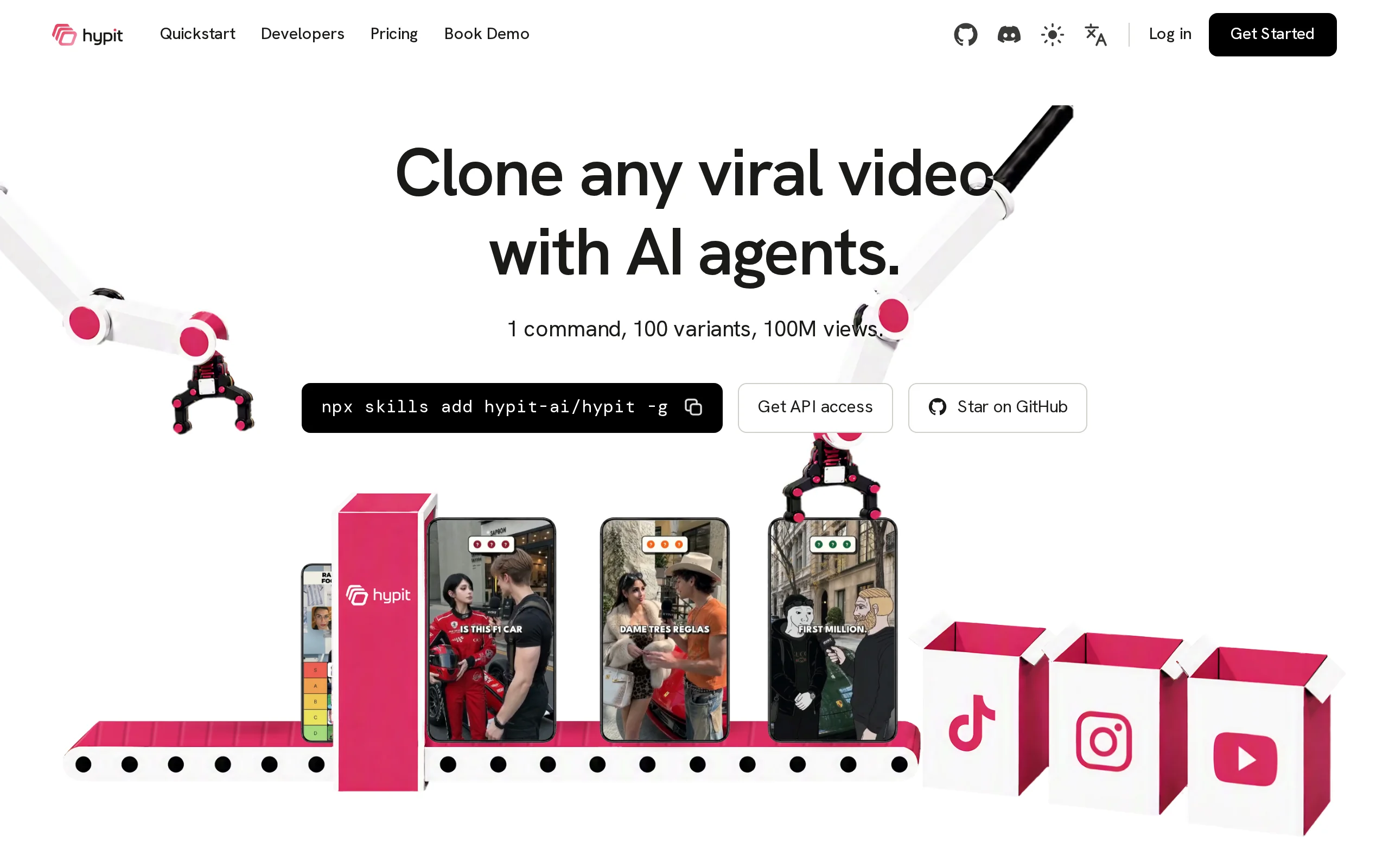
Hypit – Open-Source AI Video Generation Tool, Automatically Replicates Viral Videos
Hypit is an open-source AI video generation tool, centered on the methodology of "Provide an Agent with a viral video, and it will automatically replicate the entire workflow." It breaks down viral vi...
© All Rights Reserved. Some content on this site is partially generated by AI with human review.