
Claude Mythos 5.1: Anthropic's Flagship Model with Controlled Access for High-Risk Research Fields
Executive Summary:
Claude Mythos 5.1 is the flagship model of the Claude 5.1 series launched by Anthropic. It shares the exact same underlying model weights and inference capabilities with the publicly available Claude ...
1. What is Claude Mythos 5.1
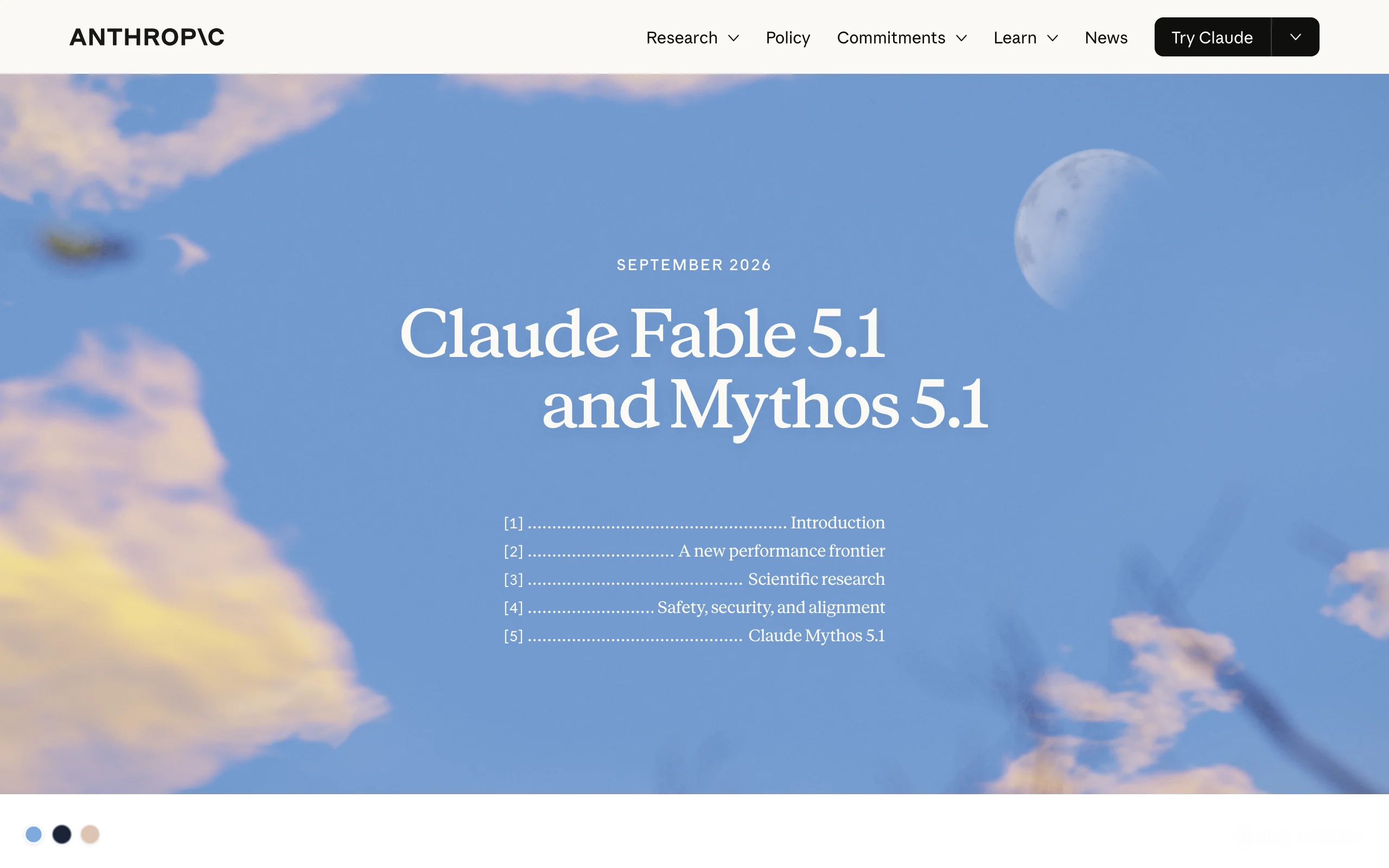
Claude Mythos 5.1 is the flagship model of the Claude 5.1 series launched by Anthropic. It shares the exact same underlying model weights and inference capabilities with the publicly available Claude Fable 5.1 in the same series, with differentiation only achieved through upper-level safety fencing strategies. This model is specifically designed for two high-risk professional domains: cybersecurity and life sciences, and is only open to research institutions that have passed background checks. It supports cutting-edge research such as vulnerability defense and protein molecular design, and users must apply for access through the Cyber Verification Program or the Life Sciences Verification Program.
Image source: Official article
Technical Positioning and Domain: Belongs to the intersection of natural language processing and AI Agent fields, positioned as a controlled-access large language model for professional research scenarios. Unlike general-purpose models, Mythos 5.1 focuses its capabilities on defensive cybersecurity and computational biology. Through a review mechanism, it ensures that high-risk capabilities are only deployed within compliant institutions, and it plays a supporting role for professional research within Anthropic's product portfolio.
Development Background: Developed by Anthropic, based on its technical expertise in AI safety alignment. Anthropic has split the same model weights into two product forms: Fable and Mythos. The former is open to the public, while the latter is available only to verified institutions, reflecting its design philosophy of balancing "capability release" with "risk control."
Core Value: Addresses the contradiction in high-risk research fields between the insufficient domain-specific capabilities of general-purpose models and the difficulty of ensuring safety and controllability. In protein design tasks, it has been experimentally validated to achieve a hit rate close to 50%, which is 3–5 times higher than the industry standard. In genomics tasks, it has achieved a maximum inference speed improvement of 2.5 times through GPU core optimization, reducing research costs by 30–60%, thereby providing a practical AI support solution for high-barrier research scenarios.
Technical Features: Uses a twin-origin architecture, sharing weights with Fable 5.1 but employing different safety fencing strategies; achieves controlled access through the dual verification systems of CVP and LSVP; possesses the ability to autonomously write code, call open-source scientific tools, and execute long-term tasks, enabling the completion of a full research cycle—from experimental design to result analysis—within a controlled environment.
2. Key Features
Protein Molecule Design: Leverages open-source protein design and folding tools to create high-affinity binding proteins for specific targets. Experimentally validated success rate approaches 50%, 3–5 times higher than industry benchmarks, significantly accelerating early-stage drug discovery and antibody engineering processes.
Computational Biology Acceleration: Custom-written GPU kernels and caching of intermediate computation results boost the inference speed of seven open-source genomic deep learning models, such as Enformer and ProGen2, by up to 2.5 times. Whole-genome analysis costs are reduced by 30–60%, effectively alleviating computational bottlenecks in computational biology research.
Defensive Cybersecurity Research: Open to institutions that pass the Cyber Verification Program review, it supports codebase vulnerability scanning, defensive penetration testing, and security remediation recommendations. The model explicitly prohibits the development of exploit tools, maintaining clear security boundaries and suitable for building protective capabilities in critical infrastructure.
Long-term Scientific Experiment Management: Capable of running continuously for tens of hours to perform complex scientific tasks, including autonomously designing experimental protocols, identifying and correcting data labeling errors, initiating multiple experimental groups in parallel, and organizing results. It exhibits near-autonomous research assistant capabilities in task execution.
Scientific Data Reconstruction and Modeling: Trains neural networks using historical observational data (e.g., NASA radar imagery) to generate high-resolution scientific maps or models, providing a basis for target selection in deep space exploration missions and expanding the model's application scope in scientific data processing.
Autonomous Code Generation and Tool Calling: The model can autonomously write code, call external scientific tools, and execute computational tasks, achieving full workflow automation from problem definition to result output in a controlled environment, thereby reducing repetitive engineering tasks for researchers.
Controlled Scientific Capability Deployment: Within a dynamic security fencing framework, it provides life sciences and cybersecurity professionals with research capabilities beyond those of public model versions, while maintaining core alignment capabilities, balancing professional efficiency with security constraints.
3. How to Use
Apply for Trusted Access Program: Users must submit an application for review through Anthropic's Cyber Verification Program (Cybersecurity Track) or Life Sciences Verification Program (Life Sciences Track). This program is only open to professional organizations that have passed background checks; individual developers cannot apply directly.
Meet Eligibility Requirements: Currently, priority is given to cybersecurity defense organizations and life science researchers within the United States. International users must wait for the expansion plan after coordination between Anthropic and the U.S. government, and will not be able to access the model in the short term.
Use Claude Security Product: Organizations that have passed the review can directly use the Claude Security service integrated with Mythos 5.1 to scan their code repositories and receive remediation recommendations. This product packages the model's capabilities into a security service, reducing the barriers for enterprise access.
Wait for Review Results: After submitting an application, users must wait for a joint eligibility review by Anthropic and its partners. Once approved, they will gain access to the model. Unlike the public version of Fable 5.1, Mythos 5.1 cannot be accessed directly via API or subscription; the entire process is centered around compliance review as a prerequisite.
Notes: Applying organizations must have clear proof of research qualifications and security governance capabilities; during usage, they must comply with Anthropic's security policies, and must not use the model's capabilities for vulnerability exploitation development or research on biosafety risks; it is recommended that organizations establish internal oversight mechanisms for model usage to ensure that outputs comply with ethical standards.
4. Pros and Cons Analysis
| Pros |
|---|
| Native Dual-Architecture: Shares identical model weights and inference capabilities with Fable 5.1, ensuring a high professional capability ceiling while achieving risk-tiered control through differentiated safety barriers, showcasing innovative architectural design. |
| Outstanding Protein Design Capability: Experimental validation hit rate is close to 50%, 3–5 times higher than industry benchmarks, providing quantifiable performance advantages in high-affinity binding protein design tasks. |
| Substantial Optimization in Computational Biology: Through GPU kernel customization and intermediate result caching, genomic model inference speed is increased by up to 2.5 times, reducing research costs by 30–60%, offering tangible economic value. |
| Robust Security Mechanisms: Dynamic safety barriers maintain core alignment capabilities while unleashing professional capabilities, explicitly prohibiting the development of exploit tools, with a clear and actionable security boundary design. |
5. Comparative Analysis with Similar Tools
| Comparison Dimension | Claude Mythos 5.1 | OpenAI GPT-Rosalind |
|---|---|---|
| Company Affiliation | Anthropic | OpenAI |
| Model Positioning | Flagship model for controlled access in cybersecurity and life sciences | Dedicated model for trusted access in life sciences (drug discovery, genomics, wet lab experiments) |
| Coverage Areas | Dual-track coverage in cybersecurity (CVP) and life sciences (LSVP) | Focused on life sciences (drug discovery, genomics, wet lab experiments) |
| Access Method | Requires government-level CVP/LSVP approval, primarily available to U.S. institutions | Open to qualified global research institutions via trusted-access deployment, requiring proof of public interest and safety governance |
| Core Capabilities | Protein design, GPU kernel optimization, defensive vulnerability research, long-term autonomous research | Drug discovery, NGS analysis, bioinformatics workflows, Codex plugin for reproducible experiments |
| Plugins/Tools | Calls open-source protein design/folding tools and self-developed code | Built-in Life Sciences Research and NGS Analysis plugins, with support for sequence/structure visualization viewers |
| Security Policies | Shares the same origin as Fable 5.1, with differentiated security fences and anti-distillation mechanisms | Enterprise-level security + controlled access, requiring governance and safety supervision capabilities |
Selection Recommendations: For research institutions involved in both cybersecurity and life sciences, Claude Mythos 5.1 offers a more comprehensive dual-track coverage capability, making it particularly suitable for integrated laboratories requiring cross-support between defensive vulnerability research and protein design. Its shared architecture with Fable 5.1 also allows institutions to manage both public and controlled scenarios under a unified technical foundation.
For research teams focused on drug discovery and genomic analysis, OpenAI GPT-Rosalind's built-in specialized plugins (such as NGS Analysis and sequence visualization viewers) provide a more out-of-the-box experience. Its open access policy for global research institutions also offers better accessibility compared to Mythos 5.1's U.S.-centric approach. If the institution does not engage in high-risk research, Claude Fable 5.1 can serve as a general-purpose research assistance tool, covering routine tasks such as literature analysis and experimental plan writing, without the need for approval.
6. Editor's Summary
Claude Mythos 5.1 represents an important practice by Anthropic in balancing the release of capabilities with risk management. From a technical architecture perspective, the dual-origin design allows the same set of model weights to differentiate into two product forms—public and professional—through the use of safety fencing strategies. This approach not only avoids the resource waste of redundant training but also enables tiered risk control, offering a reference model for the industry. The model's near 50% experimental validation hit rate in protein design tasks, as well as the data showing a maximum 2.5x increase in genomic model inference speed through GPU kernel optimization, both indicate that its performance in professional domains is not just a marketing concept, but a quantitatively verified actual capability.
In terms of practical value, while Mythos 5.1's controlled access mechanism may slow down its adoption rate, this restraint ensures that high-risk capabilities are not misused. For cybersecurity defense agencies and life science researchers, this model provides research support capabilities that surpass those of its public version, especially demonstrating near-assistant-level execution capabilities in long-term autonomous research tasks. Its value is not only reflected in the efficiency of individual tasks, but also in its ability to free researchers from repetitive engineering work, allowing them to focus on the scientific problems themselves.
The target audience is clearly defined: U.S. cybersecurity agencies that have passed review, life science laboratories, and government-related research departments. For these organizations, Mythos 5.1 is currently one of the few models that can provide in-depth professional capabilities within a controlled and compliant framework. In the future, as Anthropic's expanded coordination plan with the U.S. government takes shape, the inclusion of international research institutions will further enhance the model's global influence. Meanwhile, the reuse of the dynamic safety fencing mechanism across more professional domains may also give rise to new controlled model forms, which are worth ongoing attention from the industry.
7. Application Scenarios
Protein Molecule Design and Drug Development: Researchers use open-source protein design tools to design high-affinity binding proteins for specific targets. Experimental validation hit rates can reach 3–5 times the industry standard, significantly shortening the early drug discovery cycle and reducing trial-and-error costs during the antibody engineering and target validation phases.
Defensive Cybersecurity Research: Open to review organizations through the Cyber Verification Program, it supports code repository vulnerability scanning, defensive penetration testing, and vulnerability remediation recommendations. Security teams can leverage the model to perform systematic security assessments on source code of critical infrastructure, improving the efficiency of vulnerability detection and the quality of fixes.
Genomics and Computational Biology: Custom GPU kernels are written to optimize open-source genomic deep learning models (such as Enformer, ProGen2), reducing the cost of whole-genome analysis by 30–60% and accelerating research tasks such as variant detection, functional prediction, and disease association analysis.
Long-term Scientific Experiment Management: The model can run continuously for tens of hours to perform complex scientific tasks, including autonomously designing experimental protocols, identifying and correcting data labeling errors, initiating multiple experimental groups in parallel, and organizing results. It is suitable for scientific workflows requiring long periods of unattended operation.
Scientific Data Reconstruction and Modeling: Neural networks are trained based on historical observational data (such as NASA radar images) to generate high-resolution scientific maps or models, providing data support for target screening in deep space exploration and geological surveys, thereby expanding the application boundaries of the model in scientific data processing.
8. FAQ
Q: What is the difference between Claude Mythos 5.1 and Claude Fable 5.1?
A: Both models share identical underlying model weights and inference capabilities. The difference lies solely in the upper-layer safety guardrails. Mythos 5.1 unlocks more advanced research capabilities through differentiated guardrails, but is only available to institutions that have passed the review process. Fable 5.1 is open to the public, with its capabilities restricted to a certain extent.
Q: How can one apply for access to Claude Mythos 5.1?
A: You must submit an application through Anthropic's Cyber Verification Program (cybersecurity track) or Life Sciences Verification Program (life sciences track). The applying institution must pass a background check, and currently, access is prioritized for professional institutions within the United States.
Q: Can international users use Claude Mythos 5.1?
A: Currently, it is primarily available to U.S.-based institutions. International users must wait for Anthropic's expansion plans after coordination with the U.S. government. The official release date will be announced later, and international institutions will not be able to access it in the short term.
Q: Does Claude Mythos 5.1 support vulnerability exploitation development?
A: No. The model explicitly prohibits the development of vulnerability exploitation and only supports defensive vulnerability research and code security analysis. The safety guardrail strategy strictly limits the use of capabilities to prevent high-risk functions from being misused.
Q: How is the protein design capability of Claude Mythos 5.1 validated?
A: The model uses open-source protein design tools to generate candidate proteins and validates them through experiments. Official data shows that the experimental validation hit rate is close to 50%, which is 3–5 times higher than the industry standard. Actual performance may vary depending on the target type and experimental conditions.
Q: What is the acceleration effect of Claude Mythos 5.1 in computational biology?
A: By writing custom GPU kernels and caching intermediate results, the model can increase the inference speed of 7 open-source genome deep learning models by up to 2.5 times, reducing research costs by 30–60%. The actual acceleration effect depends on the model type, hardware configuration, and task workload.
9. Project Links
- Product Official Website: https://www.anthropic.com/claude-fable-and-mythos-5-1
Related AI Model Articles
YuE2: In-Depth Evaluation of the Symbolic Planning-Based Music Generation Model Open-Sourced by Hong Kong University of Science and Technology and the M-A-P Team
YuE2 is an open-source music generation model jointly developed by the Hong Kong University of Science and Technology and the M-A-P team. Its core design concept introduces an explicit symbolic musica...
S2: In-Depth Review of the Multimodal Foundation Model Open-Sourced by Shanghai AI Lab
S2 is a multimodal foundation model open-sourced by the Shanghai Artificial Intelligence Lab in December 2025, featuring up to 397B parameters. It is positioned as a "science-savvy" foundation model. ...
Fusion Model – Review of the Intelligent Allocation Model from FUMO Lab
Fusion Model is an intelligent allocation model launched by FUMO Lab. Its core value lies in transforming traditional "static intelligent consumption" into "adaptive intelligent allocation." This mode...
In-Depth Review of ScienceClaw: A New Paradigm for Scientific Agents from "Task Execution" to "Project Management"
ScienceClaw is a scientific native agent platform launched by ZKenny (incubated by the Institute of Automation, Chinese Academy of Sciences). It is built upon the ZKenny 4.0 multimodal large model and...
© All Rights Reserved. Some content on this site is partially generated by AI with human review.