
In-Depth Review of Claude Fable 5.1 – Anthropic's Flagship Large Model
Executive Summary:
Claude Fable 5.1 is a flagship large model launched by Anthropic, positioned as one of the high-performance AI systems available to the public. Designed for complex reasoning, long-running Agent tasks...
1. What is Claude Fable 5.1
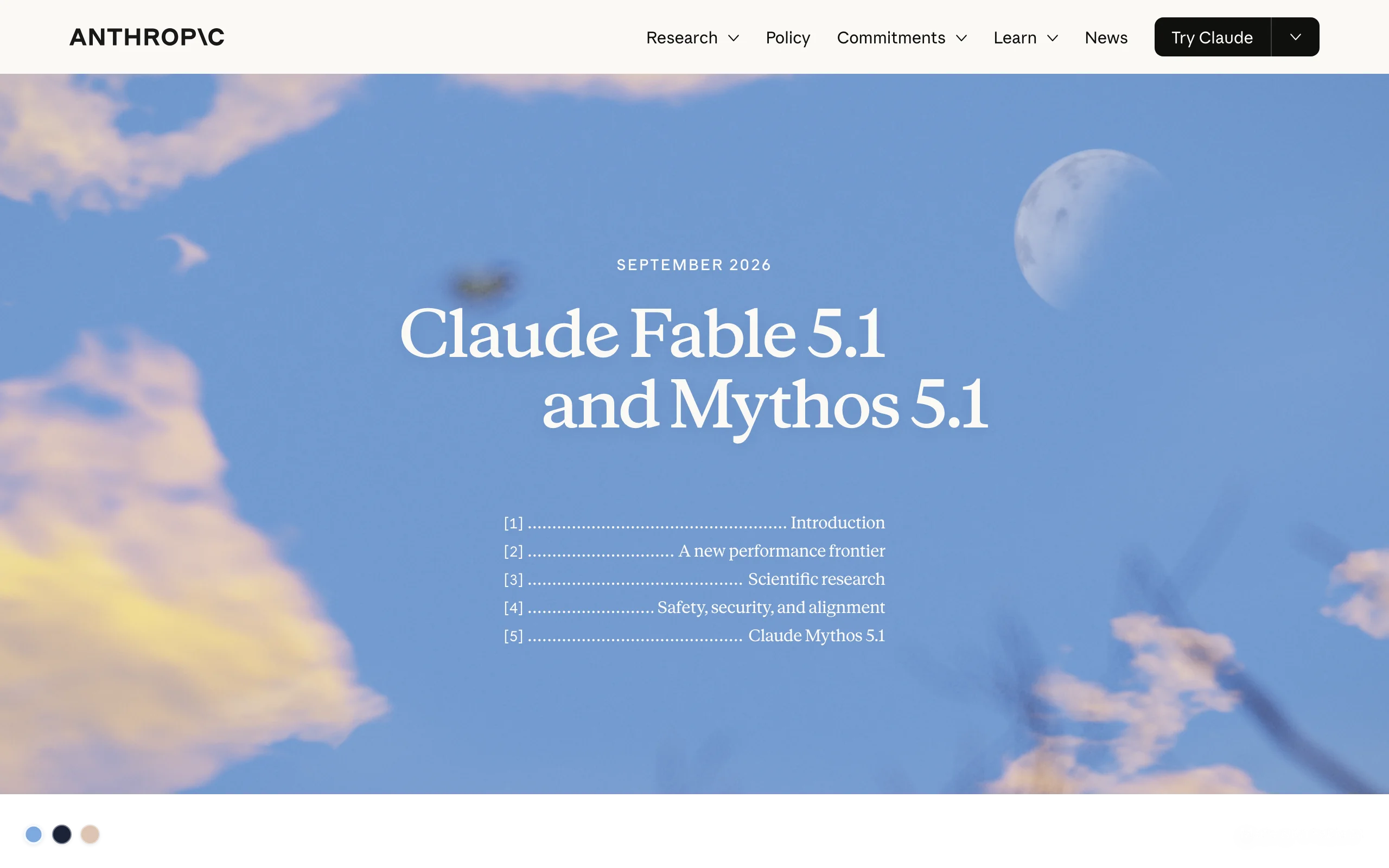
Claude Fable 5.1 is a flagship large model launched by Anthropic, positioned as one of the high-performance AI systems available to the public. Designed for complex reasoning, long-running Agent tasks, and knowledge-intensive workloads, it outperforms the previous generation across eight benchmark tests. Performance levels achievable on lower inference tiers match those of the previous generation's higher tiers. Additionally, cache read costs are reduced by 75%, typical workload costs drop by approximately 25%, and the highest savings of up to 45% are seen in highly Agent-optimized tasks, achieving a unified balance of stronger performance and higher cost-effectiveness.
Image source: Official article
Technical Positioning and Domain: Belongs to the natural language processing and general artificial intelligence domains, focusing on complex multi-step reasoning, autonomous Agent execution, and knowledge-intensive workloads. The model features a multi-tiered inference strength adjustment mechanism, enabling it to cover a wide range of computational needs—from lightweight Q&A to deep scientific research—within the same architecture. It demonstrates comprehensive superiority over previous generations and similar competitors in public benchmark tests.
Development Background: Developed by Anthropic based on its long-term expertise in AI safety and alignment technologies. This model shares the underlying infrastructure with Claude Mythos 5.1, but implements differentiated security measures to enable tiered access—Fable is open to the public, while Mythos provides higher capability boundaries exclusively to cybersecurity and life science institutions that have passed review. This reflects Anthropic's balanced strategy between capability openness and risk control.
Core Value: Addresses two major pain points in long-running Agent tasks: insufficient stability and high operational costs. Through context caching optimization, cache read costs are reduced by 75%, total costs for typical workloads drop by about 25%, and highly Agent-optimized tasks can save up to 45%. Additionally, the model improves error propagation control mechanisms, enabling it to stably execute complex multi-step tasks lasting hours or even tens of hours, providing a practical long-term execution capability for scientific research, coding, and enterprise automation.
Technical Features: Features a tiered design with a shared infrastructure and differentiated security measures. It includes five levels of inference strength, from low to max, allowing users to dynamically balance speed and accuracy. A reverse distillation protection mechanism adds signatures to each reasoning block to block distillation attacks. The enterprise privacy architecture (EFS) stores data on customer-owned cloud infrastructure, achieving zero-data-retention level privacy protection.
2. Key Features
Complex Reasoning and Long-Term Stability: Designed for multi-step deep reasoning, it can trace the root cause of problems and stably execute long-duration tasks lasting hours or even tens of hours. An improved error propagation control mechanism prevents minor early errors from amplifying over subsequent steps and causing total failure, and when encountering obstacles, it can clearly report the attempted solutions and the exact point of failure.
Agent Workflow Orchestration: Supports autonomous planning, tool calling, and multi-step task orchestration, suitable for coding, scientific discovery, and business process automation. It achieves nearly double the score of the previous generation on the AutomationBench benchmark, rising from 17.1% to 31.4%, demonstrating the ability to execute complex cross-system business workflows.
Adjustable Reasoning Intensity: Features five levels of reasoning intensity—low, med, high, xhigh, and max—allowing users to dynamically balance response speed, API cost, and accuracy based on task complexity. Performance previously achieved at high or even xhigh levels can now be reached at low or medium levels, completing more difficult tasks with fewer resources.
Context Caching Optimization: By reducing cache read costs by 75%, the model significantly lowers the overall cost of highly Agent-ized tasks when reusing previously processed context. Typical workloads see a cost reduction of approximately 25%, with heavy Agent tasks achieving up to a 45% reduction, offering clear cost control benefits for high-frequency calling scenarios.
Anti-Distillation Protection: Adds a signature to each reasoning block to verify that the conversation prefix has not been tampered with. If the context is edited, the verification fails, directly blocking distillation attacks that attempt to extract the model's reasoning capabilities by altering historical dialogues, thereby protecting the model's core capability assets.
Enterprise Privacy Architecture (EPA): Stores data on customer-owned cloud infrastructure rather than on Anthropic servers, with the customer, not Anthropic, performing necessary manual reviews. It achieves zero-data-retention level privacy protection while maintaining security monitoring, meeting data governance requirements in highly regulated industries such as finance and healthcare.
Scientific Research Capabilities: Demonstrates practical capabilities in fields such as protein design, astronomical data analysis, and computational biology. Based on NASA radar images, it generated elevation maps for approximately one-third of Venus's surface with a resolution improved to 2–3 kilometers, achieving a 25% increase in accuracy; it also achieved near 50% experimental validation hit rates across 12 targets.
Computer Operation and GUI Understanding: Possesses the ability to understand graphical interfaces and automate operations, completing complex cross-application tasks in environments such as OSWorld. In OSWorld 2.0, it achieved a partial score of 77.9% in certain data scenarios, offering a new technological pathway for desktop automation and software testing.
3. How to Use
Prerequisites: Using Claude Fable 5.1 does not require a local GPU or dedicated hardware; it can be accessed via the Anthropic API in the cloud. Developers need to register for an Anthropic account and obtain an API key. For enterprise users accessing through Amazon Bedrock, Google Cloud, or Microsoft Azure, they must have the corresponding cloud service provider account.
API Calling: Developers can integrate the model into their own applications or workflows by specifying the model ID
claude-fable-5-1through the Anthropic API. The API supports streaming responses, tool calling, and multi-turn conversations, making it suitable for building customized AI applications.Web-based Chat: Access the official Claude chat interface directly, switch to Fable 5.1 in the model selection, and engage in daily Q&A, writing assistance, and knowledge work. This is ideal for individual users who want to quickly experience the model's capabilities without programming.
Claude Code Command Line Tool: Use in a command line environment, with high inference strength enabled by default, suitable for complex coding and long-term development tasks. Developers can use this tool for code debugging, performance optimization, and multi-file project maintenance.
Claude Cowork Collaboration Scenarios: In team collaboration scenarios, the default inference strength is medium, achieving a balance between response speed and task quality. It is suitable for document collaboration, data analysis, and cross-department workflows.
Adjust Inference Strength: Switch between five levels of inference strength—low, med, high, xhigh, and max—based on task complexity. For simple Q&A, using the low setting can reduce latency and cost. For complex research or deep coding tasks, it is recommended to use higher settings to achieve more rigorous inference results.
4. Pros and Cons Analysis
| Pros |
|---|
| Comprehensive Performance Leadership: Outperforms previous generations and GPT-5.6 Sol across 8 public benchmark tests in areas such as scientific research, Agent coding, and knowledge work. Scores 55.8% on Terminal-Bench 4.0 compared to 37.3%, showing a significant gap. |
| Exceptional Cost-Effectiveness: Cache read cost reduced by 75%, total cost for typical workloads decreased by approximately 25%, and highly Agent-ized tasks save up to 45%. The long-term cost advantage is clear. |
| High Performance at Lower Inference Levels: Low and medium inference levels can achieve performance comparable to or even better than high and ultra-high levels in previous generations, enabling more complex tasks with fewer resources and demonstrating outstanding resource utilization efficiency. |
| Long-Term Stability: Improved error propagation control mechanisms support continuous multi-step tasks lasting from hours to tens of hours. Early minor errors do not lead to complete system failure, ensuring high reliability for long-range tasks. |
| Scientific Research Validation: Achieves nearly 50% hit rate in protein design, improves Venus terrain map resolution to 2-3 kilometers, and achieves a maximum GPU kernel optimization speedup of 2.5 times. Practical results can be verified. |
5. Comparative Analysis with Similar Tools
| Comparison Dimension | Claude Fable 5.1 | GPT-5.6 Sol | Gemini 3.8 |
|---|---|---|---|
| Core Architecture | Shares the underlying model with Mythos 5.1, features five levels of inference strength adjustment, and includes tiered secure access | OpenAI flagship inference model, architecture details not disclosed | Google's inference and coding model, deeply integrated with the Google ecosystem |
| Agent Coding Performance | Terminal-Bench 4.0 score: 55.8% | 37.3% | Official data to be announced |
| Scientific Research Performance | Terminal-Bench-Science 0.1 score: 52.6% | 22.4% | Official data to be announced |
| Knowledge Work Performance | GDPval-AA v2 score: 1853 | 1711 | Official data to be announced |
| Feature Highlights | Complex reasoning, Agent workflow, computer operations, anti-distillation protection, EFS enterprise privacy | Strong inference and coding capabilities, mature ecosystem | Inference and coding, integrated with Google Search and other ecosystems |
| Deployment Methods | API, web interface, Claude Code, Claude Cowork, AWS/GCP/Azure | OpenAI API, web interface | Google AI Studio, Vertex AI |
| Cost-effectiveness | Cache read cost reduced by 75%, typical load reduced by 25%, Agent tasks reduced by up to 45% | No similar cost reduction | To be officially announced |
Selection Recommendations: For teams whose core needs are long-term Agent tasks, scientific data analysis, and high-intensity coding, Claude Fable 5.1 is currently the more optimal choice in terms of overall performance and cost balance. Its significant lead on Terminal-Bench and Terminal-Bench-Science, along with the substantial reduction in cache read costs, makes it particularly suitable for scenarios requiring long-running, complex workflows, such as automated scientific pipelines, enterprise-level business process orchestration, and maintenance of large codebases.
Considerations for Other Scenarios: If a team is deeply integrated with OpenAI or Google's cloud ecosystem, the integration convenience of GPT-5.6 Sol and Gemini 3.8 within their respective ecosystems remains an important consideration. While GPT-5.6 Sol lags behind Fable 5.1 in knowledge work (GDPval-AA v2 score: 1711), the gap is smaller than in the Agent coding domain. Gemini 3.8's integration with Google Search and Vertex AI is appealing to enterprises relying on Google infrastructure. For users with limited budgets and less complex tasks, the previous generation Claude Fable 5 can still serve as a transitional option, though they must accept the generational gap in long-term task stability and cost-effectiveness.
6. Editor's Summary
The release of Claude Fable 5.1 marks Anthropic's establishment of a clear technical advantage in the field of long-cycle Agent tasks. From the perspective of technological innovation, the tiered design that combines a shared infrastructure with differentiated security measures offers a new approach to enabling the capabilities of cutting-edge models. Through the dual-track strategy of Fable and Mythos, Anthropic maintains the competitiveness of its open models while preserving controlled access channels for high-risk professional research. The introduction of the anti-distillation protection mechanism sets a precedent in the industry, providing a practical technical solution for chain-of-thought signature verification and directly addressing the core risk of large model capability leakage.
From a practical value standpoint, the context caching optimization results in a 75% reduction in cache read costs, along with a 25% cost reduction for typical workloads, making the long-term execution of high-intensity Agent tasks economically viable. The ability to achieve the performance of previous high-tier configurations using a low inference tier further lowers the barrier for users to obtain high-quality inference results. In terms of scientific research and practical applications, the near 50% hit rate in protein design, a 25% improvement in Venus terrain map accuracy, and a maximum 2.5x acceleration in GPU kernel performance are all quantifiable achievements, not just theoretical advantages from benchmark tests.
In terms of target users, this model is most suitable for three categories: first, developers who require long-term stable execution of complex coding and debugging tasks; second, researchers engaged in cutting-edge fields such as protein design and astronomical data analysis; and third, enterprise teams with cross-system business process automation needs and a certain level of cloud infrastructure operations capability. For individual developers and small teams, it is recommended to start with the low inference tier and gradually explore the balance point between cost and quality.
Overall, Claude Fable 5.1 demonstrates generational improvements in three dimensions: long-cycle Agent stability, cost control, and scientific research capabilities. As Anthropic continues to iterate on its shared infrastructure, its capability boundaries and cost structure are expected to be further optimized, unlocking greater application potential in the fields of knowledge work automation and scientific discovery.
7. Application Scenarios
Complex Software Development and Debugging: Capable of tracing and identifying the root causes of rare system crashes that have plagued engineering teams for years, supporting continuous coding sessions lasting tens of hours and parallel multi-experiment tasks. Development teams can use Claude Code for extended debugging sessions in the command line, combined with high inference intensity settings to obtain in-depth analysis results.
Protein Design in Life Sciences: Leverage open-source tools to design high-affinity protein binders, achieving an experimental validation hit rate of nearly 50% across 12 targets, with affinity levels reaching 10 times that of the best solutions in industry competitions. Researchers can integrate the model into their protein design pipelines via API, enabling closed-loop iterative cycles of design, validation, and optimization.
Astronomy Data Analysis: Based on radar images from NASA's Magellan spacecraft collected over 30 years ago, generate elevation maps with a resolution of 2-3 kilometers for approximately one-third of Venus's surface, improving accuracy by 25%. The model can process massive historical remote sensing data, providing high-resolution topographic data support for planetary science research.
Enterprise Business Process Automation: Execute complex, multi-step business workflows across systems, achieving nearly double the score of the previous generation on the AutomationBench benchmark, increasing from 17.1% to 31.4%. Enterprises can use Claude Cowork or API to orchestrate cross-departmental processes such as procurement, finance, and customer service, reducing the need for manual intervention.
Computing Infrastructure Optimization: Automatically write custom GPU kernels and cache intermediate results, increasing the inference speed of seven open-source deep learning models by up to 2.5 times and reducing GPU computing costs by 30%-60%. Infrastructure teams can integrate the model into CI/CD pipelines to achieve automated optimization of model inference performance.
8. FAQ
Q: What is the difference between Claude Fable 5.1 and Claude Mythos 5.1?
A: Both are based on the same underlying model architecture, but they implement differentiated security measures to enable tiered access. Fable 5.1 is open to the public and suitable for general development and research tasks; Mythos 5.1 is only available to cybersecurity and life science institutions that have passed review, offering higher capability boundaries for high-risk professional research scenarios.
Q: How to choose the inference intensity level?
A: For simple Q&A and daily writing, it is recommended to use the low or med levels to reduce latency and cost; for complex coding, multi-step reasoning, and research tasks, it is advised to use the high level or higher. The low and med levels can achieve performance comparable to the high level of previous generations. Users can dynamically adjust based on task importance and budget.
Q: How is the 75% reduction in cache read cost achieved?
A: The model optimizes context caching, significantly reducing redundant computation costs when reusing previously processed context. Developers should organize the conversation context appropriately in API calls to fully leverage the caching mechanism, which can reduce the total cost of typical workloads by approximately 25%.
Q: How does the anti-distillation protection mechanism work?
A: The model appends a signature to each reasoning block, verifying whether the conversation prefix has been tampered with. If the context has been edited, the verification fails, thereby blocking distillation attacks that attempt to extract the model's reasoning capabilities by altering historical conversations, and protecting the model's core capabilities from illegal replication.
Q: What is the difference between the Enterprise Privacy Framework (EFS) and the standard API?
A: EFS stores data on the customer's own cloud infrastructure rather than on Anthropic servers, and the customer—not Anthropic—performs the necessary manual reviews. It achieves zero-data-retention level privacy protection while maintaining security monitoring, making it suitable for industries with strict data sovereignty requirements.
Q: How to deploy Claude Fable 5.1 via a cloud platform?
A: It can be accessed through cloud service providers such as Amazon Bedrock, Google Cloud, or Microsoft Azure. Enterprise users need to enable Anthropic model services on the respective cloud platforms and configure access permissions. After that, they can invoke the model via the cloud platform's API, meeting enterprise-level infrastructure and compliance requirements.
9. Project Links
- Product Official Website: https://www.anthropic.com/claude-fable-and-mythos-5-1
- Official Experience Portal (Claude Chat): https://claude.ai
- Official Documentation and API Reference: https://docs.anthropic.com
- GitHub Organization: https://github.com/anthropics
Related AI Model Articles
Review of DeepSeek Harness Desktop: How the Official GUI Client Lowers the Bar for Agent Usage
DeepSeek Harness Desktop is the official graphical client launched by DeepSeek, designed to provide a visual interface for the originally command-line-based DeepSeek Harness framework. After users log...
Step Code – In-Depth Review of StepFun's Open-Source Terminal Programming Agent
Step Code is an open-source terminal programming agent launched by StepFun, licensed under the MIT License, which allows developers to complete the full workflow of code writing, debugging, execution,...
In-Depth Review of Claude Opus 5.5: A Revolution in Programming Efficiency and Safety for Anthropic's Flagship Model
Claude Opus 5.5 is the first flagship model in Anthropic's Claude 5.5 series, launched in June 2026. It is positioned as a high-end AI model designed for enterprise-level agent programming, complex kn...
In-Depth Review of GPT-6 Sol: A Cost-Effective Revolution in OpenAI's Mid-to-High-End Large Model
GPT-6 Sol is a mid-to-high-end large model introduced by OpenAI, derived from the GPT-6 Astra base model. It brings Astra's reasoning, programming, factual accuracy, and Agent capabilities down to a m...
© All Rights Reserved. Some content on this site is partially generated by AI with human review.