
Claude Fable 5 – Anthropic's Most Powerful AI Model
Executive Summary:
Claude Fable 5 is Anthropic's "safe edition" strongest model within its flagship lineup, belonging to the newly established Mythos-class capability tier. Architecturally identical to unrestricted Clau...
1. What Is Claude Fable 5
Claude Fable 5 is Anthropic's "safe edition" strongest model within its flagship lineup, belonging to the newly established Mythos-class capability tier. Architecturally identical to unrestricted Claude Mythos 5 at the base layer, it adds a conservative safety guardrail system for public deployment while maintaining top-tier performance. It achieves state-of-the-art (SOTA) results on nearly all public benchmarks—software engineering, knowledge work, visual reasoning, and long-horizon autonomous tasks—marking an important balance between AI capability and safe controllability.
Image source: Official article
Technical positioning and domain: Claude Fable 5 is positioned as the most advanced safe, controllable flagship LLM. Unlike capability-maximized, access-restricted Mythos 5, Fable 5 aims to deliver top AI capabilities safely to broader audiences, resolving the core tension of "more capability, more risk."
R&D background: Developed by Anthropic, long committed to AI safety research. Core motivation: explore how to safely unlock increasingly powerful models. Fable 5 embodies "Safe Scaling"—managing sensitive-domain applications through refined safety routing and intervention, not simple refusal or capability reduction.
Core value: Fable 5 achieves "capability unchanged, safety controlled." It solves the problem of top models being withheld from the public due to safety concerns. Users enjoy Mythos 5–level performance on most tasks; only in rare high-risk domains (cyberattacks, bioweapons) does automatic downgrade occur—an unprecedented balance between capability release and risk management.
Technical characteristics: Fable 5's core innovation is its "safety routing mechanism." Built-in independent classifiers analyze user requests in real time; upon detecting specific high-risk intent, requests route to the next-tier Claude Opus 4.8 model rather than direct refusal. Also features million-token long context, native visual understanding, and extreme token inference efficiency.
2. Key Features
Core capabilities ranked by technical importance and innovation:
Ultra-long autonomous coding: Executes complex, long-horizon refactoring in large codebases. In public tests, it autonomously plans and completes full migration of a 50-million-line Ruby codebase in one day; SWE-Bench Pro score of 80.3%—beyond simple code completion to engineering-grade capability.
Token-efficient reasoning: On FrontierCode and similar benchmarks, Fable 5 achieves 29.3% top score at medium reasoning effort with token consumption only one-third of competitors (e.g., GPT-5.5)—more complex, deeper analysis within the same budget, significantly improving cost-effectiveness.
Native visual understanding: Strong multimodal capability—processes raw game screenshots, scientific charts, etc. Example: autonomously completes Pokémon FireRed using only game screenshots without cheats; precisely extracts values from complex scientific charts; even reconstructs webpage HTML from screenshots.
Persistent memory and long context: Million-token context window with file-level persistent memory. In multi-day long-horizon tasks, autonomously writes notes and revisits them to improve subsequent output—solving long-conversation "amnesia" for complex long-term research projects.
Intelligent safety downgrade: Core safety feature distinguishing Fable 5 from Mythos 5. Independent, tamper-proof classifier monitors user input; upon detecting cybersecurity, bioweapon, or model distillation risks, routes to Claude Opus 4.8 rather than refusal—maintaining safety floor.
Frontier LLM development restrictions: For requests attempting model self-iteration (pretraining pipelines, distributed training architecture, etc.), invisible interventions apply—including prompt modification, steering vectors, and parameter-efficient fine-tuning (PEFT). Affecting only ~0.03% of traffic, limiting self-improvement risk while preserving general capability.
3. How to Use
Claude Fable 5 offers multiple access methods for different user groups.
Environment requirements: No local deployment or high-end hardware needed. Modern browser (Chrome, Edge) or terminal (for Claude Code) with internet access. API access requires Anthropic API key and RESTful API familiarity.
Web usage (most direct): Log in at claude.ai. In model selector, switch to "Fable 5." Use natural language dialogue like other Claude models for full capability access.
API access (developers): Integrate into applications or workflows via Anthropic API. Set
modelparameter toclaude-fable-5in requests. Follow Anthropic REST conventions for request bodies and streaming/non-streaming responses.Claude Code (advanced developers): Anthropic's terminal agent tool. After installation, configure default underlying model as
claude-fable-5. Claude Code leverages Fable 5's top coding and reasoning for codebase-level agent operations—refactoring, code review, automated testing.
Notes and best practices: Despite strong capability, safety mechanisms may downgrade cybersecurity, bioweapon research, and similar high-risk requests to Opus 4.8. Professional research institutions needing unrestricted capability should apply for Claude Mythos 5 access. For most general tasks, Fable 5 is the best balance of capability and safety.
4. Pros and Cons
| Pros |
|---|
| SOTA performance: Top results on software engineering, knowledge work, visual reasoning, and long-horizon autonomous tasks—current AI capability ceiling. |
| Extremely token-efficient: Far lower token consumption than competitors (e.g., one-third of GPT-5.5) for same tasks—lower cost for complex work, outstanding economics. |
| Long-horizon autonomous capability: Million-token context and persistent memory enable multi-day complex research tasks—from data integration to model training without human intervention—high automation. |
| Innovative safety routing: Independent classifier enables intelligent downgrade not refusal—exemplary balance of safety and usability; industry template for "controlled capability release." |
5. Comparison with Similar Tools
Technical comparison with Claude Mythos 5, Claude Opus 4.8, and GPT-5.5.
| Dimension | Claude Fable 5 | Claude Mythos 5 | Claude Opus 4.8 |
|---|---|---|---|
| Core architecture | Shared Mythos 5 base + safety guardrails | Unrestricted original flagship | Independent prior-gen flagship |
| Safety guardrails | Conservative; ~5% high-risk triggers downgrade | None or minimal | Standard level |
| SWE-Bench Pro | 80.3% | Same (shared base) | ~40.0% |
| Token efficiency | Extremely high; ~1/3 GPT-5.5 for same tasks | Same (shared base) | Higher |
| Access | Publicly available | Trusted institutions/Glasswing project | Publicly available |
| Data retention | 30-day mandatory monitoring | 30-day mandatory monitoring | Standard policy |
| Distillation protection | Yes; invisible intervention limits | No | No |
Selection advice:
- Most developers and enterprises: Need strongest, most versatile AI assistant for daily programming, content creation, data analysis with best cost-effectiveness → Claude Fable 5 is optimal. Near-lossless capability with extremely high token efficiency and safety.
- National research institutions or AI safety red teams: Cyber offense/defense, bioweapon risk, or AI self-safety research needing unconstrained full capability → apply for Claude Mythos 5. Fable 5 safety downgrade is an obstacle.
- Cost-sensitive teams with mature workflows: Not requiring extreme capability, accustomed to prior flagship → Claude Opus 4.8 or GPT-5.5 remain reliable. Opus 4.8 still powerful; GPT-5.5 has unique Microsoft ecosystem integration.
6. Editor's Review
Claude Fable 5's release is a milestone in AI safety. Unlike past capability reduction for safety, it uses precise "safety routing" and "invisible intervention" for "capability unchanged, safety controlled." This "capability tiering" strategy—public top capability with highest-risk operations routed to safer paths—provides invaluable industry reference. Extreme token efficiency optimization directly addresses AI application cost pain, increasing commercial appeal.
Practically, Fable 5 is today's most recommended all-around AI model. Software engineers seeking codebase-level refactoring help, researchers needing multi-day autonomous research assistants—Fable 5 shows unprecedented capability. Million-token context and persistent memory evolve AI from "dialogue assistant" to "long-term collaborative partner."
Target users: Software developers, data scientists, advanced researchers, and content creators pursuing peak productivity and efficiency. Also top choice for enterprise AI integration.
Future potential: Fable 5's success signals AI development toward "capability tiering, fine-grained control." Anthropic's safety investment positions it well in increasingly regulated markets. More "Fable" series models for different risk tiers may emerge.
Fable 5 achieves today's optimal balance of capability, efficiency, and safety—technical culmination and AI productization/safety governance exemplar. Safety limits for a minority of professional users are the foundation of public access—flaws don't overshadow merits.
7. Application Scenarios
- National cyber defense: Security analysts use Fable 5's deep code understanding and reasoning for automated vulnerability discovery, threat modeling, and nation-state adversary simulation on critical infrastructure source code—extremely low-cost security resilience improvement.
- Frontier drug discovery: Biopharma deploys Fable 5 as autonomous research assistant—identify targets from literature, protein design, compound validation from generated structures. Long-horizon autonomy accelerates early pipeline for oncology, neurodegenerative disease, etc.
- Fundamental scientific research: Molecular biology, genomics, physics—assign Fable 5 multi-day autonomous tasks analyzing massive gene sequences, proposing testable molecular mechanism hypotheses, autonomously writing research reports—accelerating discovery cycles.
- AI safety red teaming: Security researchers test other AI systems' safety boundaries. Fable 5's strong reasoning and jailbreak capability efficiently identifies complex, cross-request, novel threat vectors—helping developers patch vulnerabilities proactively.
8. FAQ
Q: What's the difference between Claude Fable 5 and Claude Mythos 5?
A: Shared underlying model; same capability ceiling. Core difference is safety: Fable 5 is public with conservative guardrails—~5% high-risk requests auto-downgraded; Mythos 5 has no such limits but trusted-institution access only via specific projects.
Q: When will my request be "downgraded" to Opus 4.8?
A: When the independent classifier detects high cybersecurity intent (e.g., attack code generation), bioweapon risk (harmful substance synthesis), or model distillation (attempting to replicate model capability)—routes to Claude Opus 4.8. Not refusal—different capable, safe model responds.
Q: How does million-token context perform in practice?
A: Excellent. Input entire books, codebases, or multi-day research logs at once. Model understands accurately and uses "persistent memory" to autonomously write and revisit notes—solving long-conversation forgetting for complex project collaboration.
Q: Is Fable 5 pricing reasonable?
A: Given top performance and extreme token efficiency, pricing (input $10/M, output $50/M) is reasonable among flagship models. Deep reasoning tasks consume only one-third competitor tokens—actual cost may be lower; strong value.
Q: How do I decide Fable 5 vs. Opus 4.8?
A: Complex codebase refactoring, long-horizon autonomous research, deep visual understanding, or ultra-long documents—Fable 5 advantages are clear. Simple Q&A, summarization, or text generation—Opus 4.8 is sufficient and lower cost.
9. Project Links
- Official product page and access: https://claude.ai
- API documentation and developer guide: https://docs.anthropic.com/claude/reference
Related AI Model Articles
Deep Dive into RAG (Retrieval Augmented Generation) for Large Models: From Basic Workflows to Advanced Retrieval Architectures and Optimization
I want to explain RAG (Retrieval Augmented Generation) from the basics to advanced concepts, as it has become one of the most popular solutions for deploying large models in real-world applications. I
H3-World – A World Model with Action Controllability Developed by Tencent in Collaboration with Universities
H3-World is an action-controllable world model developed collaboratively by Tencent, National University of Singapore, and The Hong Kong Polytechnic University. It is based on the MiniMax-H3 video gen...
FireRedAudio – In-Depth Review of Xiaohongshu FireRed's General-Purpose Audio Language Model
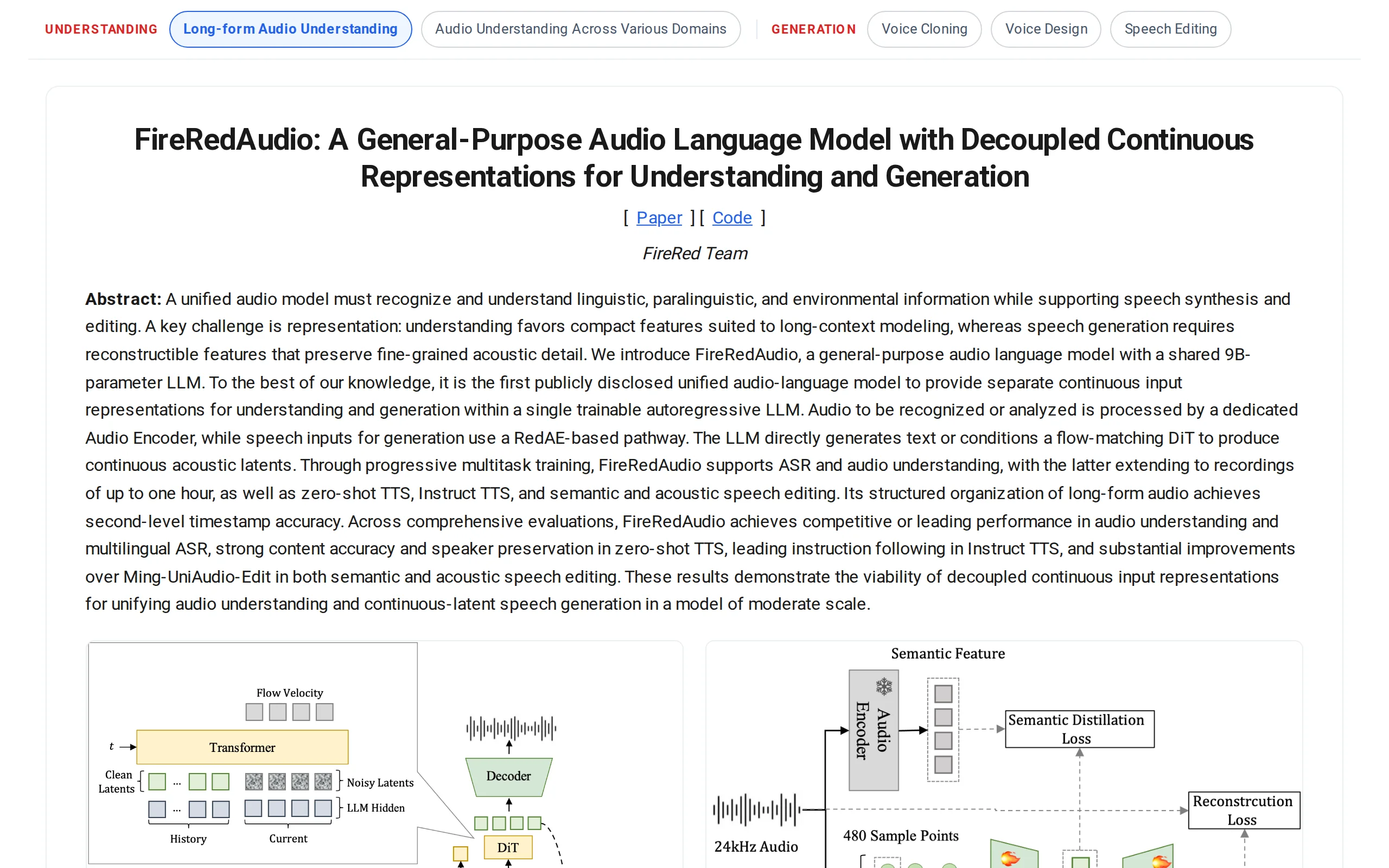
FireRedAudio is a general-purpose audio language model open-sourced by the FireRed team at Xiaohongshu in August 2026. It is built upon the Qwen3.5 autoregressive large language model with 9B paramete...
Claude Mythos 5.1: Anthropic's Flagship Model with Controlled Access for High-Risk Research Fields
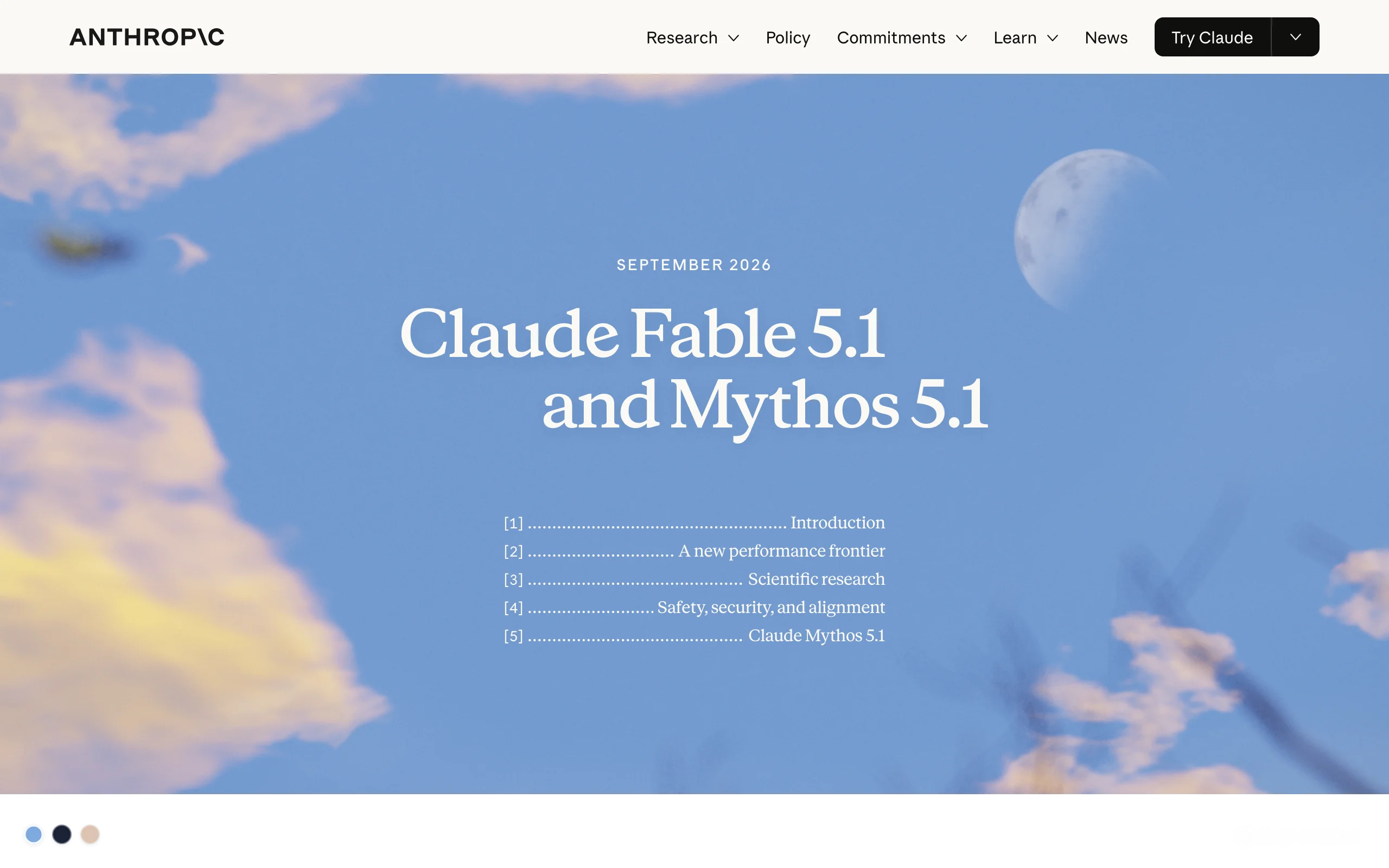
Claude Mythos 5.1 is the flagship model of the Claude 5.1 series launched by Anthropic. It shares the exact same underlying model weights and inference capabilities with the publicly available Claude ...
© All Rights Reserved. Some content on this site is partially generated by AI with human review.