
Alpamayo 2 Super – NVIDIA's Open-Source Autonomous Driving AI Inference Model
Executive Summary:
Alpamayo 2 Super is an open-source autonomous driving AI inference model developed by NVIDIA based on the Cosmos 3 Super Reasoner. It features 360° omnidirectional environmental perception, advanced d...
1. What is Alpamayo 2 Super
Alpamayo 2 Super is an open-source autonomous driving AI inference model developed by NVIDIA based on the Cosmos 3 Super Reasoner. It features 360° omnidirectional environmental perception, advanced driving decision-making inference, and automatic inference label generation, ranking first on the LingoQA autonomous driving inference benchmark. The model is hosted on Hugging Face under the OpenMDW-1.1 permissive license, supporting fine-tuning, derivation, and commercial redistribution. Additionally, it provides lightweight versions, Alpamayo 1.5 and 1, for cloud development and on-device distillation deployment, targeting scenarios such as Robotaxi, autonomous driving trucks, and ADAS, offering a complete model family from high cloud computing power to low on-device computing power.
Technical Positioning and Domain: Alpamayo 2 Super is positioned as a specialized AI inference model for autonomous driving, focusing on perception fusion, causal reasoning, and path planning in complex driving scenarios. Unlike general-purpose multimodal large models, this model has been deeply optimized for specialized driving tasks, enabling it to directly output safe and comfortable driving decisions. It fills the gap in the open-source autonomous driving inference model space by combining top-tier inference performance with a commercially friendly license.
Development Background: The model was developed by NVIDIA's research team through specialized post-training based on its Cosmos 3 Super Reasoner, a powerful inference model. With deep expertise in autonomous driving computing platforms (Drive AGX, Orin, Thor) and simulation platforms (Omniverse), NVIDIA aims to provide the industry with a customizable and commercially deployable base model, accelerating the development and iteration of autonomous driving algorithms.
Core Value: The core value of this model lies in combining state-of-the-art inference performance with an open-source commercial license. Developers can fine-tune or distill the model on their own data without starting from scratch, quickly obtaining a driving inference model tailored to their specific scenarios. At the same time, the model family covers both high-computing power cloud and low-computing power on-device requirements, significantly lowering the barrier from research to mass production. Developers retain full data sovereignty, avoiding privacy risks associated with reliance on third-party cloud services.
Technical Features: Alpamayo 2 Super is optimized for autonomous driving tasks through reinforcement learning post-training (RL Post-Training), significantly outperforming general models in causal reasoning, risk prediction, and path planning capabilities. It employs an end-to-end multi-task architecture, unifying the processing of core modules such as perception, prediction, and planning, achieving end-to-end inference from scene understanding to driving decisions. It supports knowledge distillation from the 2 Super version to the 1.5/1 versions, drastically reducing model size while maintaining key performance, making it suitable for real-time inference on vehicle endpoints.
2. Key Features
360° Environmental Awareness: The model can perform high-precision identification and understanding of all-around scenarios around the vehicle, including lane markings, traffic signs, pedestrians, vehicles, and other obstacles. Even in complex real-world conditions (such as nighttime, rain, fog, or congested intersections), it maintains stable perception output, providing a reliable representation of the environmental state for subsequent decision-making.
Advanced Driving Decision Reasoning: Based on contextual scene information, the model performs causal reasoning. It not only identifies the current state but also predicts the intentions of other road users, outputting safe and comfortable driving paths and action decisions. For example, in an unprotected left turn scenario, the model will consider factors such as the speed of oncoming straight-moving vehicles and pedestrian positions to provide reasonable decisions on waiting or proceeding.
Automatic Reasoning Label Generation: The model can automatically generate reasoning labels for driving videos, such as "The vehicle ahead is slowing down; this vehicle must maintain a safe distance" or "A pedestrian is about to cross; early braking is required." This capability significantly reduces the cost of manual annotation, helping developers quickly build large-scale, high-quality driving scenario training datasets and accelerate algorithm iteration.
Multimodal Autonomous Driving Development: Supports the fusion of multimodal inputs such as vision and text, unifying the processing of perception and decision-making tasks. Developers can input camera images, LiDAR point clouds (via encoders), and natural language instructions, and the model will integrate this information for joint reasoning, adapting to different sensor configurations and task requirements.
Model Distillation Support: The official release includes two distilled versions of Alpamayo: 1.5 and 1. Developers can use their own data to distill the knowledge from the 2 Super model into smaller models. The 1.5 version achieves a balance between performance and computational load, while the 1 version is suitable for deployment on compute-constrained automotive chips (such as NVIDIA Orin), enabling real-time inference.
End-to-End Multitask Architecture: The model uses a unified Transformer architecture to simultaneously handle core autonomous driving modules such as perception, prediction, and planning, avoiding information loss and accumulated errors between modules in traditional modular systems. This design allows the model to directly output driving instructions from raw sensor inputs, resulting in a shorter inference chain and faster response.
3. How to Use
Environment Requirements: For cloud inference and fine-tuning, it is recommended to use NVIDIA A100 (40GB/80GB) or H100 GPUs. For in-vehicle deployment, NVIDIA Orin or Thor series chips are suggested. The software environment should include CUDA 12.0+, PyTorch 2.0+, Transformers 4.40+, and be configured with NVIDIA's NeMo or TensorRT-LLM inference framework to achieve optimal performance.
Obtaining Model Weights: Access the official Hugging Face repository (nvidia/Alpamayo2-Super) and download the model weights and configuration files using
git lfs cloneorhuggingface-cli download. The model size is approximately 70B parameters, requiring at least 150GB of disk space.Confirming Commercial License: Carefully read the LICENSE file in the repository. The OpenMDW-1.1 license permits fine-tuning, derivation, and commercial redistribution, but requires the retention of copyright notices. It is recommended that the legal team review the terms to ensure compliance with corporate regulations.
Preparing Driving Data: Integrate your own vehicle sensor data (cameras, millimeter-wave radar, LiDAR, etc.) with corresponding driving strategies (such as acceleration, braking, and steering angles). The data must be preprocessed according to the model's input format, including image size normalization, sensor timestamp alignment, and scene label annotation. It is recommended to use NVIDIA's NeMo Curator tool for data cleaning and augmentation.
Model Fine-tuning and Distillation: Use NVIDIA's NeMo framework or custom training scripts to perform domain-specific fine-tuning of Alpamayo 2 Super on your own dataset. For in-vehicle deployment, run distillation scripts to transfer knowledge to Alpamayo 1.5 or 1 versions. When fine-tuning, pay attention to learning rate scheduling and overfitting control. It is recommended to use mixed-precision training to reduce GPU memory usage.
Integration and Deployment Verification: Integrate the optimized model into the vehicle's perception-decision-control pipeline. Conduct closed-loop testing first in simulation environments such as NVIDIA Omniverse or CARLA to evaluate the model's performance across various scenarios. Then proceed with real-world road testing to verify system stability and safety. During deployment, use TensorRT-LLM for model quantization and acceleration to ensure that the inference latency on the vehicle meets real-time requirements (typically <50ms).
4. Pros and Cons Analysis
| Pros |
|---|
| Open Source and Commercially Friendly: Licensed under the Linux Foundation OpenMDW-1.1, it supports fine-tuning, derivation, and commercial redistribution without requiring additional licensing fees, reducing the adoption barrier for enterprises. |
| Superior Inference Performance: It ranks first on the LingoQA autonomous driving inference benchmark and significantly outperforms Qwen2.5-VL 72B and Gemini 2.5 Pro in Lingo-Judge tests, demonstrating its specialized advantages in driving inference tasks. |
| Full-Stack Model Family Coverage: From the high-computational-power 2 Super version in the cloud to the lightweight 1.5/1 versions for vehicles, it provides a complete deployment pipeline. Developers do not need to design distillation schemes themselves, reducing engineering complexity. |
| Complete Data Sovereignty Control: Model weights and training data are stored locally, without reliance on third-party cloud services. Enterprises can build their own driving knowledge base, meeting data security and compliance requirements. |
5. Comparative Analysis with Similar Tools
| Dimension | Alpamayo 2 Super | Qwen2.5-VL 72B | Gemini 2.5 Pro |
|---|---|---|---|
| Developer | NVIDIA | Alibaba Qwen | Google DeepMind |
| Model Positioning | Specialized inference model for autonomous driving | General-purpose multimodal large model | General-purpose multimodal large model |
| Open Source License | OpenMDW-1.1 (commercial-friendly) | Partially open-sourced, commercial use restricted | Closed-source |
| Base Architecture | Cosmos 3 Super Reasoner | Qwen2.5 architecture | Gemini architecture |
| Lingo-Judge Score | Leads Qwen2.5-VL by 17.0 points | Benchmark comparison target | Significantly behind |
| Autonomous Driving Inference Capability | Ranked first in LingoQA, optimized for driving | Strong in general scenarios, weak in driving-specific tasks | Strong in general scenarios, weak in driving-specific tasks |
| Deployment Scenarios | Full-stack support from cloud to vehicle end | Primarily cloud-focused | Cloud-based |
| Model Distillation | Officially provides 1.5/1 distilled versions | Requires self-distillation | Not supported |
| Data Control | Fully locally controllable | Depends on cloud service providers | Depends on cloud service providers |
Selection Recommendations: For companies focused on autonomous driving R&D, Alpamayo 2 Super is the optimal choice. Its specialized optimization and commercial-friendly open source license provide significant advantages in driving inference tasks, and the full-stack model family reduces engineering costs for mass production deployment. If the team also requires strong general visual understanding capabilities (such as scene description and image-text Q&A), Qwen2.5-VL 72B can serve as a supplementary option, but attention should be paid to its commercial use restrictions and performance gap in driving-specific tasks. For academic research with limited budgets or only requiring driving scenario Q&A, DriveLM offers a lightweight solution, but it cannot directly output driving decisions. Although Gemini 2.5 Pro is powerful in performance, its closed-source nature and reliance on Google Cloud make it unsuitable for mass production projects requiring data sovereignty and customization.
6. Editor's Summary
The release of Alpamayo 2 Super marks a significant step forward in the field of autonomous driving AI models. From a technological innovation perspective, NVIDIA has deeply integrated post-training reinforcement learning with an end-to-end multi-task architecture, enabling the model to surpass general multi-modal models in causal reasoning and risk prediction capabilities. This "domain-specific + post-training optimization" approach provides a reference model for other vertical industries.
The model's leading performance on the LingoQA benchmark is no coincidence, but rather a result of its targeted training and architectural design on driving scenario data.
In terms of practical value, the model's most notable contribution is breaking down the barriers between high-performance autonomous driving models and open-source commercial licenses. In the past, developers had to either use closed-source commercial models (such as Tesla FSD and Waymo) or use general open-source models and perform extensive adaptation work themselves. Alpamayo 2 Super provides "out-of-the-box" driving inference capabilities, and through its distilled versions, it covers the entire chain from cloud simulation to in-vehicle mass production. This directly reduces the initial cost of L4-level autonomous driving R&D. Data sovereignty is entirely retained by the enterprise, which is particularly important for OEMs and Tier 1 suppliers that emphasize data security.
The target users mainly include: autonomous driving algorithm development teams (for joint training of perception and decision-making), Robotaxi operating companies (for scenario inference and label generation), ADAS suppliers (for deployment of distilled lightweight models), and university autonomous driving laboratories (for academic research). For individual developers, due to the high hardware requirements, it is recommended to first experience the model through the online inference interface available on Hugging Face.
In terms of future development potential, as NVIDIA continues to iterate on the Cosmos base model and the Drive platform, the Alpamayo series is expected to further improve in terms of scene coverage, real-time performance, and multi-sensor fusion. Currently, the model is primarily based on visual input, but if it can natively support multi-modal data such as LiDAR and millimeter-wave radar in the future, its perception robustness will experience a qualitative leap. At the same time, the gradual maturation of the community ecosystem will attract more third-party tools and datasets, creating a positive feedback loop. Overall, Alpamayo 2 Super is a milestone product in the open-source ecosystem for autonomous driving, and its technical approach and commercial licensing strategy may become new industry standards.
7. Application Scenarios
Robotaxi Autonomous Taxis: Provide real-time scene reasoning and decision-making support for L4-level autonomous driving fleets. The model can handle complex urban traffic scenarios (such as intersections without traffic lights, pedestrians crossing the street, and construction zones), outputting safe and comfortable driving behaviors, while automatically generating reasoning logs for remote monitoring and post-event analysis.
Freight Logistics Autonomous Trucks: Achieve long-distance perception and path planning in highway scenarios. The model is optimized for characteristics of trucks, such as large blind spots and long braking distances, enabling early prediction of events like forward vehicle deceleration and lane merging, thereby improving freight safety and fuel efficiency.
Advanced Driver Assistance Systems (ADAS): The distilled lightweight model (Alpamayo 1 or 1.5) can be deployed in mass-produced passenger vehicles to enhance advanced driver assistance features. For example, integrating causal reasoning into adaptive cruise control allows the vehicle to adjust speed based on the intentions of adjacent vehicles, rather than reacting solely to distance parameters.
Autonomous Driving Simulation Testing: Leverage the model's automatic reasoning tag generation capability to quickly build large-scale simulation scene datasets. Developers can input real-world road video footage into the model and automatically obtain scene descriptions with reasoning tags, which can then be imported into NVIDIA Omniverse or CARLA for closed-loop testing, significantly increasing the coverage and realism of simulation scenarios.
Driving Data Annotation and Quality Inspection: Automatically generate reasoning tags for collected driving videos, such as "a vehicle is cutting into this lane ahead" or "a pedestrian is about to enter the crosswalk." These tags can be used to train other perception models or serve as pre-annotations for manual labeling, reducing annotation costs while improving data quality consistency.
8. FAQ
Q: What hardware is required to run Alpamayo 2 Super?
A: For cloud inference, we recommend NVIDIA A100 (40GB/80GB) or H100 GPUs, with at least 24GB of video memory. For in-vehicle deployment, the distilled versions of Alpamayo 1 or 1.5 are recommended, and they should be run on NVIDIA Orin or Thor chips.
Q: What is the specific open-source license for the model? Is commercial use allowed?
A: The model is licensed under OpenMDW-1.1, a permissive license under the Linux Foundation. It allows for fine-tuning, derivation, and commercial redistribution without requiring additional authorization. However, the copyright notice must be retained, and it is recommended that corporate legal teams conduct compliance reviews.
Q: How can the model be fine-tuned?
A: Developers can prepare their own driving datasets (including sensor data and driving strategies) and perform domain-specific fine-tuning using the NVIDIA NeMo framework or standard PyTorch training scripts. It is recommended to use mixed-precision training and gradient accumulation to reduce GPU memory usage. After fine-tuning, knowledge can be transferred to the lightweight version using distillation scripts.
Q: What are the differences between Alpamayo 1.5, 1, and 2 Super?
A: 2 Super is the high-performance cloud version with 70B parameters, delivering the strongest performance on the LingoQA benchmark. The 1.5 version is distilled to approximately 20B parameters, maintaining most of the inference capabilities while being suitable for edge deployment. The 1 version is further compressed to about 7B parameters, ideal for real-time inference in vehicles, though with some performance trade-offs.
Q: Does the model support multi-sensor fusion?
A: The current version is primarily based on visual input (camera images), but the architecture supports multi-modal expansion. Developers can convert LiDAR point clouds, radar data, etc., into token sequences using encoders, and then fuse them with visual features before inputting them into the model to achieve joint inference across multiple sensors.
Q: What is the LingoQA benchmark test?
A: LingoQA is an autonomous driving reasoning question-answering benchmark introduced by NVIDIA, containing thousands of driving scenario videos and corresponding reasoning questions. It evaluates the model's understanding of scenes, causal reasoning, and decision-making rationality. Alpamayo 2 Super ranks first on this benchmark, verifying its specialized capability in driving reasoning.
9. Project Links
- NVIDIA Autonomous Vehicles Developer Page: https://developer.nvidia.com/autonomous-vehicles (Entry point for related models and technical documentation)
- NVIDIA NeMo Framework: https://github.com/NVIDIA/NeMo (Toolchain for fine-tuning and distillation)
- Official Model Repository (HuggingFace): https://huggingface.co/nvidia/Alpamayo2-Super
Related AI Model Articles
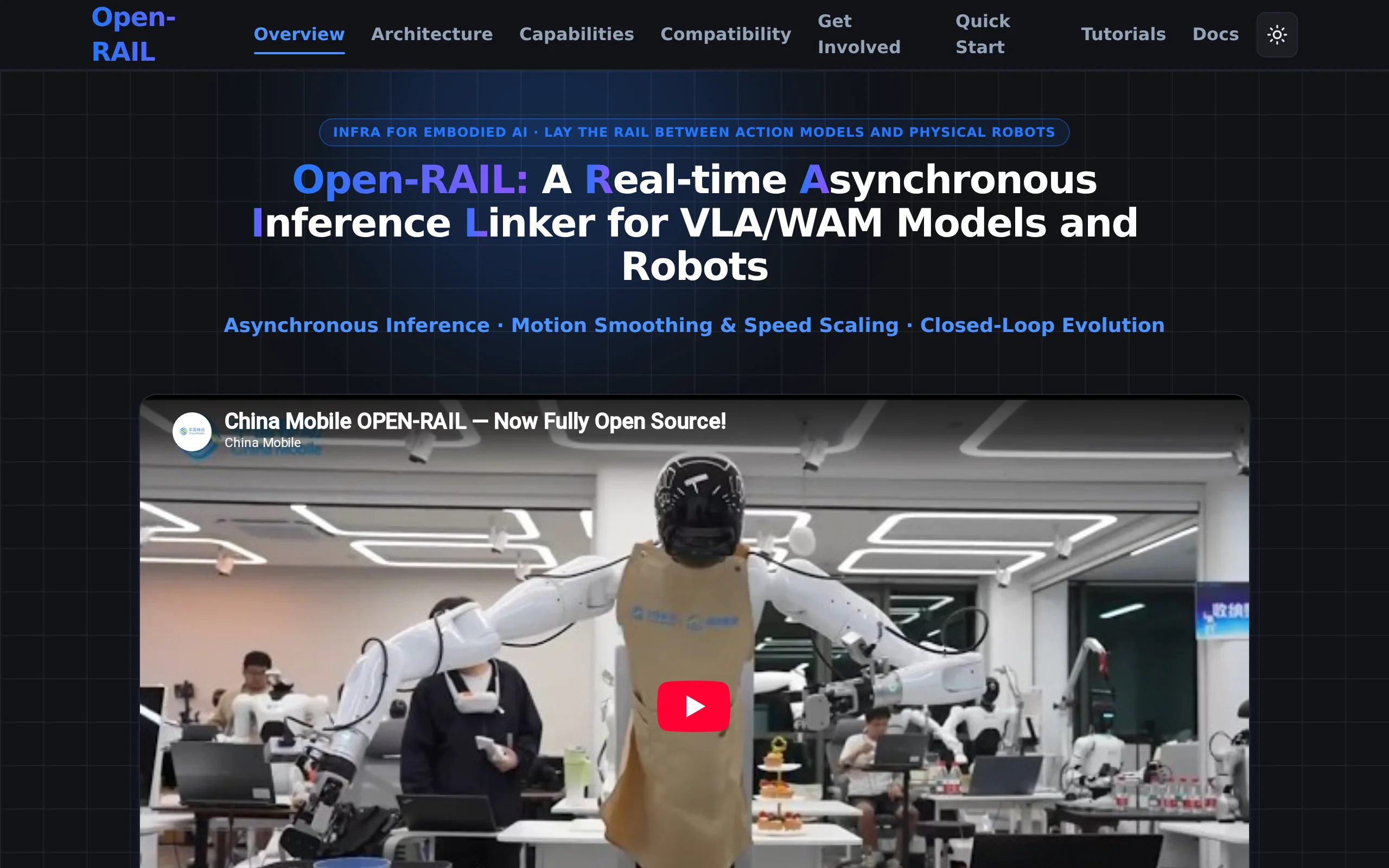
Open-RAIL Evaluation: China Mobile's Open-Source General-Purpose Engineering Foundation for Embodied Intelligence, Bridging the "Last Mile" for VLA/WAM Model Deployment
Open-RAIL is a general-purpose engineering foundation for embodied intelligence that China Mobile has open-sourced globally. It is positioned as the industry's first universal "nervous system" connect...
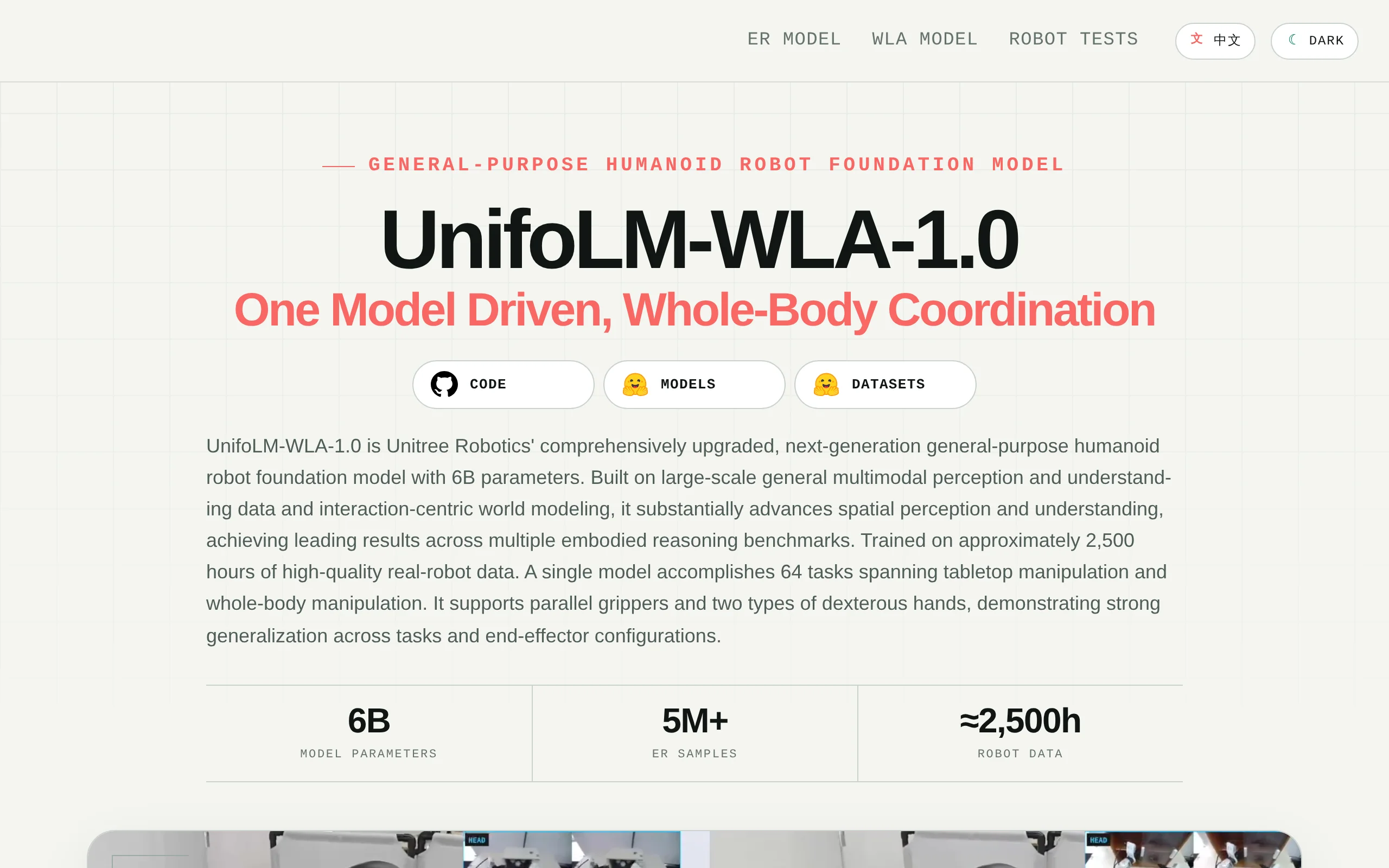
UnifoLM-WLA-1.0 – Unitree Robotics' Embodied Multimodal Large Model
UnifoLM-WLA-1.0 is a 6B-parameter embodied multimodal large model launched by Unitree Robotics, trained on approximately 2500 hours of real-robot operation data. It unifies visual perception, language...

Obscura – Open-Source AI Agent Headless Browser for Automated Web Browsing and Scraping
Obscura is an open-source headless browser designed specifically for AI Agent and automation scenarios, built using Rust. This tool bypasses the heavy architecture of Chromium and implements a lightwe...

Atlas – The World's First Multimodal World Model from World Labs
Atlas is the world's first multimodal world model introduced by World Labs, founded by Fei-Fei Li. This model natively understands text, images, videos, and 3D spatial information. By anchoring visual...
© All Rights Reserved. Some content on this site is partially generated by AI with human review.