
Midjourney V8.2 – Midjourney's Most Advanced AI Image Generation Model

Executive Summary:
Midjourney V8.2 is the latest version of the AI image generation model released by Midjourney Inc., achieving comprehensive upgrades in prompt understanding, style reference logic, and image generatio...
1. What is Midjourney V8.2
Midjourney V8.2 is the latest version of the AI image generation model released by Midjourney Inc., achieving comprehensive upgrades in prompt understanding, style reference logic, and image generation stability. Compared to V8 and V8.1, V8.2 significantly improves style seed consistency, image blending naturalness, complex scene parsing capabilities, and text rendering accuracy. It particularly excels in the nuanced depiction of Eastern classical aesthetics, with a notably increased success rate for single-generation image outputs, making it one of the most capable models in the current AI image generation field.
Image source: Official article
Image source: official article
Technical Positioning and Domain: Midjourney V8.2 belongs to the AI image generation domain, specializing in generating high-quality images from natural language descriptions. Its unique positioning lies in the deep integration of artistic aesthetics and engineering optimization, offering a ready-to-use cloud-based image generation service tailored for professional designers, artists, and creative professionals, and setting a benchmark in the industry for aesthetic expression and style control.
Development Background: Developed by Midjourney, Inc., an independent research laboratory based in San Francisco. The team has long been dedicated to the visual field of generative AI, continuously iterating from V1 to V8.2, accumulating extensive experience in model architecture and training. The release of V8.2 aims to address shortcomings in previous versions regarding style consistency, complex prompt handling, and text rendering, further solidifying its leading position in the AI image generation market.
Core Value: V8.2 resolves the "gacha" pain point that creators face in image generation—high image failure rates and uncontrollable styles. By optimizing the prompt understanding engine and style reference logic, it significantly improves the success rate of single-generation image outputs and the stability of style reproduction, reducing the time cost associated with repeated parameter adjustments. Additionally, its deep adaptation to Eastern aesthetics fills a gap in the cultural diversity representation of mainstream models.
2. Key Features
Prompt Understanding Engine Upgrade: V8.2 optimizes the natural language to image mapping mechanism, enabling it to handle the叠加 of multi-dimensional parameters simultaneously. It provides more precise parsing of prompts that include complex scenes, style descriptions, and detailed requirements, significantly reducing generation deviations caused by semantic ambiguity. This results in a substantial improvement in the overall consistency of long prompts.
Style Reference Logic Restructuring: The style transfer algorithm has been improved, allowing it to better integrate the content requirements from user prompts while preserving the stylistic features of the reference image. By uploading style seeds or character references using the
--srefand--crefparameters, V8.2 can achieve high-fidelity style reproduction, resolving the issue of style-content conflicts in previous versions. Its ability to coordinate multiple reference sources has also been significantly enhanced.Aesthetic Model Iteration: The overall aesthetic model has returned to the impressive level seen in the V7 era, with deep optimization across artistic dimensions such as color hierarchy, compositional tension, and the interplay between real and abstract elements. The generated images achieve industry-leading levels of visual sophistication and artistic impact, making them particularly suitable for commercial design and conceptual art creation that requires strong visual impact.
Multimodal Fusion Mechanism: The synergy between image references and text prompts in generation has been enhanced. Users can now upload a base image, mood board (
--moodboard), and personalized configurations simultaneously, and V8.2 can coordinate multiple references without causing semantic conflicts, achieving a harmonious and unified generation result. This significantly improves usability in complex creative scenarios.Commercial-Grade Text Rendering: Text generation capabilities have been greatly improved, with complete character structures and neat layouts that are directly applicable to commercial design scenarios such as magazine covers and brand posters. By clearly specifying text content, font style, and layout requirements in the prompt, V8.2 has significantly increased the success rate and quality of text generation compared to V8.1, reducing the workload for post-editing.
Complex Prompt Compatibility: It can process complex instructions such as long text descriptions, multiple reference images, and multi-parameter settings without crashing. Even with a large number of parameter overlaps, the model maintains stable output quality, reducing the time spent on repeated debugging and allowing creators to focus more on their creative work itself.
Image Generation Stability Optimization: The probability of generating an image that meets expectations in a single attempt has significantly increased, with a substantial reduction in image generation failures. This improvement directly enhances creative efficiency, enabling designers and artists to focus more on their creativity rather than technical tuning, especially suitable for production environments requiring rapid generation of large volumes of visual assets.
3. How to Use
Environment Requirements and Prerequisites: To use Midjourney V8.2, you need a Midjourney subscription account (paid subscription) and access via the official Discord server or Web interface (midjourney.com). No local hardware configuration is required, as all computations are performed in the cloud. Users only need a stable internet connection, and the operating system is unrestricted.
Model Switching: When entering prompts in the input box of Discord or the Web interface, the system defaults to using the latest model (V8.2). If you want to explicitly specify a version, add the parameter
--v 8.2at the end of the prompt. For example:/imagine a serene Chinese landscape painting --v 8.2. This parameter ensures that the image is generated using the V8.2 engine, preventing changes in output due to updates in the default version.Style Reference and Character Reference: Upload a style seed image using the
--srefparameter, and the model will extract its color, texture, composition, and other stylistic features to apply to the generated result. Upload a character reference image using the--crefparameter to maintain character consistency. Upload a mood board using the--moodboardparameter to convey the overall atmosphere. For example:/imagine a futuristic city --sref [image URL] --moodboard [image URL]. It is recommended to set the reference weight between 0.5 and 0.8 to balance the influence of the reference and the prompt content.Multiple Reference Overlays and Parameter Combinations: In complex creative scenarios, you can simultaneously overlay style seeds, mood boards, and personalized configurations. V8.2 can coordinate multiple reference sources and avoid semantic conflicts. For example, combine character reference, style seed, and mood board:
--cref [URL] --sref [URL] --moodboard [URL]. It is recommended to first test the effect of each reference source individually, then gradually combine them to optimize the final output.Text Rendering and Prompt Optimization: If you need to generate images containing text, clearly specify the text content, font style, and layout requirements in the prompt. For example:
/imagine a magazine cover with title "FASHION" in bold serif font, elegant layout --v 8.2. V8.2 has high precision in text rendering and can be directly used for commercial design. However, it is recommended to carefully review and make necessary post-processing adjustments for critical projects.Recommendations for Re-testing Old Prompts: For prompts that performed poorly in V8 or V8.1, it is recommended to re-test them using V8.2. Due to compatibility improvements and enhanced model capabilities, many previously failed prompts may now yield impressive results, saving time on rethinking. It is advised to re-test your commonly used prompt library one by one to fully leverage the improvements in V8.2.
4. Pros and Cons Analysis
| Pros |
|---|
| Significantly improved image generation stability: The success rate of single-generation attempts has increased substantially, with a very low crash rate, reducing the time cost of repeated sampling and parameter adjustments. This greatly enhances creation efficiency, especially suitable for batch production scenarios. |
Enhanced style consistency: The accuracy and stability of style reference reproduction are far superior to V8.1. Through --sref and --cref, users can reliably reuse and iterate on their personal styles, making it ideal for projects requiring long-term visual consistency, such as IP development and character design. |
| Compatibility with complex prompts: It can handle complex instructions such as long text, multiple reference images, and multi-parameter settings without crashing, significantly reducing technical debugging costs and allowing creators to focus more on creative expression. |
| Deep adaptation to Eastern aesthetics: It has a nuanced understanding of themes such as traditional Chinese art and national-style landscapes, producing images with rich flavor in a single generation without the need for cumbersome prompts, generating high-quality national-style works and filling the gap in cultural diversity among mainstream models. |
| Commercial-grade text rendering: The text structure is complete and the layout is neat, making it directly usable for commercial design applications such as magazine covers and brand posters, greatly expanding the practical scenarios for AI-generated images and reducing the workload of post-processing text. |
5. Comparative Analysis with Similar Tools
| Comparison Dimension | Midjourney V8.2 | DALL-E 3 | Stable Diffusion 3 |
|---|---|---|---|
| Style Consistency | Style seeds and prompt images are naturally integrated, with strong coordination among multiple reference sources. The --sref and --cref features enable high-fidelity reproduction, ensuring reliable style replication. |
Style control is primarily achieved through prompt descriptions, lacking an explicit style reference mechanism, resulting in average consistency. Multi-character scenarios require detailed descriptions. | Supports style control through extensions like ControlNet, but requires additional configuration and model loading, leading to weaker native style consistency. |
| Text Rendering | Text structure is complete and well-formed, suitable for direct use in commercial cover designs. Success rate is high, and complex layout performance is stable. | Text rendering is strong, but occasional errors occur in complex layouts and fine details, requiring post-processing corrections. | Text generation is generally average, often requiring post-processing corrections. Native model support for text is limited, restricting commercial applications. |
| Oriental Aesthetics | Demonstrates a refined understanding of traditional Chinese and guofeng (national style) landscapes, producing images with rich flavor in a single generation. No special prompts are needed, and cultural details are accurately represented. | Performance in oriental aesthetics is acceptable, but requires precise prompt guidance. Cultural misunderstandings or mixed elements can occasionally occur. | Oriental aesthetics can be improved with specific models or LoRA, but native capabilities are average, requiring community resources. |
| Image Generation Stability | Success rate with complex long prompts has significantly improved, with extremely low image failure rates. Parameter stacking does not lead to image breakdown, and output quality is stable. | Stability is relatively high, but in cases of extremely complex prompts, inconsistencies or missing elements can occur, requiring multiple generations. | Stability depends on the model version and configuration. Open-source models require more debugging, and differences between models are significant. |
| Artistic Expression | The aesthetic model is mature, with top-tier industry performance in visual sophistication and compositional tension. Color and lighting handling is excellent, resulting in strong artistic impact. | Artistic expression is strong, with diverse styles, but in some scenarios, the composition tends to be "safe," resulting in moderate visual impact. | Artistic expression depends on community models, with the native model leaning toward realism. Creativity requires additional adjustments, and style diversity is limited. |
| Usage Threshold | Subscription-based, with ready-to-use cloud services via Discord or Web interface. Easy to get started, no technical configuration required, ideal for quick onboarding. | Accessible through ChatGPT Plus or API, with a low threshold, but no standalone interface, requiring reliance on the OpenAI ecosystem. | Open-source and can be deployed locally, with flexible API calls, but requires hardware configuration and technical knowledge, suitable for technical teams. |
Selection Recommendations: For professional designers and creative agencies seeking the highest image quality and artistic expression, and with sufficient budget, Midjourney V8.2 is the optimal choice. Its ready-to-use cloud service and exceptional style control capabilities significantly enhance creative efficiency, especially for commercial visual design and projects focused on oriental aesthetics. If the team prioritizes open-source control and customization needs, Stable Diffusion 3 or FLUX.1 offer flexible local deployment and fine-tuning capabilities, but require technical resources for configuration and optimization, making them more suitable for teams with technical expertise.
Scenario-Based Recommendations: In scenarios requiring high-frequency generation of commercial-grade images (such as advertisements or magazine covers), Midjourney V8.2's stability and text rendering capabilities make it the top choice. For IP development projects that require long-term consistency in characters or styles, V8.2's style reference features are clearly advantageous. In research and experimental projects requiring deep model customization or control over the generation process, the open-source nature of Stable Diffusion 3 and FLUX.1 is more appealing. Overall, V8.2 leads in comprehensive experience and output quality, but open-source models offer unique advantages in customization and cost control. Users should make choices based on their specific needs and technical capabilities.
6. Editor's Summary
The release of Midjourney V8.2 marks a significant step forward for AI image generation models in terms of "usability" and "artistic quality." Technically, the upgrade of its prompt understanding engine and the restructuring of its style reference logic are not merely parameter adjustments, but rather a deep optimization of the natural language-to-image mapping mechanism. Particularly, the enhanced ability to coordinate multiple reference sources addresses a long-standing industry challenge of conflicting style and content, allowing V8.2 to outperform similar products in complex creative scenarios. The aesthetic model iteration has returned to the impressive level seen in the V7 era, but with further improvements in stability and consistency, demonstrating that the Midjourney team has found a better balance between artistic perception and engineering implementation.
In terms of practical value, V8.2 has truly transitioned AI image generation from an "experimental tool" to a "production-grade tool." The commercial-level text rendering and deep adaptation to Eastern aesthetics directly expand the application boundaries of AI-generated images in professional fields such as magazine covers, brand posters, and traditional Chinese-style illustrations. The increased success rate of image generation significantly reduces the time cost of creation, enabling designers to focus more on the creative process itself rather than technical troubleshooting. For individual creators and small teams, the ease of use and high-quality output of V8.2 mean that they can obtain professional-grade images without requiring deep technical expertise, which helps lower the barrier to creative expression.
In terms of target users, V8.2 is especially suitable for professional designers, illustrators, advertising creatives, and social media content creators who require high-frequency production of high-quality visual content. Its powerful style reference functionality is particularly useful in scenarios such as IP development and character design that require visual consistency. Additionally, its deep support for Eastern aesthetics makes it a valuable tool for creators working with cultural themes such as traditional Chinese styles and classical aesthetics. For researchers or users seeking extreme customization, open-source models may be more suitable, but the comprehensive experience offered by V8.2 cannot be overlooked.
Against the backdrop of rapid iteration in open-source community models, Midjourney must continue to innovate to maintain its competitiveness. The maturity and professionalism of V8.2 have reached new heights, making it worth in-depth exploration for all users interested in AI image generation technology. If Midjourney were to expand into video generation or 3D content creation in the future, it would further broaden its application scope, but this will require official disclosure of future plans. Overall, V8.2 is a product that excels in comprehensive capabilities, setting a new benchmark for the AI image generation field.
7. Application Scenarios
Commercial Visual Design: Suitable for business design scenarios requiring precise text layout and high-level aesthetics, such as magazine covers, brand posters, and advertising visuals. Designers can explicitly specify text content, fonts, and layouts through prompts, and V8.2 can generate images directly usable for printing or publishing, significantly shortening the cycle from concept to final product and reducing reliance on post-production design software.
Illustration and Concept Art: Ideal for creative fields requiring complex scene construction and consistent styling, such as game concept art, film concept visuals, and book illustrations. By leveraging V8.2's style reference and multi-reference overlay capabilities, artists can rapidly iterate on visual styles while maintaining consistency in characters and scenes, improving creative efficiency, especially for projects requiring extensive pre-concept exploration.
Sinic Style and Oriental Aesthetic Creation: Generation and iteration of visual content rooted in Eastern culture, such as traditional Chinese characters, Sinic-style landscapes, and seasonal theme visuals. V8.2 has achieved new levels of understanding and nuanced expression of Oriental aesthetic themes, allowing creators to generate richly evocative works with minimal and less cumbersome prompts, making it particularly suitable for innovative expressions of traditional culture and Guochao (national trend) design.
Style Exploration and IP Development: Quickly explore visual styles using style seeds and mood boards to develop personal artistic IPs or brand visual systems. Enhanced style consistency in V8.2 enables creators to reliably reuse and iterate on their personal styles, providing a stable visual foundation for long-term projects such as IP character development and brand visual systems, thereby reducing the risk of style drift.
Social Media Content Production: Rapid generation of high-quality visual content to meet the needs of content creators and designers for daily social media posts. V8.2 boasts a high success rate in generating images in one go, significantly reducing content production time and helping creators maintain frequent updates, thus enhancing their social media influence. It is especially suitable for content teams that need to quickly respond to trending topics.
8. FAQ
Q: What are the main improvements of Midjourney V8.2 compared to V8.1?
A: V8.2 has seen significant improvements in style seed consistency, image blending naturalness, complex scene parsing capability, and text rendering accuracy. Particularly, after restructuring the style reference logic, the model's ability to coordinate multiple reference sources has increased, reducing conflicts between style and content. Additionally, the aesthetic model has returned to V7-level performance, achieving new heights in image generation stability and artistic expression, with a substantial reduction in image failure rates.
Q: How can I switch to using the Midjourney V8.2 version?
A: When entering prompts in the Discord or Web interface, the system defaults to the latest model (V8.2). To enforce the use of V8.2, add the parameter --v 8.2 at the end of the prompt. For example: /imagine a fantasy landscape --v 8.2. It is recommended that users always use the latest version for the best results. Older versions can be accessed using --v 8 or --v 8.1.
Q: Does V8.2 support Chinese prompts?
A: Midjourney is primarily optimized for English prompts, but V8.2 has improved its understanding of Chinese prompts, especially when dealing with themes related to Eastern aesthetics. However, for the most accurate results, it is recommended to use English prompts, or combine Chinese keywords with English descriptions to avoid semantic deviations.
Q: How is the text rendering capability of V8.2? Can it be used directly for commercial design?
A: The text rendering capability of V8.2 has been greatly enhanced, with complete text structure and consistent typography, making it suitable for direct use in commercial design scenarios such as magazine covers and brand posters. Specifying the text content, font style, and layout requirements in the prompt yields high success rates. However, it is still recommended to carefully review and make necessary post-processing adjustments for critical commercial projects to ensure perfect results.
Q: What hardware configuration is required to use V8.2?
A: Midjourney is a cloud service, with all computations performed on official servers. Users do not need a local GPU. A stable internet connection and either a browser or Discord client are sufficient. After subscription, it is ready to use immediately, without requiring any software installation, and there are no special operating system requirements.
Q: How can the style reference feature of V8.2 be best utilized?
A: Upload a style seed image using the --sref parameter, and the model will extract its color, texture, and composition features. Use --cref to maintain character consistency. Use --moodboard to convey the overall atmosphere. It is recommended to set reference weights between 0.5 and 0.8 to balance the influence of the reference and the prompt content. When combining multiple references, V8.2 can coordinate the sources effectively and avoid conflicts. It is advised to test each reference individually before combining them.
9. Project Links
- Midjourney Official Website: https://www.midjourney.com/
- Midjourney Official Documentation: https://docs.midjourney.com/hc/en-us
- Midjourney Version Notes: https://docs.midjourney.com/hc/en-us/articles/32199405667853-Version
Related AI Model Articles
In-Depth Evaluation of TeleOCR – The Open-Sourced Document Parsing Model by China Telecom's XingChen Lab
TeleOCR is an open-sourced document parsing model developed by China Telecom's XingChen Lab. It employs a lightweight vision-language architecture with approximately 1.2B parameters, unifying the proc...
Qwen-Audio-3.1: A Full-Stack Evaluation of the Qwen Audio Large Model Series
Qwen-Audio-3.1 is a series of large audio models launched by Alibaba's Qwen. It consists of five models: ASR speech recognition, ASR-Next audio understanding, TTS speech synthesis, TTS-Next audio crea...
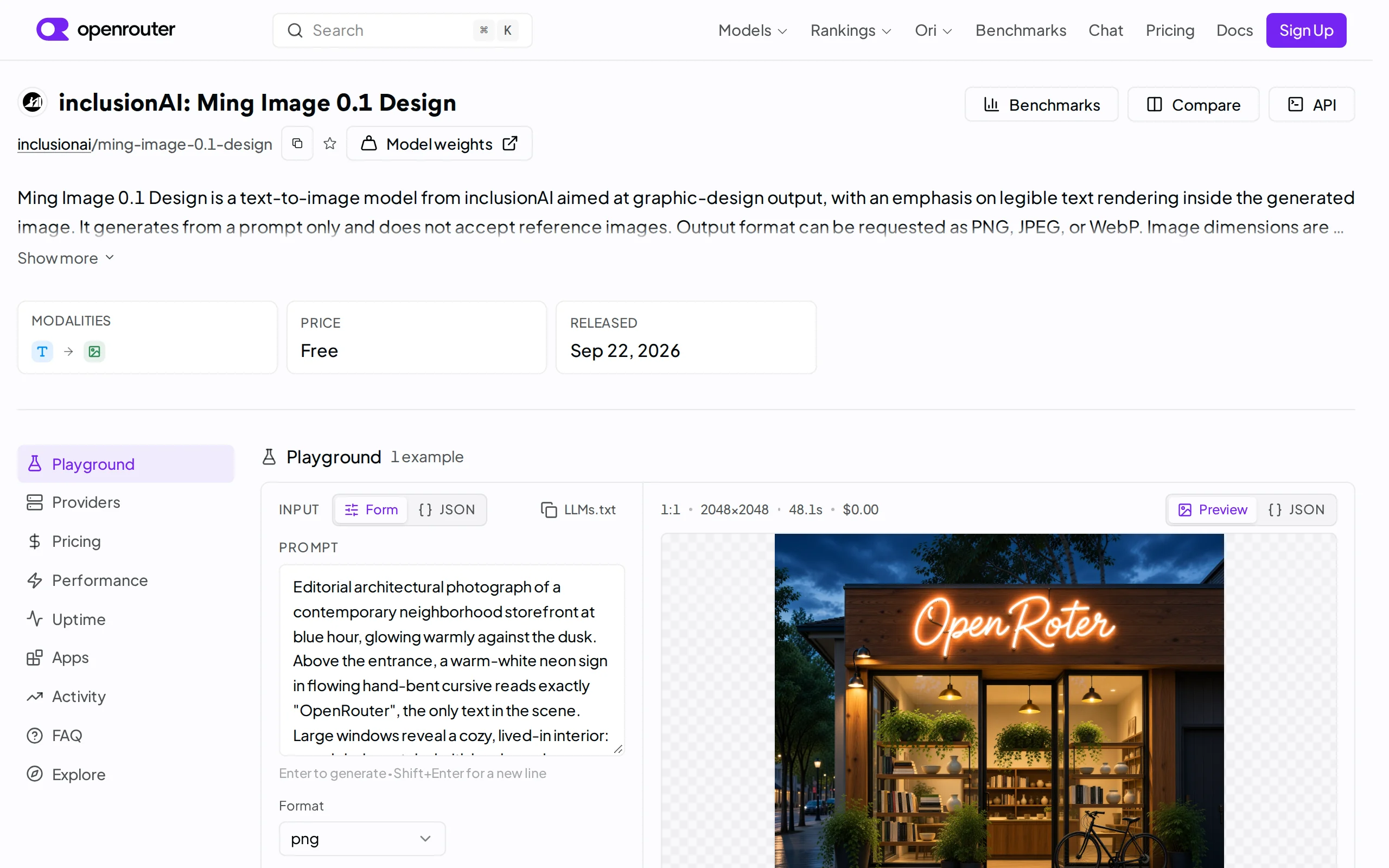
Ming-Image-0.1-Design: Ant Group Open-Sources 6B Parameter Image Generation Model, End-to-End Reimagining the Design Workflow
Ming-Image-0.1-Design is a 6B parameter image generation model open-sourced by Ant Group's InclusionAI team, specifically tailored for design scenarios. It supports 8K long, structured prompts and can...
In-Depth Review of Claude Opus 5.5: A Revolution in Programming Efficiency and Safety for Anthropic's Flagship Model
Claude Opus 5.5 is the first flagship model in Anthropic's Claude 5.5 series, launched in June 2026. It is positioned as a high-end AI model designed for enterprise-level agent programming, complex kn...
© All Rights Reserved. Some content on this site is partially generated by AI with human review.