
Lumos NexCore – Lumos Robotics' Embodied Intelligence Evolution Engine

Executive Summary:
Lumos NexCore is Lumos Robotics' evolution engine for embodied intelligence, positioned as a skill infrastructure for industrial deployment. This platform integrates data assets, model training, evalu...
1. What is Lumos NexCore
Lumos NexCore is Lumos Robotics' evolution engine for embodied intelligence, positioned as a skill infrastructure for industrial deployment. This platform integrates data assets, model training, evaluation verification, skill management, and robot operations into a unified service, transforming robot skills from manually crafted development into trainable, reusable, and continuously iterated assets. It enables skills to be invoked and verified like cloud services, propelling embodied intelligence from isolated demos toward large-scale industrial applications.
Image source: Official article
Image source: official article
Technical positioning and domain: Belongs to the field of embodied AI, focusing on the production and evolution of industrial robot skills. Unlike traditional project-based development models, NexCore platformizes and standardizes skill development, positioning itself as a skill infrastructure aimed at reducing industry application barriers and accelerating the deployment and iteration of robot capabilities in real-world scenarios.
Development background: Independently developed by the Lumos Robotics team, refined through real production lines such as those of Mitsubishi Electric. Its flagship brain, Prime R0, ranked first globally in the MolmoSpaces zero-shot evaluation. The team has deep expertise in robot hardware and AI algorithms, committed to bridging the full pipeline from data collection to deployment and operations, addressing core pain points in industrial robot skill development such as redundant wheel reinvention and reliance on individual engineers' experience.
Core value: Enables continuous self-iteration of robot capabilities through a closed-loop evolution mechanism; significantly lowers development barriers via natural language orchestration, allowing business professionals to participate in skill development without requiring an algorithm team; achieves cross-scenario reuse and version control through skill assetization, transforming models from one-time project deliverables into accumulated, callable platform assets.
Technical features: Employs a closed-loop flywheel mechanism to achieve continuous evolution from data to training, evaluation, and deployment; emphasizes effective data scaling, driving model improvements through task experience rather than sheer data volume; decouples form from function, not bound to specific hardware bodies; supports natural language task descriptions, automatically orchestrating the entire workflow to realize low-threshold skill production.
2. Key Features
Natural Language Orchestration: Users simply describe the task goal in conversational language, and the platform automatically orchestrates the subsequent data preparation, model training, evaluation, and deployment processes. This significantly lowers the skill development barrier, enabling non-algorithm professionals to quickly create robot skills.
Data Asset Platform: Aggregates real-world scenario data, simulation data, and video data in a unified manner. Each data entry can be searched, annotated, and reused, addressing the challenge of acquiring high-quality data for skill production and providing a structured foundation for model training.
Model Training Platform: Manages the entire training workflow, including task orchestration, hyperparameter optimization, and process tracking. Customers can initiate model training with a single click without needing to set up their own algorithm environment, and it supports multiple model architectures and distributed training strategies.
Evaluation and Validation: Through multi-dimensional evaluation metrics and capability diagnostics, model performance is converted into quantifiable and reproducible acceptance evidence, ensuring that skill quality is verifiable and enabling precise identification of bottlenecks during iteration.
Skill Management: Packages trained models along with code, parameters, and execution strategies into deployable, versionable, and cross-scenario reusable skill units, achieving skill assetization. It supports version rollback and access control.
Robot Operations: Connects to real devices, automatically feeding back operational status, logs, and high-value samples (including failure cases) during runtime, driving the next round of training and skill iteration, and forming a complete data loop.
3. How to Use
Apply for a Trial and Activate Your Account: Send an application email to [email protected], specifying the use case, expected task types, and robot hardware information. After review by the platform team, you will be granted access and provided with login credentials.
Log in to the Platform and Create a Project: Access the Lumos NexCore console via your browser and log in using your assigned account. Create a new project in the project panel, entering the project name, objective description, and associated robot devices.
Define Task Objectives in Natural Language: Use natural language within the project to describe the tasks the robot needs to perform, such as "Perform visual quality inspection and sorting of electronic components on the production line." The platform automatically parses the task and generates an initial skill development workflow. Users can preview and adjust key steps as needed.
Platform Automation and Execution: Based on the task description, the platform automatically handles data preparation (indexing existing data or prompting for new data uploads), model training (selecting a base model and tuning parameters), and evaluation and validation (generating evaluation reports and providing capability diagnostics). Users can monitor training progress in real time and manually adjust parameters or add data when necessary.
Skill Deployment and Continuous Iteration: After passing evaluation, package the skill and deploy it to the target robot. During operation, the platform automatically collects runtime data and failure samples, which are fed back into the data asset platform and trigger a new round of training, enabling continuous evolution of the skill in real-world operations.
4. Pros and Cons Analysis
| Pros |
|---|
| Closed-loop Evolution Mechanism: Integrates the entire workflow from data, training, evaluation, skill development, and device operations, enabling robots to continuously self-iterate during real-world tasks and improve task success rates. |
| Low-Threshold Natural Language Orchestration: Supports describing task objectives in natural language and automatically orchestrating the entire process, allowing business personnel to participate in skill development without needing an algorithm team, significantly reducing human resource costs. |
| Skill Assetization and Reusability: The model is packaged into skill units, supporting version management and cross-scenario invocation, enabling delivery similar to cloud services and reducing redundant development. |
| Hardware Decoupling: Not bound to a specific robot body, with core technology stacks that can be migrated, compatible with both Luming and non-Luming ecosystems, reducing hardware replacement costs. |
5. Comparative Analysis with Similar Tools
| Comparison Dimension | Lumos NexCore | NOKOV ShadowEngine | NVIDIA Isaac Lab |
|---|---|---|---|
| Product Positioning | Industrial embodied skill infrastructure, platform-based service | End-to-end robot AI training platform, integrating motion capture and simulation | Open-source framework for basic model training and simulation of robots |
| Core Architecture | Five modules: data assets, model training, evaluation verification, skill management, and operations | Six modules: ShadowEngine's aggregation, source, translation, remote, training, and verification | Based on Omniverse's Isaac Gym and Isaac Lab, modular design |
| Data Loop | Unified indexing of real/simulation/video data, automatic feedback of real robot data to drive iteration | Real-time aggregation of multimodal data, Sim2Real loop, real robot feedback | Supports synthetic data generation and Domain Randomization, no automatic feedback |
| Skill Reusability | Encapsulation of skill units, version management, and cross-scenario calling | Provides standardized human motion data assets, supports batch simulation export | Strategy library is transferable, but requires retraining or fine-tuning |
| Hardware Compatibility | Compatible with Lumos ecosystem and non-Lumos robots, not bound to specific hardware | Already adapted to mainstream humanoid robots like Unitree G1, supports URDF/MJCF | Supports multiple robot models, imported via URDF |
| Usage Threshold | Task description via natural language, automatic orchestration, no need for algorithm teams | Requires optical motion capture equipment and simulation environment, aimed at research teams | Requires familiarity with reinforcement learning and simulation environments, high technical threshold |
Selection Recommendations: For enterprises wishing to get started quickly and whose business teams lack algorithm expertise, Lumos NexCore's natural language orchestration and full-process automation can significantly reduce the barrier to skill development, especially suitable for industrial manufacturing and commercial service scenarios. NOKOV ShadowEngine is more suitable for research teams that already have motion capture equipment and humanoid robots, offering advantages in precise motion capture and simulation verification.
For R&D teams with reinforcement learning capabilities, NVIDIA Isaac Lab provides a flexible open-source framework, ideal for cutting-edge algorithm research and simulation verification, but requires self-building of training and deployment pipelines. Google RT-2, as a foundation model, is suitable for research institutions exploring end-to-end control, but industrial deployment still requires substantial customization and data accumulation.
6. Editor's Summary
Lumos NexCore introduces a new paradigm in embodied intelligence known as "skill infrastructure," with its core innovation lying in transforming robot skill development from a project-based model into a platformized service. Through a closed-loop flywheel mechanism and an effective data scaling philosophy, the platform achieves continuous evolution driven by data, offering greater practical value than traditional one-time development approaches. The natural language orchestration feature significantly lowers the barrier to entry, enabling non-algorithm professionals to participate in skill definition, which helps promote the adoption of embodied intelligence across industries. In terms of practical value, the platform has been validated on real production lines, such as those of Mitsubishi Electric. The flagship brain, Prime R0, achieved first place in the zero-shot evaluation on MolmoSpaces, indicating that its technical maturity has reached an industrial level. The platform is suitable for industrial enterprises, robot integrators, research laboratories, and business teams looking to rapidly deploy robotic skills. From an architectural standpoint, its decoupled form and skill assetization design provide the foundation for cross-scenario reuse. As the ecosystem expands and hardware compatibility increases, Lumos NexCore's role in the infrastructure of embodied intelligence will become even more solid. Currently, the platform is still in its early stages, with documentation and community support needing further refinement. However, its technical direction aligns closely with industrial needs, and it holds significant potential for continuous iteration.
7. Application Scenarios
Research and Experimentation: Provides a full-chain research platform for universities and laboratories, from data collection to skill deployment, accelerating the iteration of embodied intelligence algorithms. Researchers can quickly define tasks and train models, validate new algorithms using real robots, and shorten the cycle from academic papers to practical experiments.
Industrial Manufacturing: Completes tasks such as quality inspection, logistics, transportation, and loading/unloading on factory production lines, and continuously optimizes skills through real operational data. The platform can integrate with various industrial robots, enabling flexible production and reducing reprogramming costs during line changeovers.
Commercial Services: Supports the full "pickup-transport-delivery" service process in scenarios such as hotels, buildings, and shopping malls, enabling rapid cross-task adaptation and deployment. Service robots can quickly acquire new skills based on the platform, adapting to different environments and improving operational efficiency.
Entertainment and Exhibition: Provides editable and iterable skill assets for robot performances and exhibition interactions, supporting the reuse of multiple hardware forms. Curators can describe performance actions using natural language, and the platform automatically generates the corresponding skills, eliminating the need for professional programming.
8. FAQ
Q: How can I apply to use Lumos NexCore?
A: The platform is currently in early access. You need to send an application email to [email protected], specifying your use case, task type, and robot hardware information. After review by the team, you will be granted access and provided with login credentials.
Q: What robot hardware does Lumos NexCore support?
A: The platform is not tied to a specific body and is compatible with various robots from both the Lumos ecosystem and third-party ecosystems. For a specific list of supported devices, please consult the official team. The hardware must support standard communication interfaces (such as ROS 2, EtherCAT, etc.).
Q: How complex of tasks can the natural language orchestration handle?
A: The platform can handle common industrial and service tasks, such as grasping, moving, quality inspection, and sorting. For highly complex or non-standard tasks, users may need to provide example data or perform minor manual tuning, and the platform will offer corresponding guidance.
Q: How can skill units be reused across different scenarios?
A: Trained models are packaged as skill units, which include code, parameters, and execution strategies. These can be directly called in different robots or scenarios through the platform's skill marketplace or project import. The platform also supports version rollback and access control.
Q: How does the data loop ensure data security?
A: The platform supports private deployment options, allowing enterprise data to be stored locally. The data feedback process uses encrypted transmission, and users can control the scope of data sharing, meeting internal data compliance requirements within the enterprise.
Q: What advantages does Lumos NexCore have compared to NVIDIA Isaac Sim?
A: Lumos NexCore focuses more on full-process automation for industrial deployment, providing a one-stop service from task definition to deployment iteration. In contrast, Isaac Sim mainly targets simulation and algorithm research, requiring users to build their own training and deployment pipelines. NexCore's natural language orchestration and skill assetization features further reduce the barrier to entry.
9. Project Links
- Product Official Website: https://www.lumosbot.tech/
- Official Introduction Page: https://www.lumosbot.tech/about/
Related AI Model Articles
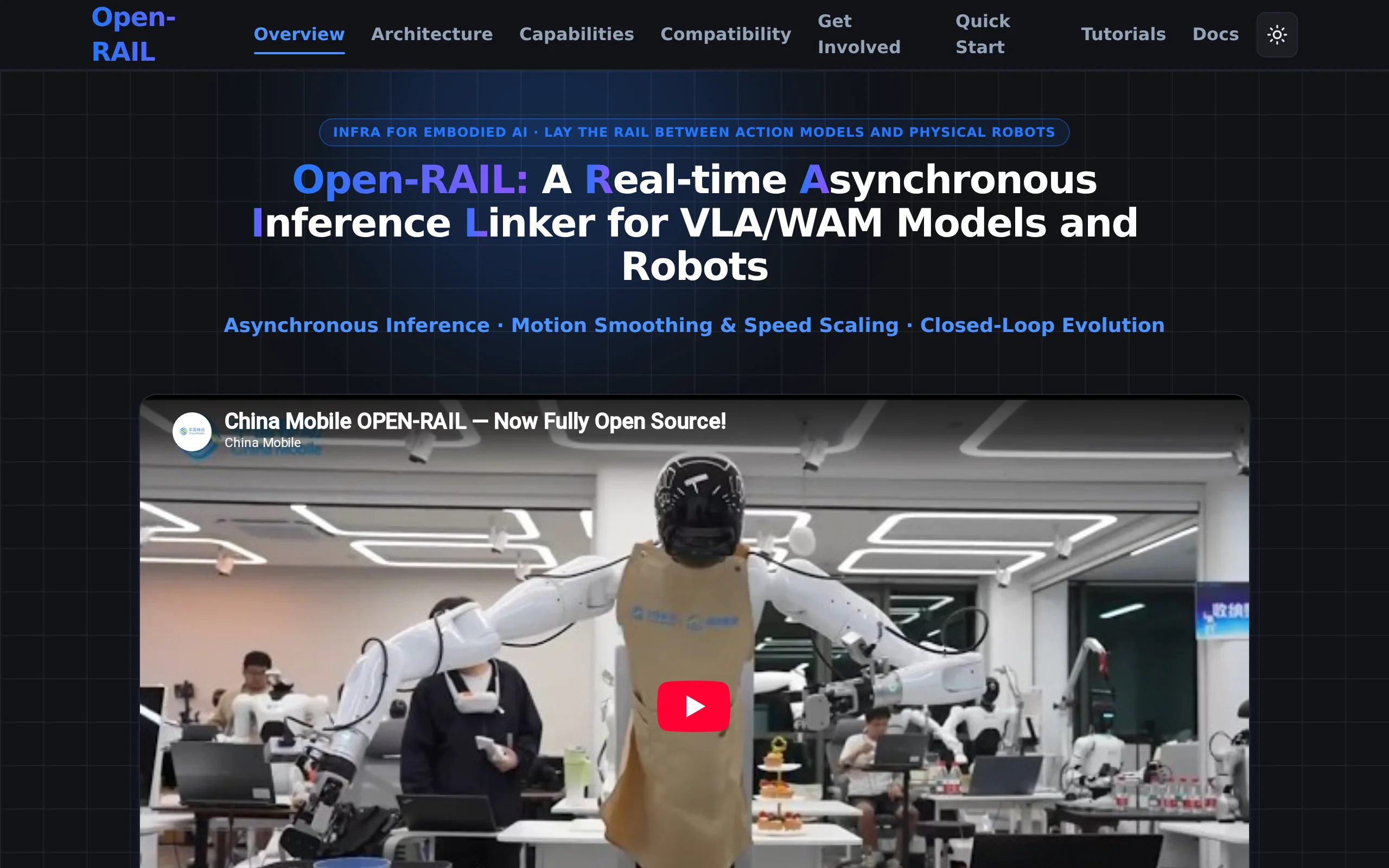
Open-RAIL Evaluation: China Mobile's Open-Source General-Purpose Engineering Foundation for Embodied Intelligence, Bridging the "Last Mile" for VLA/WAM Model Deployment
Open-RAIL is a general-purpose engineering foundation for embodied intelligence that China Mobile has open-sourced globally. It is positioned as the industry's first universal "nervous system" connect...
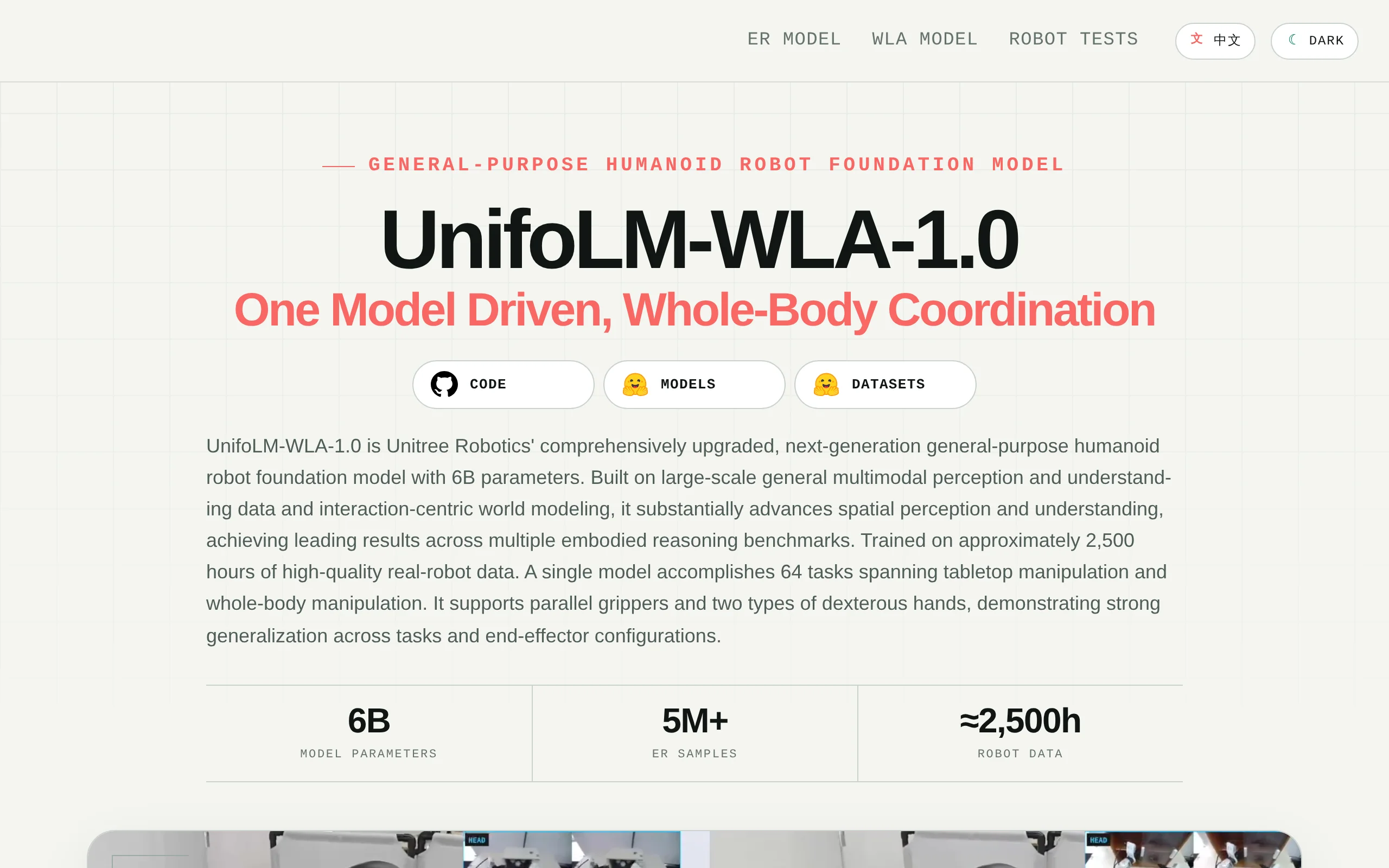
UnifoLM-WLA-1.0 – Unitree Robotics' Embodied Multimodal Large Model
UnifoLM-WLA-1.0 is a 6B-parameter embodied multimodal large model launched by Unitree Robotics, trained on approximately 2500 hours of real-robot operation data. It unifies visual perception, language...
Obscura – Open-Source AI Agent Headless Browser for Automated Web Browsing and Scraping
Obscura is an open-source headless browser designed specifically for AI Agent and automation scenarios, built using Rust. This tool bypasses the heavy architecture of Chromium and implements a lightwe...

Atlas – The World's First Multimodal World Model from World Labs
Atlas is the world's first multimodal world model introduced by World Labs, founded by Fei-Fei Li. This model natively understands text, images, videos, and 3D spatial information. By anchoring visual...
© All Rights Reserved. Some content on this site is partially generated by AI with human review.