
Horizon – Open-Source AI News Aggregator for Your Personal Radar
Executive Summary:
Horizon is an MIT-licensed, AI-driven information aggregation system for building a personal AI news radar. An async fetch engine pulls in parallel from RSS, Hacker News, GitHub Trending, Reddit, Tele...
1. What Is Horizon
Horizon is an MIT-licensed, AI-driven information aggregation system for building a personal AI news radar. An async fetch engine pulls in parallel from RSS, Hacker News, GitHub Trending, Reddit, Telegram, Twitter/X, and OpenBB; LLMs dedupe, score relevance, summarize, and enrich background context; outputs include web dashboards, email digests, webhooks, and MCP—bilingual Chinese/English daily briefs. It frees AI practitioners from noise to focused, high-signal reading.
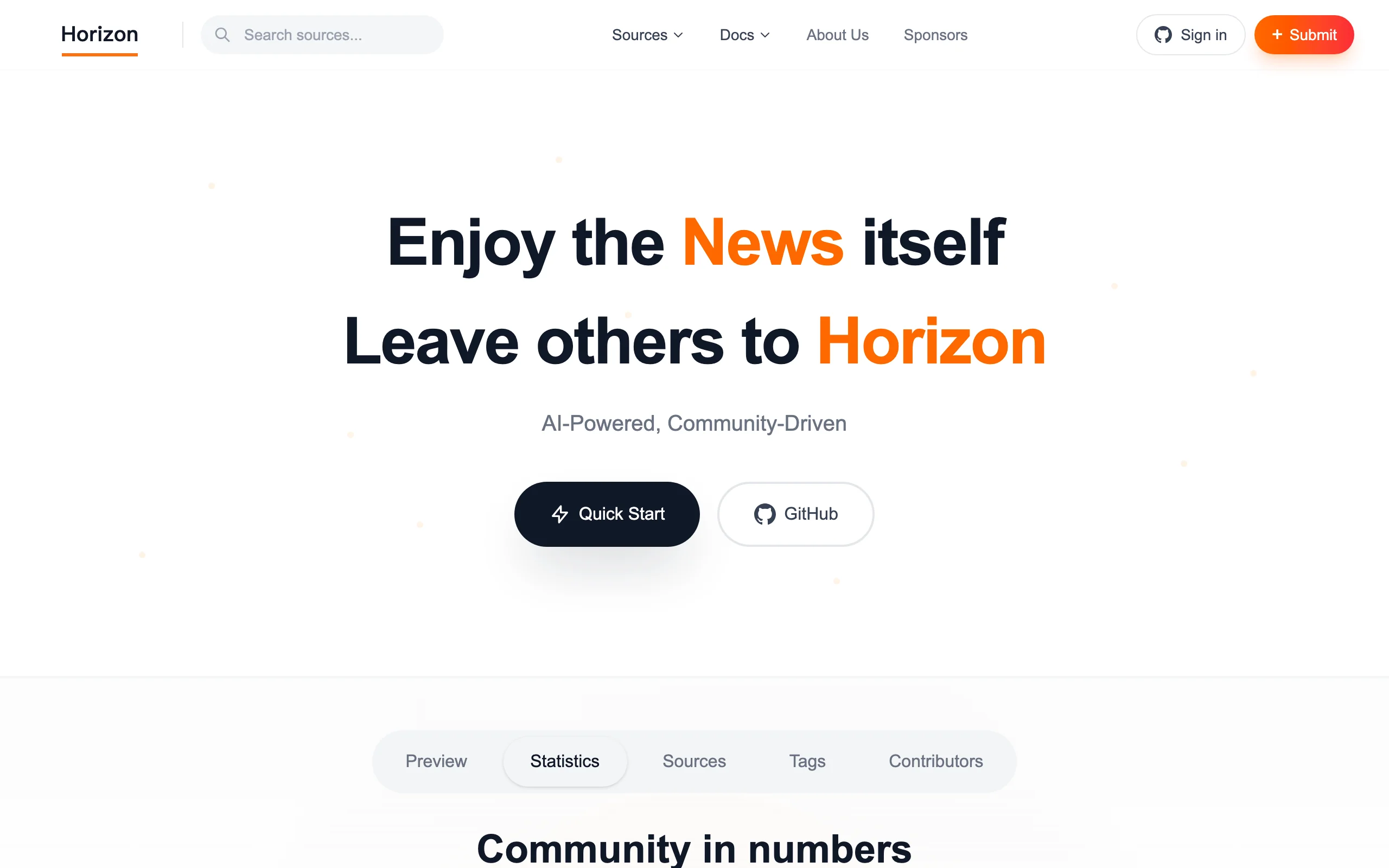
Image source: Official article
Technical positioning and domain: Personalized aggregation and intelligent summarization—LLM semantic filtering vs passive RSS readers that list everything unread.
Development background: Maintained by Thysrael and the OSS community—born from tracking dozens of sources manually and missing important updates.
Core value: Shifts from passive subscription to AI-curated feeds—dedupe, 0–10 scoring, structured summaries, and background notes in one pipeline.
Technical characteristics: Async multi-source ingestion; pluggable LLMs (OpenRouter, DeepSeek, xAI, etc.); modular outputs (web, email, webhook, MCP); runs with just an LLM API key.
2. Key Features
Multi-source aggregation: Seven channel types—async parallel fetch; enable/disable per source.
AI relevance scoring: LLM scores 0–10; buckets high (7–10), medium (4–6), low (0–3) to surface signal.
Dedup and summarization: Similarity filtering plus structured summaries—key points, data, community highlights—cutting read time.
Background enrichment: High-score items get extra context—papers, timeline, community takes—for complex topics.
Multi-format output: Web board, email, webhook, MCP—for humans or agents.
Flexible filters: Score thresholds, source filters, time windows (24h/3d/7d), keyword match—custom radar rules.
Bilingual briefs: Daily CN + EN editions—global and domestic AI trends without language gap.
Modular extensions: Plugin architecture for new sources and sinks—community contributions welcome.
Signal tiering workflow: After scoring, Horizon buckets items so dashboards emphasize 7–10 "must read" links while still archiving 4–6 for weekly deep dives—reducing FOMO-driven re-reading of low-value reposts common in raw RSS feeds.
3. How to Use
Requirements: Python 3.10+, Linux/macOS, Git, uv (recommended) or pip, at least one LLM API key; optional Twitter/Telegram credentials.
Clone:
git clone https://github.com/Thysrael/Horizon.git && cd HorizonInstall deps:
uv syncorpip install -r requirements.txt(~5–10 min).Configure:
cp config.example.yaml config.yaml—set LLM key/model (e.g.claude-sonnet-4-20250514) and source credentials.Rules: Enable sources; set score cutoffs, time window, keyword filters—start with 2–3 sources for testing.
Run:
python main.py—first run ~10–20 min; watch logs.Output: HTML under
output/pages/; optional email/webhook delivery—tune thresholds from quality feedback.
4. Pros and Cons
| Pros |
|---|
| MIT OSS, full control: Self-host, fork, modify—data stays yours. |
| Multi-model, cost flexible: OpenRouter, DeepSeek, xAI, etc.—no vendor lock-in. |
| Bilingual briefs: CN + EN for global/local AI news. |
| Modular plugins: Extend sources/outputs—community growth path. |
5. Comparison with Similar Tools
| Dimension | Horizon | AIHOT | RSSHub |
|---|---|---|---|
| Architecture | Async fetch + LLM score/summary/dedupe | Two-stage DeepSeek prefilter + score | RSS routes, community-driven |
| Deploy | Self-host | Hosted SaaS | Self-host or public instance |
| Sources | User-configured 7 types | 168 curated | 3000+ routes |
| AI filter | Single-stage 0–10 + enrich | Two-stage V3.2 + V4 Pro | None native |
| Output | Web, email, webhook, MCP | Web, RSS, REST, Agent skill | RSS → third tools |
| Languages | CN + EN briefs | Chinese-first | Source-dependent |
| Cost | Your LLM usage | Free hosted | Host cost or free public |
Selection advice: Technical users wanting ownership and customization—Horizon. Zero-config readers—AIHOT. RSS veterans extending routes—RSSHub (+ optional AI glue).
6. Editor's Review
Horizon systematically applies LLMs across ingest→dedupe→score→summarize→enrich—not just another reader. MCP output fits agent stacks well.
It directly attacks overload for AI builders—score gates focus attention; bilingual briefs help CN researchers track global news.
Effectiveness depends on source curation and model choice; setup is not casual—Docker one-click would help adoption.
— Professional async + LLM design; −0.5 for deploy friction and source dependency; high value for target users.
7. Use Cases
Daily AI digest: Engineers/PMs scan GitHub/HN/X highlights in ~10 minutes.
Creator ideation: High-score topics + background for articles and threads.
Team tech radar: Internal briefs filtered by domain keywords.
Personal knowledge inbox: Replace raw RSS with scored feeds and time windows.
Agent knowledge feed: MCP stream for research assistants and consulting bots.
8. FAQ
Q: GPU needed?
A: No local model—external LLM APIs only. 4C8G+ CPU server recommended.
Q: Best LLM?
A: Budget: DeepSeek V3 or Claude Haiku; quality: Claude Sonnet 4 or GPT-4o. Test on OpenRouter free tiers first.
Q: Private deploy / data safety?
A: Fully self-hosted; only LLM requests leave box—use Ollama locally if strict.
Q: Twitter/Telegram access?
A: X dev account (rate limits); Telegram bot token—or disable and use RSS/HN/GitHub only initially.
Q: Tunable scoring?
A: Yes—thresholds, tier cutoffs, keyword allow/deny lists in config.
Q: Multi-user?
A: Single-user core—multiple Docker instances or webhooks to teams; enterprise RBAC needs custom work.
Q: Always-on operation?
A: systemd/Docker + cron daily runs; log rotation; monitor with Uptime Kuma etc.
Q: Can I swap LLM providers without rewriting fetch logic?
A: Yes—config.yaml abstracts provider endpoints and model names. Switching from OpenRouter to DeepSeek or a local Ollama endpoint typically requires only key and model string changes, then a short validation run to recalibrate score thresholds because different models rank relevance differently.
9. Project Links
- GitHub: https://github.com/Thysrael/Horizon
- Website: https://www.horizon1123.top/
Related AI Model Articles
T3PO – NetEase Youdao's Open-Source Streaming Simultaneous Interpretation Model
T3PO (simulTaneous Translation via pareTo Policy Optimization) is an open-source streaming simultaneous interpretation model developed by NetEase Youdao. Its core focus is on dynamically balancing tra...
In-Depth Review of GPT-6 Sol: A Cost-Effective Revolution in OpenAI's Mid-to-High-End Large Model
GPT-6 Sol is a mid-to-high-end large model introduced by OpenAI, derived from the GPT-6 Astra base model. It brings Astra's reasoning, programming, factual accuracy, and Agent capabilities down to a m...

Qwen3.8-LiveTranslate – A Real-Time Simultaneous Interpretation Model Launched by Alibaba Tongyi
Qwen3.8-LiveTranslate is a real-time simultaneous interpretation large model launched by the Tongyi Qianwen team at Alibaba. Based on the Interleave single-stream architecture, it processes audio and ...
Iris Review: In-Depth Analysis of Xiaohongshu AllSpark Team's Open-Source Search Agent
Iris is a search agent open-sourced by the Xiaohongshu AllSpark team, featuring two versions: 35B (Iris-mini) and 397B (Iris-pro). It utilizes a MoE architecture, with activated parameters of 3B and 1...
© All Rights Reserved. Some content on this site is partially generated by AI with human review.